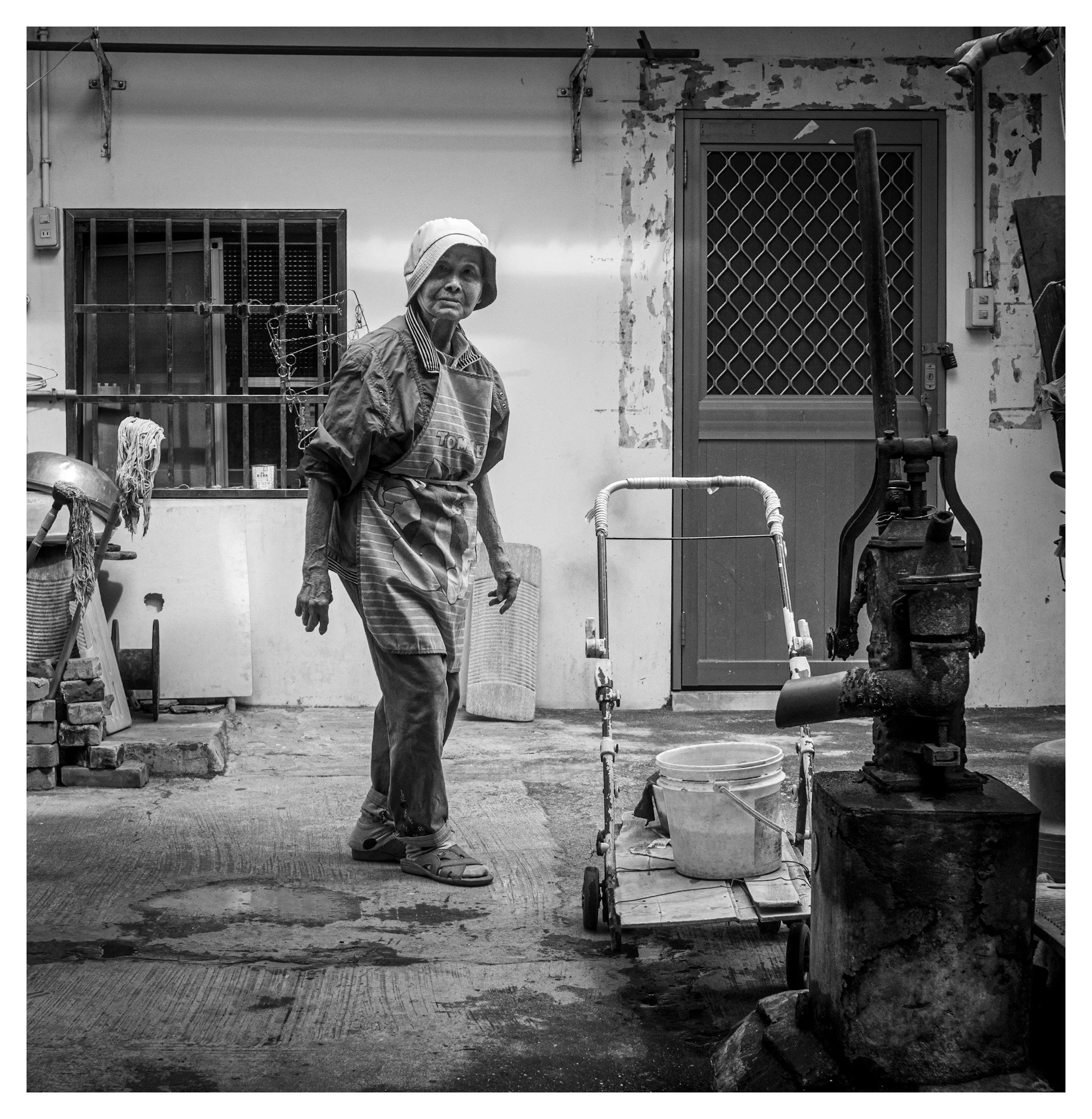
Day 106/365 The Pump and the Matriarch: Visual Tensions in the Domestic Sphere
Image Metadata
Camera Model: Leica D-Lux8
Shutter Speed: 1/250
Aperture: f/5.6
ISO: 200
Critique
This image possesses a quiet, vernacular authority. You have captured a moment of stillness in what is likely a busy daily routine. The monochromatic conversion is handled well; the textures of the peeling paint and the damp concrete floor are palpable, giving the viewer a sense of the humidity and history of the space. The subject’s gaze is the anchor—direct, unbothered, and dignified.
However, the composition suffers from a battle of attention. The water pump in the foreground is a sculptural marvel of the past, but it is visually heavy. It competes with the woman rather than complementing her. Similarly, the walker adds a narrative layer about aging, but its placement creates a visual barrier. The "clutter" of the mop and bucket on the left contributes to environmental context but distracts from the primary emotional connection: the woman's eyes.
How to Improve
1. Refine the Frame (The "Clean Up" Technique):
Next time, ask yourself: "What is the subject?" If it is the woman, the pump is too dominant. A simple step to your left or forward would have pushed the pump out of the frame or turned it into a soft, out-of-focus framing element rather than a competing subject.
2. Dodge and Burn with Intention:
In post-production, use a brush to slightly darken (burn) the white patch on the wall behind the walker and the bright highlights on the pump. Conversely, slightly lighten (dodge) the woman's face to ensure she remains the brightest, most commanding part of the image.
3. Separation:
Wait for the subject to move slightly away from the background elements. If she had stepped two feet forward, she would have separated from the walker and the dark window, creating a "pop" that three-dimensionalizes the image.
Becoming a Better Photographer: The Data Approach
You cannot improve what you do not measure. To evolve, you must treat your photography as a dataset, not just a gallery.
• The "Keeper" Log: Create a spreadsheet. For every shoot, log how many photos you took vs. how many you kept. Over time, watch if your "keeper rate" increases—this is a sign of intentionality.
• Focal Length Audit: Review your metadata. If you find 90% of your best shots are at 24mm (or the equivalent on your Leica), force yourself to shoot at 50mm or 75mm for a month. Discomfort breeds creativity.
• The "Why" Column: In your log, add a column for "Reason for Failure." Tag images with Missed Focus, Bad Composition, or Poor Light. After six months, analyze the most common tag. That is your curriculum for the next year.
Recommendations for Study
To refine your eye for this type of environmental portraiture, I recommend diving into the following resources.
Photographers to Research:
• Chien-Chi Chang: A Magnum photographer born in Taiwan. His series The Chain is a masterclass in repetition and human dignity, but look also at his Jet Lag work for how he handles alienation in public spaces.
• Fan Ho: While his work is Hong Kong-based, his mastery of light in alleyways and the use of geometric shadows is directly applicable to the architecture of Taiwan.
• Daido Moriyama: For a grittier, higher-contrast approach to the street. Study his book Farewell Photography or A Hunter to see how he embraces clutter and chaos rather than fighting it.
• Vivian Maier: Her self-portraits and street photos often utilize reflections and domestic objects (like the walker in your shot) to frame the subject.
Books to Read:
• The Americans by Robert Frank – To understand how to sequence images of a nation.
• Minutes to Midnight by Trent Parke – For understanding how to push black and white processing to its emotional limit.
• The Decisive Moment by Henri Cartier-Bresson – The bible of timing.
Video Resource:
I have selected a specific video on Fan Ho. His philosophy on patience and "waiting for the actor" to enter the stage is the exact lesson needed for your image above.
... Fan Ho: Street Photography and the Cinematic Aesthetic
This video is relevant because Fan Ho was a master of transforming mundane alleyways into theatrical stages using only natural light and composition—techniques that will help you declutter your own environmental portraits.