

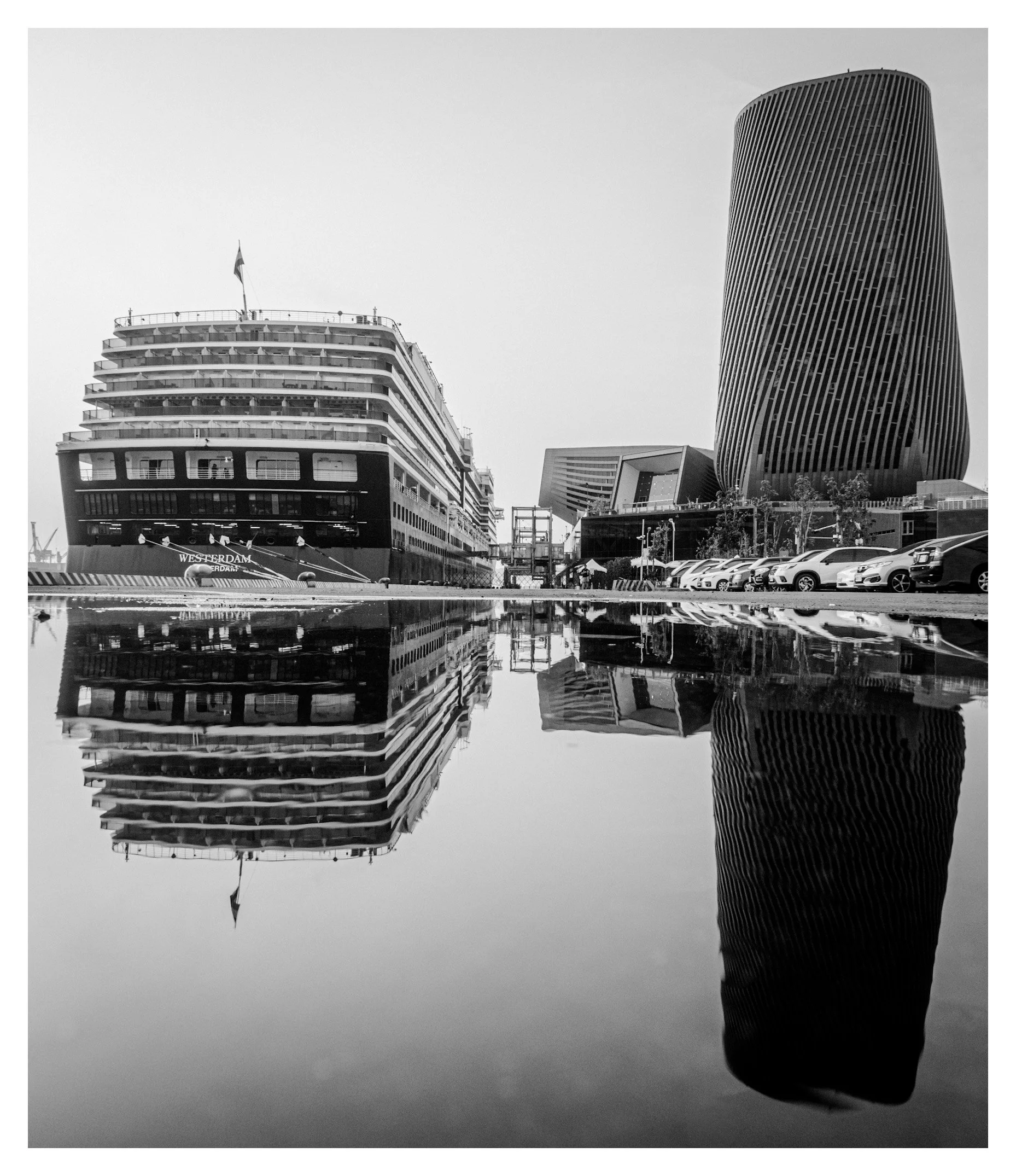
Day 110/365 Monoliths in Mirror: The Geometry of Arrival
EXIF Data
Camera Model: Leica D-Lux8
Shutter Speed: 1/250
Aperture: f/5.6
ISO: 200
The Critique
There is an undeniable weight to this image. You have placed two leviathans in conversation: the horizontal stratification of the Westerdam cruise ship against the vertical, twisted torsion of the Kaohsiung Port Terminal. It is a study in grids—the floating grid of the vessel’s decks versus the static, organic grid of the terminal’s façade.
The decision to shoot in black and white was the correct one. Color would have distracted us with the likely gaudy livery of the ship or the blue of the sky; here, stripped of chroma, the image becomes purely about texture and mass. The reflection in the foreground puddle is a classic, if somewhat safe, device to ground the image and double the geometry.
However, the image suffers from a lack of decisiveness in its spacing. The gap between the ship and the tower—that slice of negative space—is where the tension lives, yet it feels loose. The clutter in the middle ground (the gangways, the cars) dilutes the purity of the standoff. You have captured a scene, but you have not yet distilled it into an abstraction.
Improving This Image
1. Get Lower (Much Lower)
The reflection is currently an accessory; it should be the protagonist. If you had placed your camera mere inches from the water’s surface, the puddle would have expanded to fill the lower third of the frame. This would obscure the distracting asphalt and cars in the middle ground, leaving only the two giants and their ghostly doubles.
2. Tighten the Crop
The sky above and the pavement below (outside the reflection) are "dead space." A tighter crop that cuts into the edges of both the ship and the tower would emphasize their scale. Force the viewer to feel claustrophobic, as if they are being crushed between these two massive structures.
3. Wait for the "Punctum"
Roland Barthes spoke of the punctum—the prick, the accident that creates interest. A lone figure walking across the wet pavement, silhouetted against the bright reflection, would have provided a crucial sense of scale. Without it, the image is a sterile study of engineering; with it, it becomes a stage .
Becoming a Better Photographer: The Data Approach
To evolve, you must treat your photography as a dataset. You are currently shooting at f/5.6 and 1/250, safe settings for a bright day. Over the next six months, compile a spreadsheet of your best 50 images with the following columns:
• Focal Length: Are you always zooming to the same comfortable range?
• Time of Day: Do you only shoot at noon when the light is harsh (as implied by the high contrast here), or do you venture out at civil twilight?
• Subject Distance: Are you always a polite observer from across the street?
If you find 90% of your shots are taken at eye level from a medium distance, you have diagnosed your own stagnation. Force yourself to shoot 500 frames from hip-height or lower.
Recommendations for Study
Photographers
• Hiroshi Sugimoto: Study his Architecture series. He purposely blurs massive monuments to dissolve them into pure form. He understands that sharpness is sometimes the enemy of memory.
• Fan Ho: For his mastery of light, shadow, and geometric composition in Hong Kong. He turned the chaos of a port city into theatrical stages.
• Michael Wolf: For his work on density. He looked at high-rises not as buildings, but as endless, suffocating patterns.
Books to Read
• "Portrait of Hong Kong" by Fan Ho: This is essential study for you. Ho’s work deals heavily with the relationship between water, structure, and the human figure in a monochromatic port environment.
• "Moments in Time 1959-2013" by Chang Chao-Tang: Since you are shooting in Taiwan, you must understand Chang’s influence. His work embraces the absurd and the surreal, often using high contrast and grain to evoke a sense of alienation that would suit your architectural work well.
• "Tokyo Compression" by Michael Wolf: While this focuses on the subway, the way Wolf frames "windows" and "grids" will teach you how to photograph the side of that cruise ship not as a boat, but as a wall of human storage.
Video to Watch
... Fan Ho: The Art of Light and Shadow ...
I selected this video because Fan Ho is the absolute master of the aesthetic you are attempting here: using high-contrast black and white to turn the messy reality of a dockside into a piece of geometric art.