

Day 121/365 The Raw Pulse of Kaohsiung: A Study in Southern Motion
Technical Profile
Camera Model: Leica D-Lux8
Shutter Speed: 1/125
Aperture: f4.5
ISO: 400
Critique: Analysis of the Frame
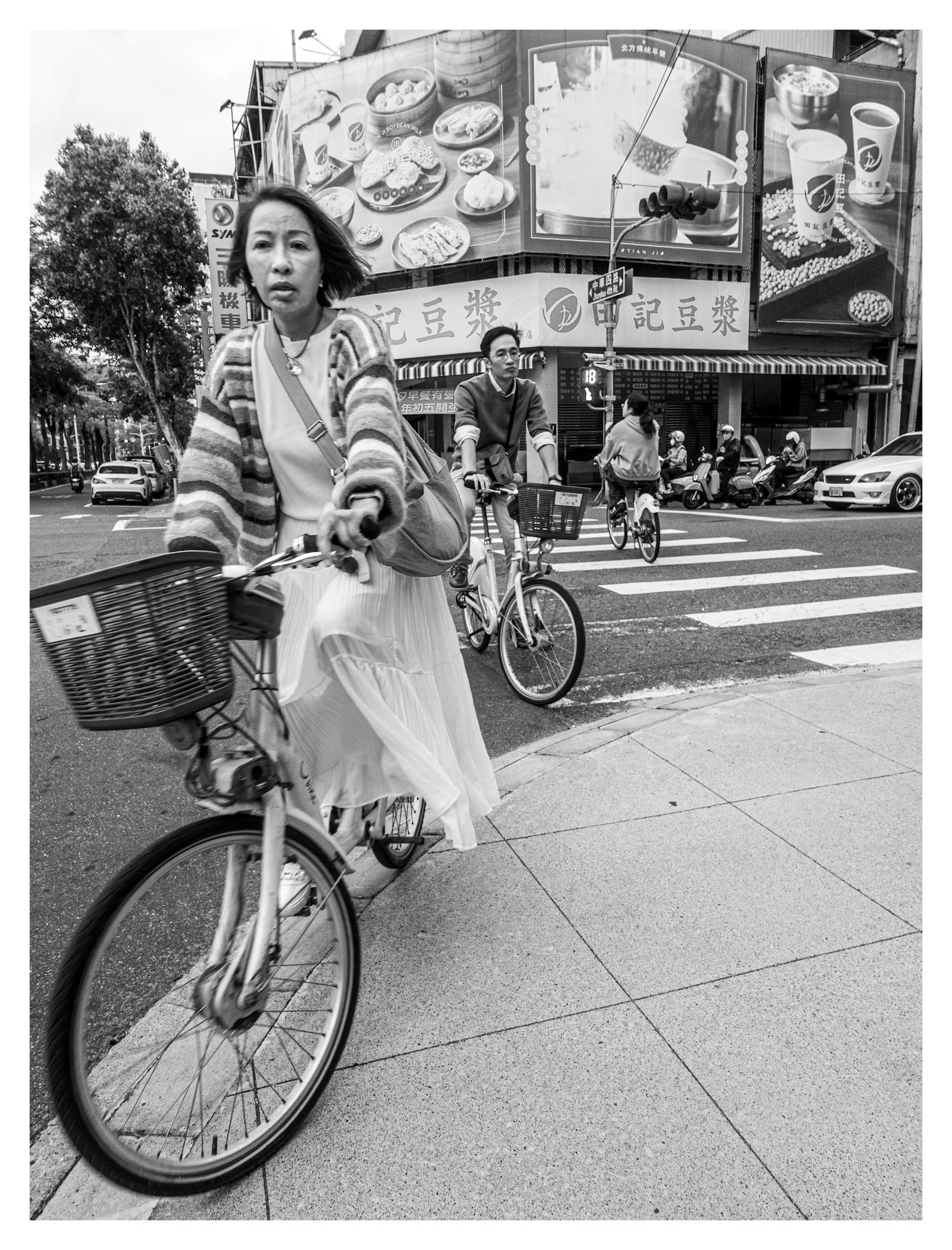
This image captures the unapologetic energy of Kaohsiung. The composition relies on a series of overlapping planes: the hurried cyclist in the foreground, the observant rider in the mid-ground, and the stagnant, layered signage of the soy milk shop in the background. This "stacking" of subjects is a classic street photography technique that creates depth in a two-dimensional medium.
The choice of monochrome is effective here because it unifies the disparate elements of the street—from the textures of the woven basket to the soft folds of the skirt—into a single narrative about movement. The woman's expression is the anchor of the shot; her eyes suggest a story beyond the frame, which is exactly what a viewer looks for in a candid street scene.
Room for Improvement
To refine your output while shooting in the specific environment of the south:
• Shutter Priority for Action: At 1/125, you are seeing a hint of "micro-blur" on the main subject. In a city where scooters and cycles move with unpredictable speed, aim for 1/500 to ensure the eyes are tack-sharp.
• Frame Edges: The front tire of the foreground bicycle is slightly cut off at the bottom. When shooting wide, try to include the "base" of your subjects to give them a solid foundation within the frame.
Growth Strategy: Compiling Your Data
To improve over time, you should begin cross-referencing your images with your specific shooting habits in Kaohsiung:
1. Lens Position Data: Track how often you use the wide end (24mm) versus the tight end (75mm) of your Leica. You may find that your most successful Kaohsiung shots happen when you are physically closer to the subject rather than zooming in.
2. High-Contrast Hit Rate: Categorize your photos by light quality. Does your work hold up better under the harsh, direct sun of a Kaohsiung afternoon, or during the diffused light of a rainy day? Use your ISO and Aperture data to see which "look" yields the most keepers.
3. Subject Consistency: Use your database to see if you are gravitating toward single-subject portraits or complex, multi-person scenes like this one.
Research and Inspiration
Photographers to Study
• Shen Chao-Liang: A must-study for his deep documentation of Taiwanese "Stage" culture and the evolving cultural landscape of the island.
• Nobuyoshi Araki: To understand how to capture the "raw" and personal side of urban life with an unfiltered lens.
• Mark Cohen: Known for his "grab shots" and close-up street work, which can help you learn to use your wide-angle lens more aggressively.
Books to Read
• "Moments in Time 1959-2013" by Weng Ting-hua: An essential retrospective on the absurdity and surrealism found in daily life.
• "Tokyo Compression" by Michael Wolf: A masterclass in capturing the claustrophobia and modern reality of Asian urban transit.
• "The Americans" by Robert Frank: To see how an "outsider" perspective can reveal the true soul of a place.
Watch and Learn
• The Decisive Moment: Henri Cartier-Bresson: A look at the master of geometry and timing in the street.
• Daido Moriyama: Near Equal: A documentary on the "Provoke" era style—grit, blur, and high contrast.
• Garry Winogrand: All Things are Photographable: Learn how to find order within the energy of a crowded city.