

Technical Metadata
Camera Model: Leica D-Lux8
Shutter Speed: 1/500
Aperture: f/2.8
ISO: 200
The Critique: A Dialogue Between Substance and Shadow
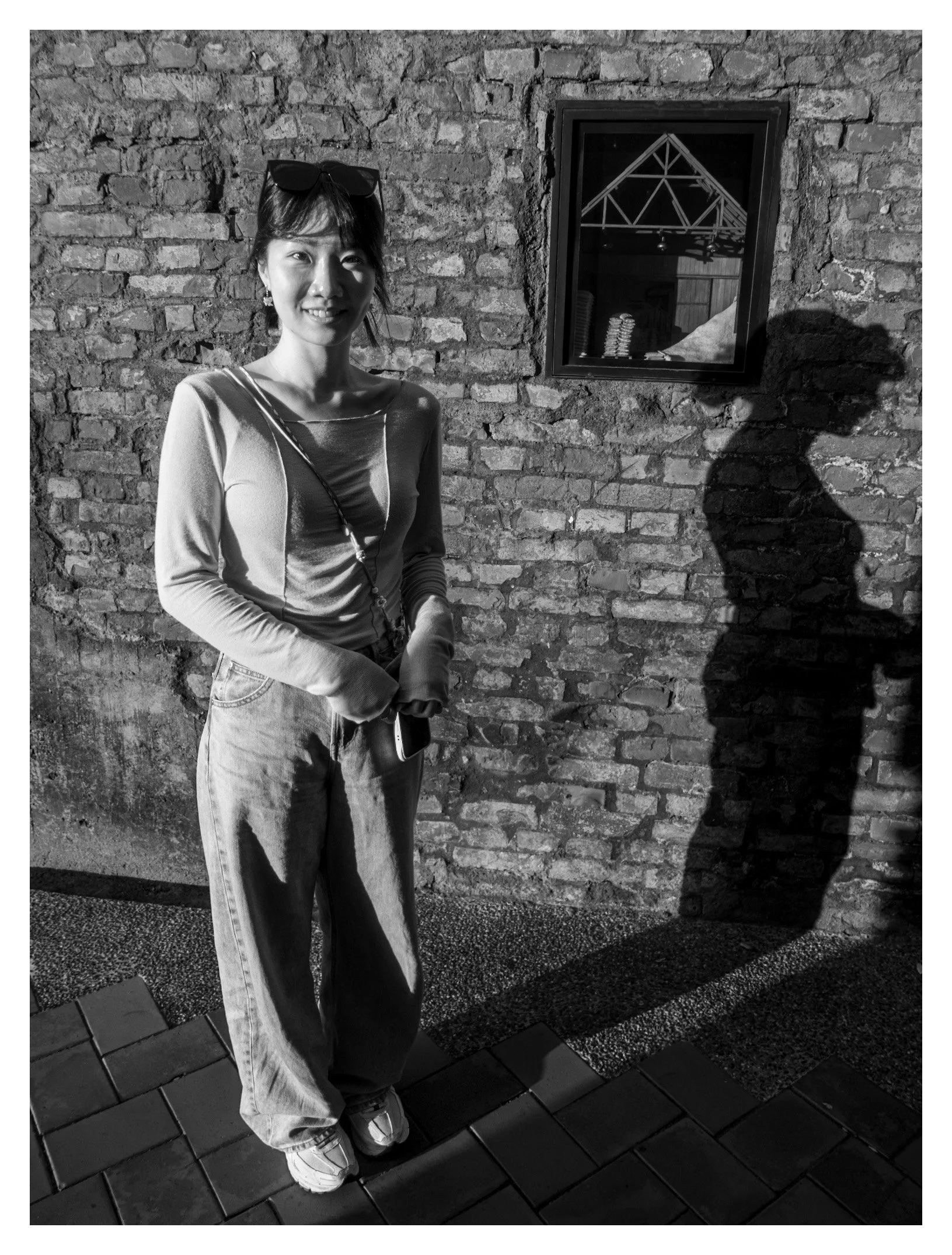
This monochrome capture utilizes the harsh, directional light of the "golden hour" to create a striking duality. By positioning the subject against a heavily textured brick wall, you have invited a tactile quality into the frame that thrives in black and white. The Leica's rendering of the masonry provides a gritty, rhythmic backdrop that grounds the composition.
The most compelling element here is not the subject herself, but the relationship between her physical presence and the elongated silhouette cast to her left. The shadow becomes a second character, distorted and amplified by the uneven surface of the wall. Furthermore, the inclusion of the window—reflecting an architectural skeletal frame—adds a layer of "photograph within a photograph," creating a sophisticated geometric counterpoint to the organic form of the woman.
Areas for Improvement
• Limb Management in Shadows: Notice how the shadow’s arm appears somewhat truncated or merged with the torso due to the angle of the light. To improve this, have your subject create "daylight" between their limbs and body (the "chicken wing" technique) to ensure the silhouette maintains a clear, recognizable human outline.
• Depth of Field: At f/2.8 on a 4/3 sensor, you have a decent separation, but the brickwork remains very sharp. If the goal is a pure environmental portrait, this works. However, to make the subject "pop" further, consider stepping further away from the wall while staying close to the subject to increase the focal fall-off.
• The Lower Frame: The transition from the brick wall to the patterned pavement at the bottom creates a horizontal line that cuts through the subject’s feet. Aiming slightly higher or moving back to include the full stride of the shadow without clipping the pavement would provide a cleaner "grounding" for the composition.
Evolution Through Data
To grow from a hobbyist to a master, you must treat your metadata as a diary. Start a spreadsheet or use a cataloging tool to tag your images by Lighting Condition (e.g., Side-lit, Overcast, Backlit). Over six months, you will likely find that your strongest work occurs at specific apertures or light angles. If you find your best "street" shots are all at 1/500, you’ve found your "sharpness floor." Use this data to eliminate technical guesswork so you can focus entirely on the emotional resonance of the scene.
Curated Research for the Developing Eye
Photographers to Study
• Fan Ho: The absolute master of using light and shadow in Asian urban environments. Study his book Portrait of Hong Kong to see how he uses high-contrast monochrome to turn everyday streets into cinematic stages.
• Ray K. Metzker: For a masterclass in "composites" and how to use shadows to break the human form into abstract geometry.
• Chien-Chi Chang: A Magnum photographer who often explores themes of alienation and connection within Taiwan. Study his work The Chain to see how he handles repetitive textures and human subjects.
Recommended Reading
• "The Decisive Moment" by Henri Cartier-Bresson: The foundational text for understanding timing and geometry.
• "Thoughts on Street Photography": Excellent for developing a philosophical approach to why we point the camera at strangers.
• "Bystander: A History of Street Photography": A vital academic reference to understand the evolution of this genre.
Required Viewing
• The Art of Photography - Fan Ho: A deep dive into the techniques of the master of light.
https://www.youtube.com/watch?v=L_9pG7C7-6Q
• Magnum Photos - The Photographic Essay: Insights into how to tell a story across multiple frames.