

Day 126/365 The Teppanyaki Tension: Freezing the Point of No Return
Technical Profile
Camera Model: Ricoh GRIII
Shutter Speed: 1/250
Aperture: f2.8
ISO: 1250
The Critique: Psychological Geometry
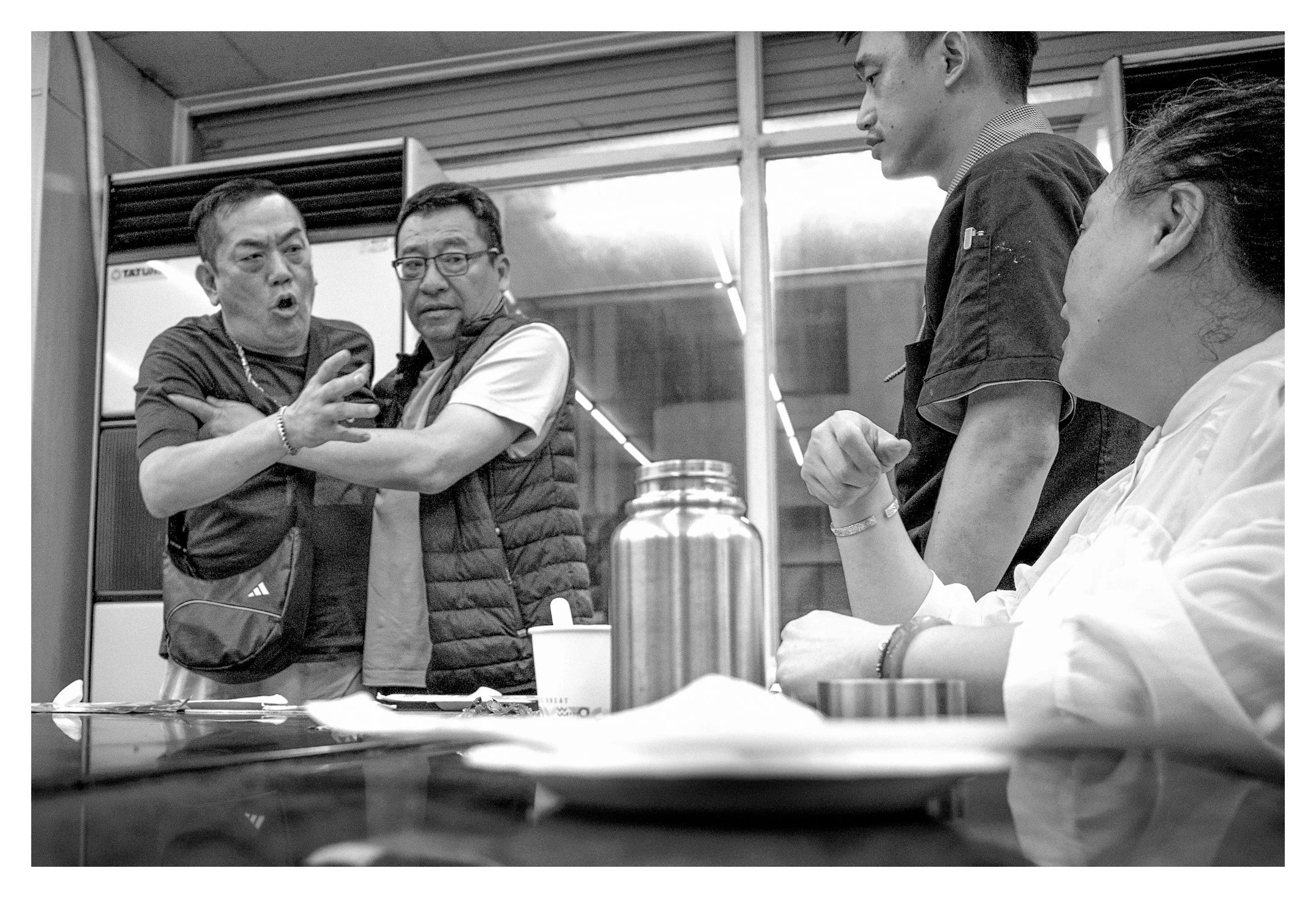
Street photography is often a game of inches and milliseconds, and here you have captured a moment vibrating with cinematic dread. The strength of this frame lies in its layers of reaction. While the primary action is the heated exchange on the left, the composition is anchored by the two figures on the right. Their proximity creates a foreground frame that traps the viewer in the restaurant’s claustrophobic atmosphere.
The high-contrast monochrome treatment is a wise choice. It strips away the distracting colors of a teppanyaki grill and forces us to focus on the gestural language: the splayed hand of the aggressor, the firm grip of the peacemaker, and the stoic, almost weary profile of the woman in the foreground. By utilizing the f2.8 aperture, you have kept the central conflict sharp while allowing the foreground elements to soften slightly, guiding the eye exactly where the tension peaks.
Paths for Improvement
While the image is visceral, there are two areas where the 5narrative could be tightened:
1. Vertical Alignment: The vertical lines of the window frames and the air conditioning unit are slightly tilted. In a scene this chaotic, squaring your verticals can provide a "structural irony"—a sense of formal order that makes the human disorder in the center feel even more volatile.
2. Foreground Depth: The white plate in the extreme foreground is "blown out" and lacks detail. While it serves as a leading line, its brightness competes with the faces. Next time, try to stop down slightly or shift your physical position to ensure the brightest part of the frame is the subject's expression, not the tableware.
Developing the Eye: A Long-Term Strategy
To evolve from a witness to a master of the "decisive moment," you must move beyond the single shot. I recommend starting a Contact Sheet Journal. Instead of only saving your "hero" shots, keep the frames immediately preceding and following them. This data reveals your instinctual patterns: do you tend to pull the trigger too early out of nerves, or do you linger too long and miss the peak? Analyzing the "misses" is the fastest way to refine your timing.
Curated Research for the Narrative Photographer
Photographers to Study
• Bruce Gilden: For his uncompromising, close-up approach to physical confrontation and energy in urban spaces.
• Anders Petersen: Study his "Café Lehmitz" series to see how to capture raw, intimate, and sometimes aggressive human interactions in confined environments.
• Chien-Chi Chang: A master of documenting alienation and social tension within the Taiwanese context.
Essential Reading
• The Decisive Moment by Henri Cartier-Bresson: The foundational text on timing and geometry in photography.
• Bystander: A History of Street Photography by Colin Westerbeck: An academic yet accessible evolution of the genre that will help you find your place in its lineage.
• Magnum Contact Sheets edited by Kristen Lubben: To see the "data" behind the masterpieces and understand how the best photographers work a scene.
Watch and Learn
• The Evolution of Street Photography: An exploration of how street styles have shifted from the candid to the confrontational.
• Joel Meyerowitz - What makes a great photograph?: Insightful commentary on finding the "thread" of a story in a chaotic environment.