

Day 130/365 The Centenarian’s Gaze: Finding the Eternal in a Kaohsiung Market
EXIF Data
Camera Model: Fujifilm X-Pro2
Shutter Speed: 1/200
Aperture: f5.6
ISO: 1250
The Critique
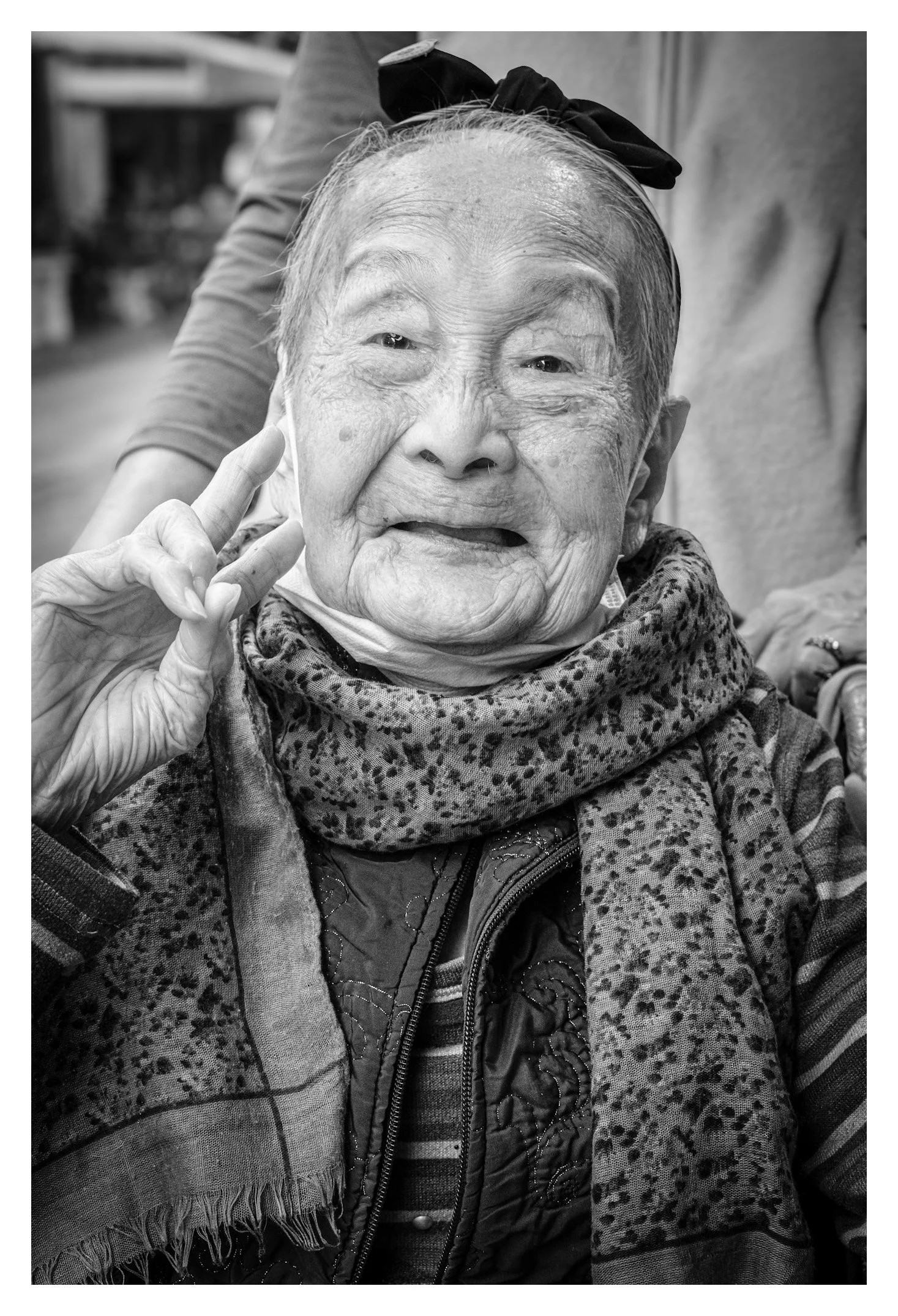
There is a deceptive simplicity to this portrait that rewards the patient viewer. As a specialist in the monochrome tradition, I am immediately struck by the tactile richness of the frame. You have captured more than a face; you have documented a landscape of lived experience.
The choice of black and white is essential here. By stripping away the distracting colors of a Taiwanese wet market, you have forced the eye to navigate the rhythmic patterns of the subject's life—the deep-etched lines of her smile, the leopard-print scarf, and the ribbed texture of her sweater. The "V" for victory gesture provides a wonderful counterpoint to her age, injecting a sense of contemporary playfulness into a face that has seen over a century of history.
The framing is intimate, though the background figures, while providing necessary context of the market's density, compete slightly with the subject’s silhouette. The high ISO has introduced a fine grain that actually benefits the image, lending it a "Tri-X" film aesthetic that feels authentic to the grit of street photography.
Refinement and Improvement
To elevate this piece from a documentary record to a gallery-grade portrait, consider the following:
• Background Management: While the figures behind her provide "flavor," the vertical line of the person directly behind her head creates a slight visual "merger." Moving inches to the left or right would have separated her head from the background clutter, allowing her form to pop more effectively.
• Tonal Depth: The highlights on her forehead and the bridge of her nose are slightly flat. In post-processing, subtle dodging of the eyes and burning of the lower corners of the frame would draw the viewer deeper into her expression, creating a more dramatic chiaroscuro effect.
• The Decisive Moment of Hands: The hand gesture is fantastic, but it is slightly cut off at the wrist. In street portraiture, the hands are often as expressive as the face; ensuring the entirety of the gesture is within the frame preserves the "action" of the portrait.
Growing Through Data
To become a master of this craft, you must move beyond the "hit and run" style of shooting. Start a Photography Metadata Journal. For every outing in Kaohsiung, categorize your "keepers" by focal length and light quality.
If you find your best portraits are consistently shot at f5.6, challenge yourself to spend a week at f2 to master thin depth of field, or f11 to learn how to integrate a subject into their environment. Compiling this data reveals your "crutches"—the settings you use when you are afraid to take a risk.
Curated Research for the Soul
To broaden your visual vocabulary, I recommend diving into these specific resources:
Photographers to Study
• Fan Ho: Master his use of light and shadow in 1950s Hong Kong. His ability to find geometric perfection in chaotic markets is unparalleled.
• Diane Arbus: Study her "square-on" approach to subjects. She had a way of capturing people on the margins with a psychological intensity that you should strive for in your Kaohsiung portraits.
Literature for the Library
• "The Decisive Moment" by Henri Cartier-Bresson: The "bible" of timing and geometry in photography.
• "The Americans" by Robert Frank: Observe how he used grain and "imperfect" compositions to capture the raw energy of a culture.
Essential Viewing
• The Beauty of Gritty Photography (Daido Moriyama): Learn why "blur, grain, and out-of-focus" can be more emotional than a sharp image. Watch here
• How to Read a Photograph (Joel Meyerowitz): A masterclass in understanding the "layers" of a street scene. Watch here