

EXIF Data
Camera Model
Ricoh GRIII
Shutter Speed
1/200
Aperture
f2.8
ISO
1250
The Critique: Layers of Industry
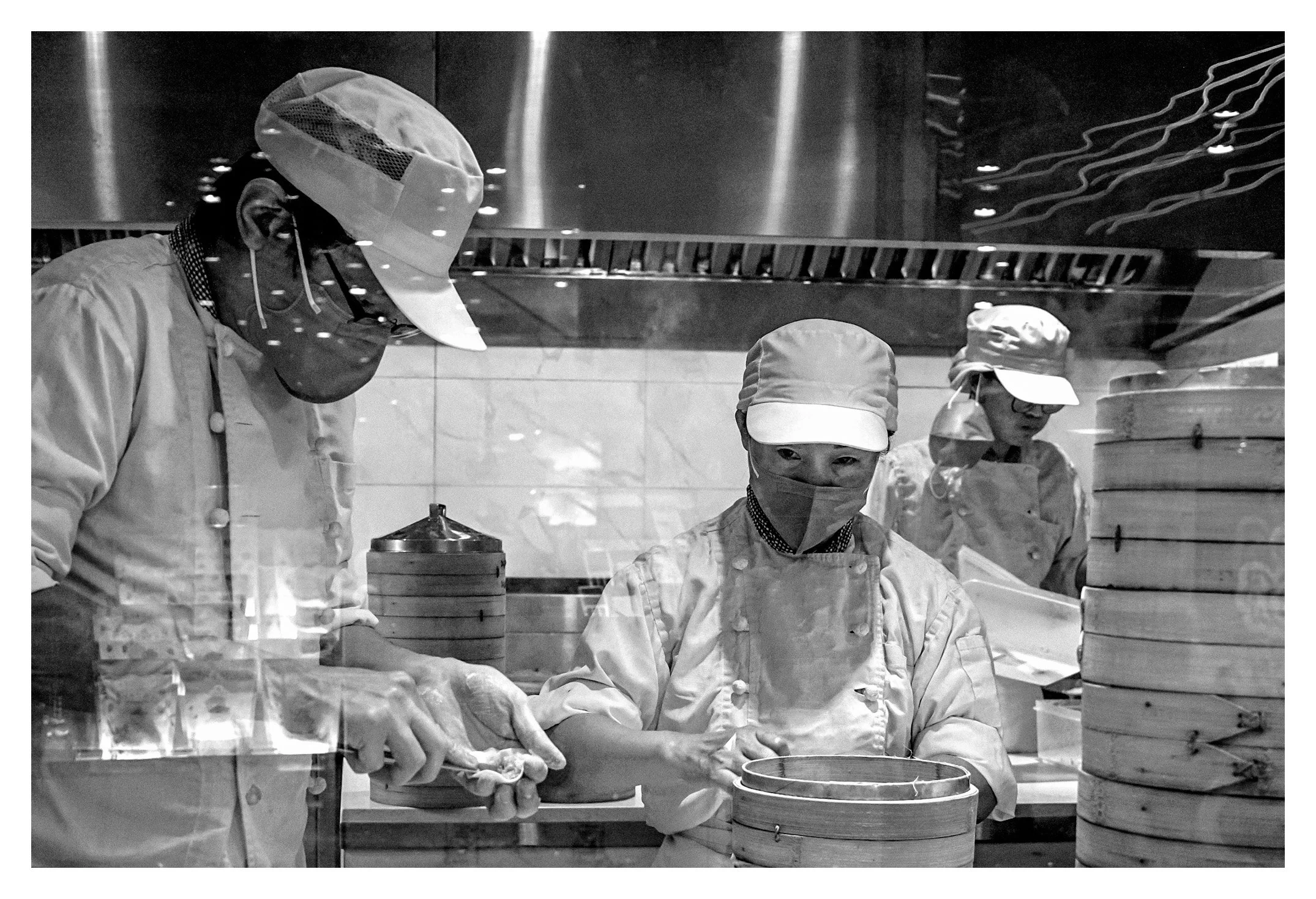
There is a profound rhythmic quality to this image that immediately calls to mind the work of the humanist masters. By shooting through the glass, you have introduced a layer of "atmospheric noise"—reflections and glare—that serves as a proscenium arch, separating the viewer from the intense, focused world of the chefs.
The black and white conversion is essential here; it strips away the distracting heat of the kitchen and focuses our attention on the textures: the grain of the bamboo steamers, the starch of the uniforms, and the metallic sheen of the industrial hood. The composition creates a strong internal dialogue between the three figures, led by the chef on the left whose hands are frozen in a moment of delicate assembly.
Paths to Improvement
While the f2.8 aperture provides a necessary depth of field for the environment, the reflection on the left occasionally competes with the primary subject's face.
• Mind the Highlights: In post-processing, consider a slight "burning" of the brightest reflections on the glass to ensure the viewer's eye travels directly to the hands and faces of the workers.
• The Power of the Vertical: While the landscape orientation works for the group dynamic, a vertical "portrait of labor" focusing solely on the stack of steamers and the lead chef might have provided a more claustrophobic, intense study of the craft.
Growing Through Data
To evolve, you must treat your metadata as a diary. Start a spreadsheet that correlates your ISO and Shutter Speed with your "hit rate" of sharp versus blurry street photos. You are shooting at 1/200, which is safe, but for the frenetic movement of a kitchen, 1/400 would eliminate the micro-blur in the hands, allowing for a crisper documentation of the process.
Curated Recommendations
Photographers to Study
• Fan Ho: For his unparalleled mastery of light, shadow, and the "decisive moment" in the streets of mid-century Hong Kong.
• Michael Wolf: Specifically his Tokyo Compression series, to see how a photographer handles the tension of subjects behind glass in a cramped urban environment.
• Chien-Chi Chang: Look at The Chain to understand how to document people within a specific institutional or work-related framework with gravity and precision.
Books for Your Shelf
• The Decisive Moment by Henri Cartier-Bresson: The foundational text for understanding geometry and timing in photography.
• Uncommon Places by Stephen Shore: Though he works in color, his structural approach to the "vernacular landscape" will help you see the kitchen not just as a room, but as a series of planes and shapes.
• Minutes to Midnight by Trent Parke: For a lesson in how to use high-contrast black and white to create a dreamlike, documentary narrative.
Videos to Watch
• The World of Fan Ho: A deep dive into how he used the urban environment as a stage. https://www.youtube.com/watch?v=8m9_L1vD_m0
• Magnum Photos - Chien-Chi Chang on "The Chain": Insight into long-form documentary projects and the ethics of the gaze. https://www.youtube.com/watch?v=S-t7i_o-2Xk