

Day 172/365 The Divine Play of Light: Finding Stillness in the Sacred Chaos
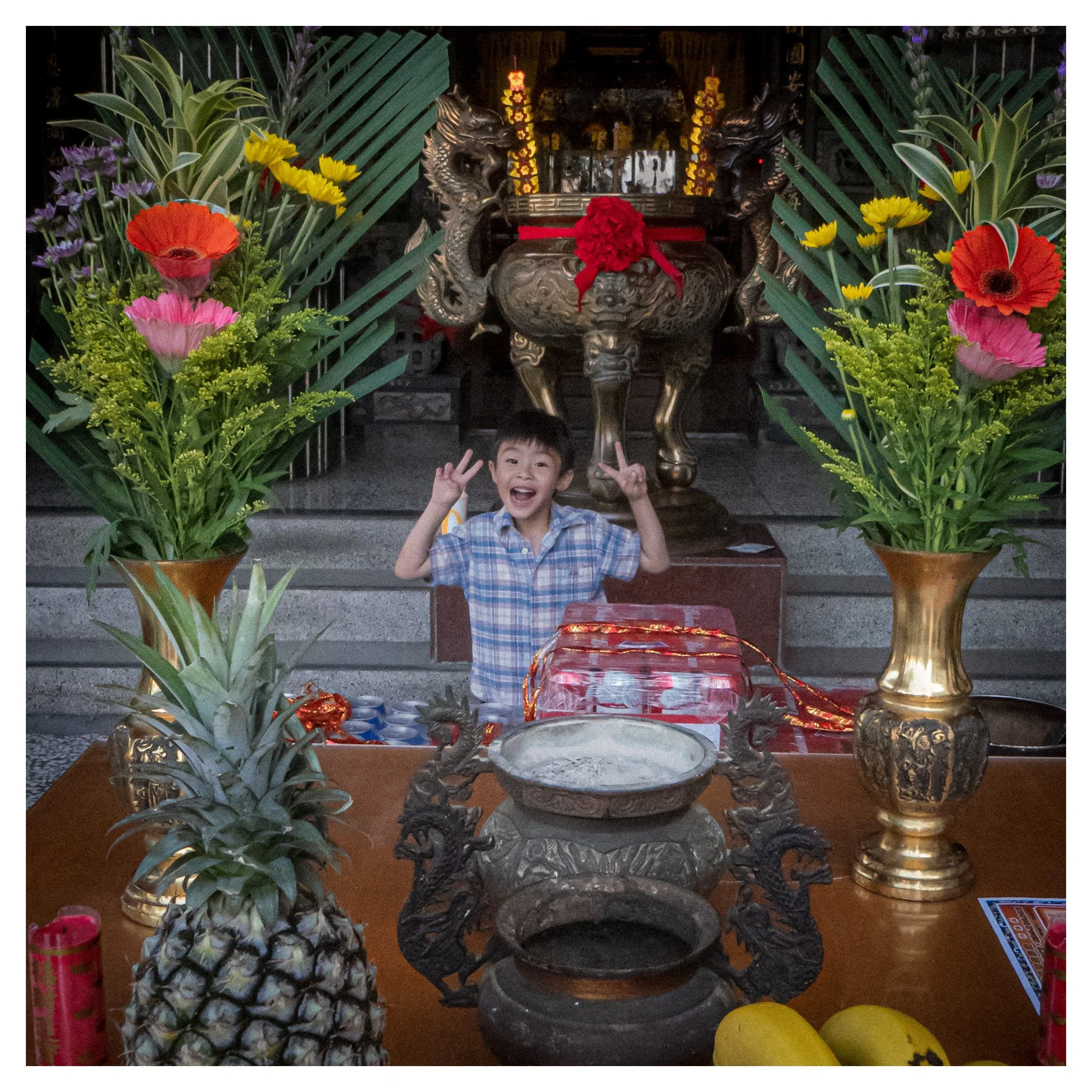
Capturing the exuberant energy of childhood against the stoic backdrop of a Taiwanese temple creates a profound visual tension. In this critique, we explore how layering and environmental storytelling can transform a spontaneous moment into a masterful composition. You will learn why embracing the background is the key to depth.
Technical Metadata
Camera Model: Leica D-Lux8
Shutter Speed: 1/250
Aperture: f8
ISO: 4000
The Critique: Theodore Marr’s Analysis
The photograph presents a striking juxtaposition between the fleeting, joyful spontaneity of youth and the eternal, ritualistic gravity of a temple environment. The subject—a child caught in a dual-peace-sign salute—radiates a raw energy that breaks through the formal symmetry of the religious setting.
The composition utilizes a classical three-plane depth strategy. We have the foreground defined by the tactile texture of the pineapple and incense burners, the mid-ground occupied by our protagonist, and the background featuring the ornate, dragon-etched urns. The choice of f8 was wise here; it allows the intricate details of the temple architecture to remain legible, providing the necessary context that makes the child’s irreverent joy so effective.
However, the high ISO 4000 has introduced a significant amount of digital noise and softened the micro-contrast. While the Leica sensor handles luminance noise with a certain film-like grace, the shadow detail in the temple interior is beginning to muddy. The central framing is functional but perhaps too safe. By placing the child slightly off-center, you could have invited the viewer’s eye to wander through the ritual offerings before landing on the human element.
Professional Advice for Improvement
• Refine Your Exposure Geometry: Given the static nature of the temple, a shutter speed of 1/125 would likely have sufficed to freeze the child’s movement while allowing you to drop the ISO to 2000. This would have preserved the rich golds and deep reds of the temple more effectively.
• Manage Foreground Intrusion: The pineapple in the lower left is a fantastic cultural signifier, but its proximity to the lens creates a slight "blocking" effect. Stepping back or using a slightly longer focal length would compress these layers, making the relationship between the fruit, the child, and the dragons feel more intentional and less cluttered.
• Color Grading for Narrative: The current palette is quite neutral. To lean into the "Taiwanese Gothic" aesthetic, consider warming the highlights to emphasize the candlelight and cooling the shadows to add mystery to the temple’s depths.
Your Path to Mastery
To evolve from a documentarian to an auteur, you must treat your body of work as a living data set. I recommend maintaining a digital archive where you tag images not just by technical specs, but by compositional DNA (e.g., "Symmetry," "Juxtaposition," "Low-Light"). Over time, you will see patterns—perhaps you rely too heavily on eye-level shots or certain color ratios. Identifying these habits is the first step to breaking them.
Recommended Study Materials
Photographers to Research
• Chien-Chi Chang: A master of the Taiwanese landscape whose book The Chain explores the darker, more surreal side of human connection within institutions.
• Fan Ho: Study his work for his unparalleled ability to use light and shadow to create drama within ordinary street scenes.
• Shen Chao-Liang: Specifically his STAGE series, which captures the vibrant, surreal "stage wagons" of Taiwan, offering a masterclass in local cultural landscapes.
Essential Reading
• "The Decisive Moment" by Henri Cartier-Bresson: The foundational text for capturing the exact second where form and emotion align.
• "Uncommon Places" by Stephen Shore: To understand how to find beauty and structure in the mundane and the kitsch.
• "The Americans" by Robert Frank: A lesson in looking at a culture from the perspective of an outsider to find its "raw" truth.
Watch and Learn
• The Art of Street Photography - Magnum Photos