

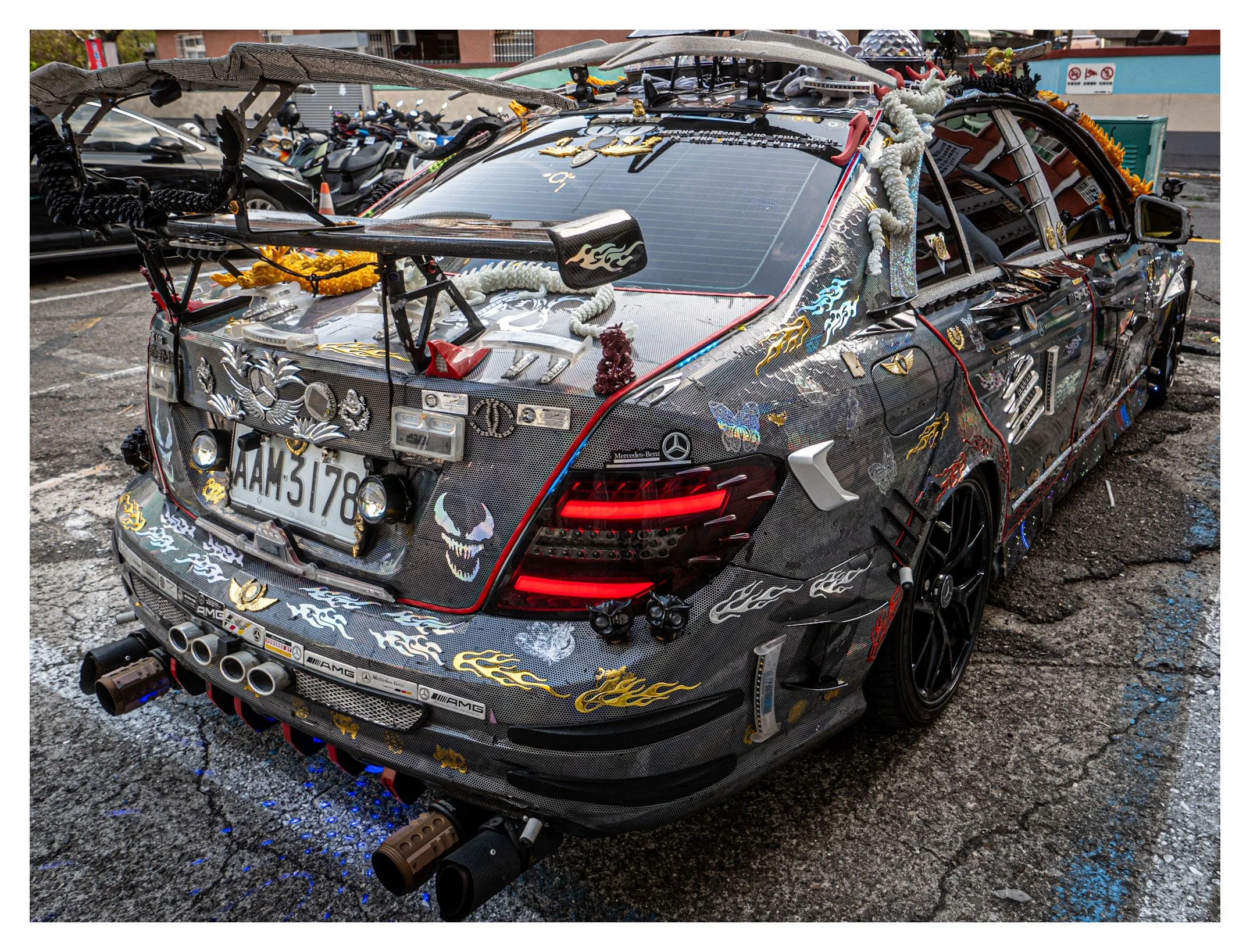
The streets of Taiwan offer a unique visual language, but few subjects challenge the eye quite like this Mercedes-Benz. You will learn why this explosion of texture and symbolism serves as a masterclass in modern folk art and how capturing such complexity requires a delicate balance of technical restraint.
Technical Specifications
Camera Model Leica D-Lux 8
Shutter Speed 1/125
Aperture f/3.5
ISO 200
The Critique: Theo Marr on "The Maximalist Chariot"
This image is a frantic, celebratory collision of consumerism and personal mythology. The subject—a Mercedes-Benz C-Class transformed into a shimmering, textured totem—is an incredible find. By utilizing the Leica D-Lux 8, you have captured the tactile quality of the carbon fiber wrap and the myriad of plastic flourishes with commendable clarity.
However, the composition is currently struggling against its environment. The high-angle perspective and the inclusion of the surrounding motorbikes and asphalt create a "snapshot" aesthetic that competes with the car's inherent drama. When a subject is this loud, the photographer must decide whether to lean into the chaos or isolate the madness.
Refinement and Improvement
To elevate this work, I suggest the following adjustments:
• Simplify the Geometry: Get lower. A low-angle shot would lend the car a "heroic" stature, emphasizing those aggressive exhaust ports and the sprawling rear wing while cropping out the distracting background elements.
• Controlled Depth of Field: While f/3.5 is relatively wide for a compact sensor, moving closer to the subject would increase the separation. Isolate specific details—the dragon motifs or the Venom decal—to create a series rather than a single wide shot.
• Manage the Highlights: The metallic and plastic surfaces are "pinging" with harsh light. Shooting during the "blue hour" or in overcast conditions would allow the under-glow and internal textures to sing without the distracting glare of direct sun.
The Path to Mastery: Data and Discipline
To become a better photographer, you must treat your catalog as a laboratory. Start a "Shoot Journal" where you cross-reference your metadata with your emotional success rate.
• Analyze Your Aperture: Look at your most successful images. Are they shot wide open or stopped down? If you find your "eye" prefers f/8, seek out lenses and lighting that optimize that range.
• Track Focal Lengths: Your D-Lux has a zoom; determine if you are habitually shooting at the wide end. If so, you may be a "physical" photographer who needs to move their body more to find better angles.
Curated Research for the Developing Eye
To broaden your visual vocabulary, I recommend studying those who find beauty in the unconventional and the cluttered.
Photographers to Study
• Shen Chao-Liang: Specifically his STAGE series. He documents Taiwanese stage wagons which share a similar "maximalist" energy with your car.
• Lee Friedlander: For his ability to organize visual "clutter" within the frame into a cohesive, complex puzzle.
• Martin Parr: For his unflinching look at the quirky, the garish, and the ultra-saturated elements of modern life.
Literature for the Library
• Stage by Shen Chao-Liang: This will provide context on Taiwanese cultural landscapes and surreal night photography.
• The Decisive Moment by Henri Cartier-Bresson: A fundamental text for understanding geometry and timing.
• Uncommon Places by Stephen Shore: A lesson in finding the extraordinary within the mundane urban environment.
Required Viewing
• The Genius of Photography (BBC Documentary): A comprehensive look at how the medium evolved from documentation to art. Watch on YouTube
• The Photographic Eye - Why Your Photos Aren't Good Enough: A deep dive into the psychological blocks of composition. Watch on YouTube
• Sean Tucker - Finding Your Voice: Excellent for moving beyond technical settings and into personal expression. Watch on YouTube