

Day 202/365 Shadows and Steel: A Midday Encounter in Yancheng
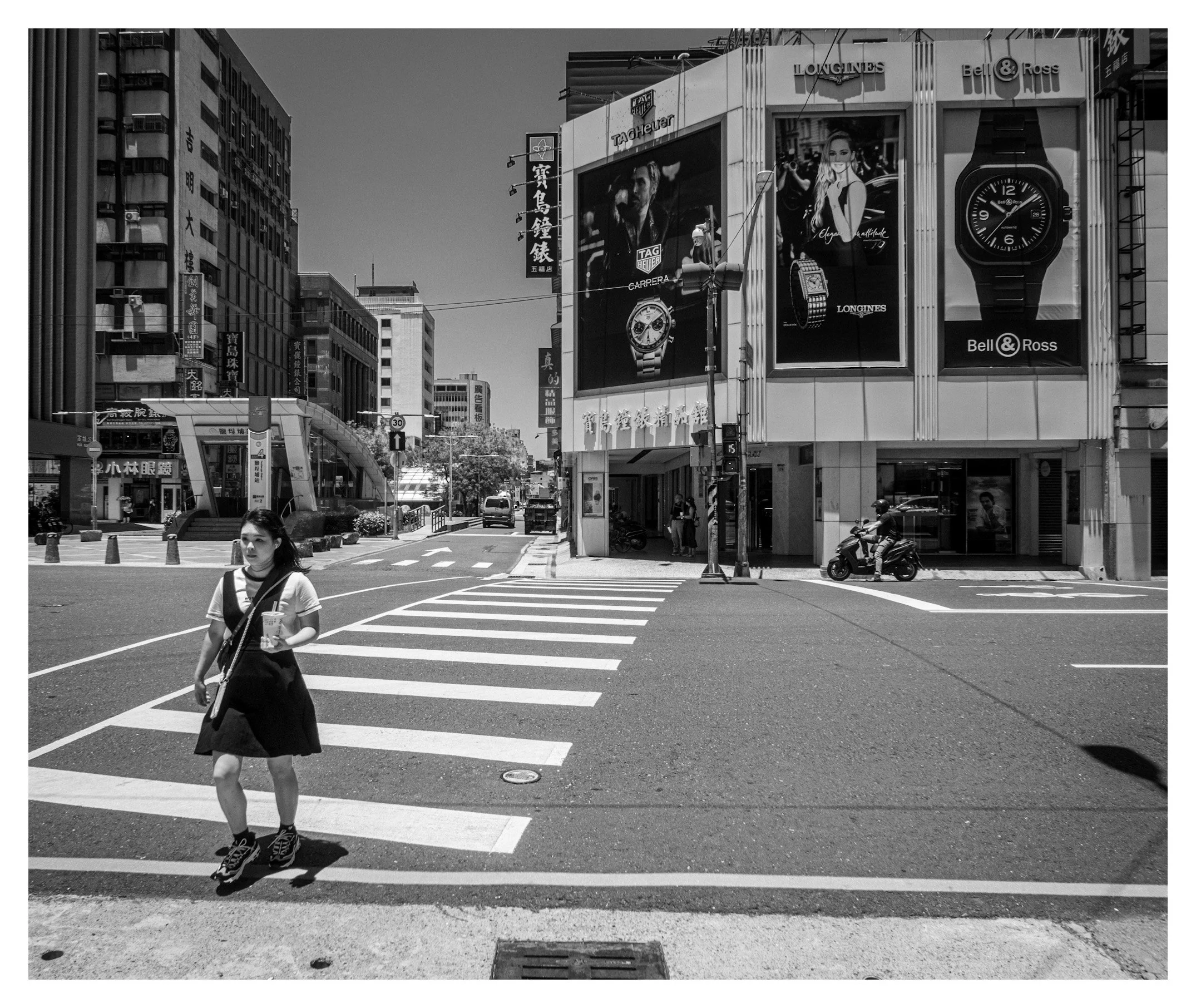
Street photography in the harsh midday sun is often avoided, but this capture from Kaohsiung’s Yancheng District suggests otherwise. You will learn how high-contrast monochrome transforms a common intersection into a stage for urban geometry and why the placement of a single subject dictates the entire narrative of the frame.
EXIF Data
Camera Model: Leica D-Lux 8
Shutter Speed: 1/1000
Aperture: f/5.6
ISO: 200
The Critique: Negotiating the Noon Sun
In this frame, we see a stark, unapologetic look at Yancheng. By choosing a black-and-white treatment, you have successfully stripped away the visual "noise" of colorful signage to focus on the interplay of geometry and light. The leading lines of the zebra crossing provide a strong rhythmic foundation, pulling the viewer’s eye toward the towering watch advertisements that dominate the upper right quadrant.
The exposure is handled with technical precision. At 1/1000 of a second, the motion is frozen completely, lending a sense of stillness to what is likely a bustling intersection. The choice of f/5.6 on the D-Lux 8 provides a deep enough depth of field to keep both the pedestrian and the architectural details sharp, which is essential for this "street-as-stage" aesthetic.
However, the primary challenge here is the timing of the light. Midday sun creates "dead" shadows directly beneath subjects. While the high contrast works for the buildings, it flattens the human element. The subject is caught in a moment of transition—clutching a drink, mid-stride—but she is competing with the massive, high-contrast watch faces above her. There is a slight tension between the "micro" story of the pedestrian and the "macro" story of the commercial landscape.
Areas for Improvement
1. Timing and Shadow Play
To elevate this composition, consider returning to this exact spot during the "Golden Hour" or shortly after sunrise. Longer shadows would stretch across the pavement, creating leading lines that are physical rather than just painted. This would add a three-dimensional quality to the pedestrian that the current overhead lighting lacks.
2. Subject Isolation
The pedestrian is positioned somewhat centrally within her half of the frame. If you had waited half a second longer for her to move further into the "white" space of the crosswalk stripes, her silhouette would have popped more dramatically against the dark asphalt.
3. Simplification
The left side of the frame contains a lot of architectural clutter that doesn't quite match the clean lines of the right side. Experimenting with a tighter crop or a slightly different angle to exclude the more chaotic building structures might strengthen the overall impact.
Building Your Photographic Legacy
To become a master of the craft, you must move beyond taking "good pictures" and start building a cohesive body of work. I recommend keeping a digital contact sheet—much like the database you are already constructing. Track not just your settings, but the "Why." Was it the light? The gesture? The irony? Over time, you will see patterns in your own psyche that define your "style."
Curated Research for the Soul
Photographers to Study
• Fan Ho: Look at his work "Approach" to see how he used massive shadows and architectural scale in Hong Kong to dwarf his subjects. He is the master of the "Stage" approach you are utilizing here.
• Ray K. Metzker: His "Composites" and street work will show you how to turn city light into pure abstract geometry.
• Chien-Chi Chang: Since you are shooting in Taiwan, study his work The Chain or Jet Lag to see how he captures alienation and the human condition within structured environments.
Essential Reading
• The Decisive Moment by Henri Cartier-Bresson: This is the "Bible" of street photography. It will teach you the exact relationship between geometry and the "peak" moment of a gesture.
• Bystander: A History of Street Photography by Joel Meyerowitz and Colin Westerbeck: An academic yet vital reference that tracks the evolution of the genre you are currently practicing.
Required Viewing
• The Mind's Eye (Henri Cartier-Bresson): A documentary exploring his philosophy on the "Geometry" of a moment.
https://www.youtube.com/watch?v=hyhMqDfm77o
• The Photographers - Fan Ho: A short look into how he mastered the light of the East.