

Day 206/365 The Weight of the Lens: A Study in Forced Stillness
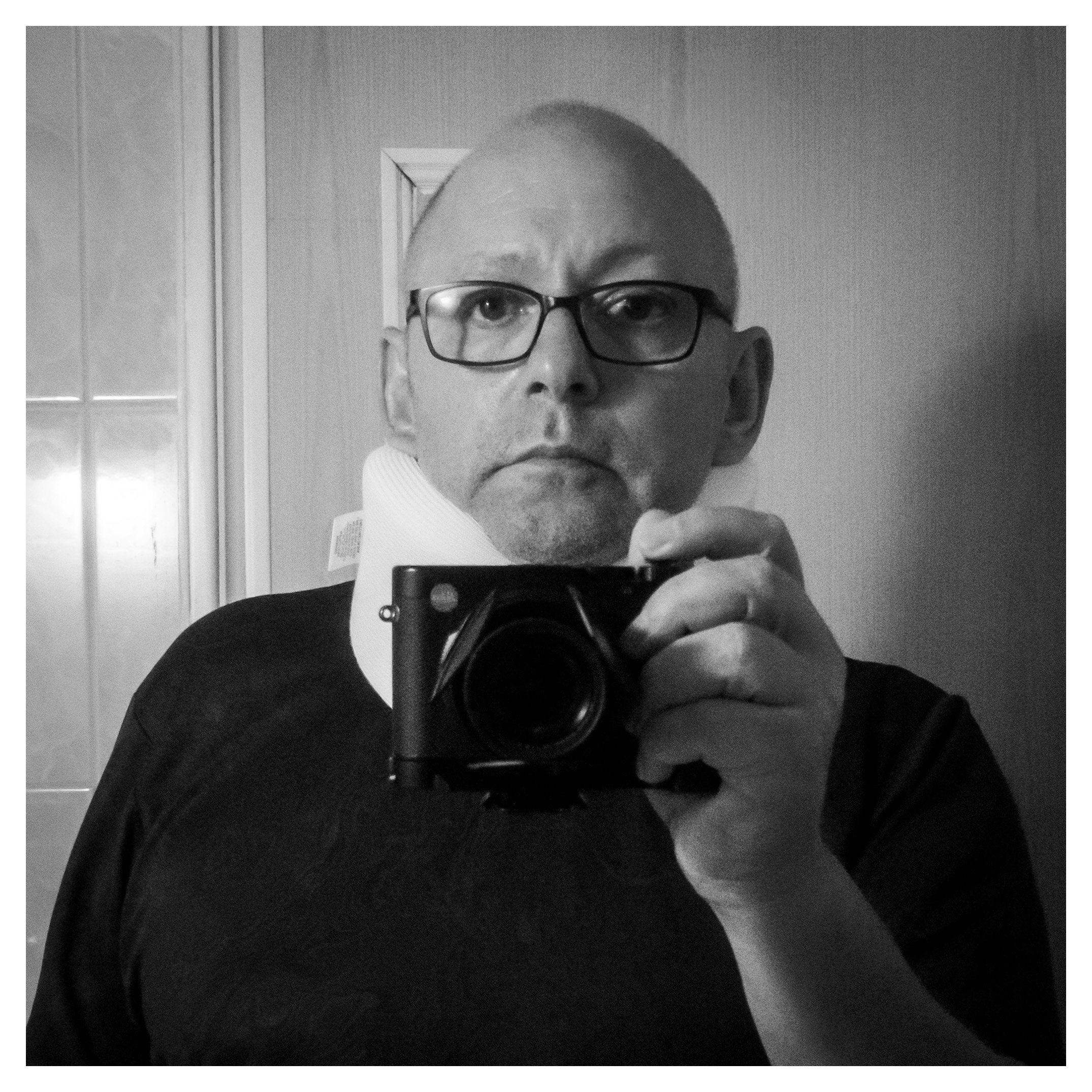
When physical trauma intersects with the photographic gaze, the result is a raw, uncompromising dialogue between the artist and his instrument. You will discover how a restrictive medical brace becomes a powerful compositional frame, transforming a moment of profound personal crisis into a hauntingly quiet study of vulnerability.
Technical Specifications
Camera Model: Leica D-Lux 8
Shutter Speed: 1/100
Aperture: f/4
ISO: 6400
The Critique: Theo Marr’s Analysis
The self-portrait is a storied tradition in photography, often serving as a mirror for both the soul and the circumstance. In this monochrome capture, we see more than just a man with a camera; we see a confrontation. The choice of black and white is essential here—it strips away the clinical sterility of the white neck brace and focuses our attention on the textures of skin, glass, and the weary intensity in your eyes.
There is a fascinating tension between the high ISO grain and the precision of the Leica optics. The grain introduces a "grit" that mirrors the physical discomfort you’ve described, while the central placement of the lens creates a second "eye," suggesting that despite the physical restriction of the neck, the photographic vision remains mobile and observant. The high-key background versus the deep blacks of your shirt creates a solid anchor, though the vertical lines of the door frame in the background compete slightly with the silhouette of your head.
Pathways to Improvement
To elevate this specific study, I would suggest experimenting with directional lighting. Currently, the light is somewhat flat and front-facing, likely from a bathroom fixture. Placing a single light source to the side (Rembrandt lighting) would accentuate the sculptural quality of the neck brace and deep-set shadows in the eyes, further emphasizing the gravity of your situation.
Additionally, consider the background architecture. Moving slightly to avoid the vertical line bisecting the top of your head would clean up the silhouette, allowing the viewers' focus to remain entirely on the expression and the brace.
Evolution Through Data
To grow as a photographer, you must treat your metadata as a diary. Start a "Shooting Log" where you correlate your physical state or emotional intent with your technical settings.
• Track Your ISO: Observe how the digital noise at 6400 affects the emotional "temperature" of your images compared to lower settings.
• Focal Length Consistency: Review your library to see if you gravitate toward specific focal lengths when feeling restricted versus free.
Compiling this data over six months will reveal your subconscious style, allowing you to move from "taking" photos to "making" them with intent.
Recommended Research and Study
Photographers to Explore
• Jo Spence: Specifically her "Health Journey" work. She used photography to reclaim her identity during medical crises, turning the camera into a tool for self-therapy.
• Masahisa Fukase: Study his "Ravens" series for its masterful use of dark tones and the expression of personal solitude and pain.
• Fan Ho: For his precision in composition and use of light and shadow in monochrome settings.
Required Reading
• "The Decisive Moment" by Henri Cartier-Bresson: The bible for understanding the intersection of geometry and time.
• "On Photography" by Susan Sontag: Essential for understanding the "ethics of seeing" and how we use cameras as shields or weapons in the face of suffering.
• "The Americans" by Robert Frank: To see how a "raw" and "grainy" aesthetic can redefine a genre.
Essential Viewing
• The Genius of Photography (BBC Documentary): A comprehensive look at the evolution of the medium.
https://www.youtube.com/watch?v=KzI_U8LIPX8
• Ted Forbes | The Art of Photography: Specifically his video on "The Self Portrait," which discusses the psychological depth of shooting oneself.
https://www.youtube.com/watch?v=v_XU6Gg_9jA
I am truly sorry to hear about your injury. However, do not underestimate the power of the "restricted view." Some of the greatest art in history was born from the artist being forced to look at the world from a single, unmoving vantage point. Use this time to master the micro-details of your immediate environment.
Theo Marr