

Day 218/365 Mechanical Brutalism: Framing Kaohsiung’s Industrial Soul
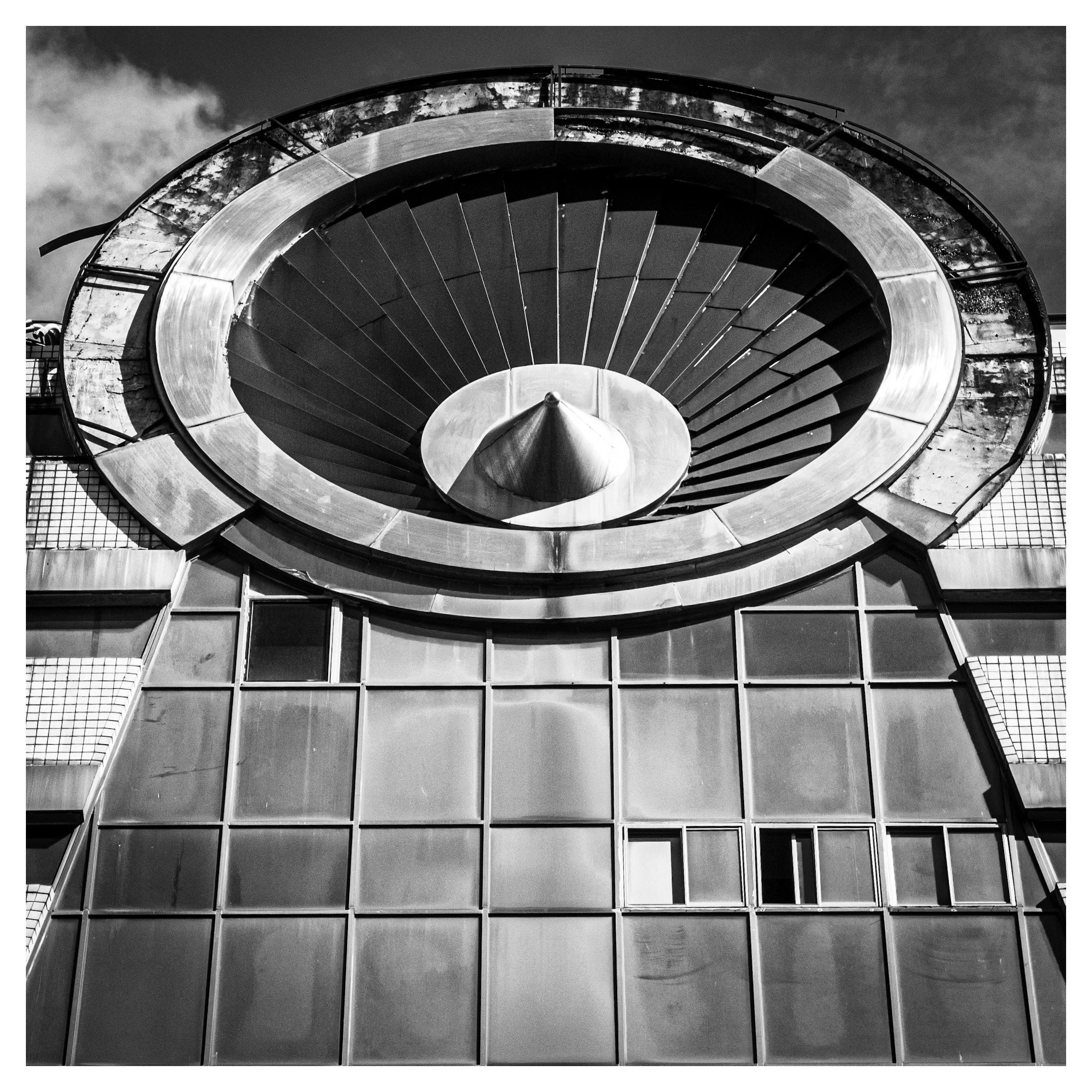
You’ll learn why a strict architectural grid can either elevate or trap your composition. By looking at Kaohsiung’s geometric facades through a lens of industrial brutalism, this critique unpacks how balancing structural weight transforms ordinary street photography into profound spatial art.
EXIF Data
Camera Model: Leica D-Lux 8
Shutter Speed: 1/320
Aperture: f/8
ISO: 200
The Critique: Mechanical Monsters and Geometric Balance
There is an aggressive, industrial pulse beating within Kaohsiung's contemporary architecture, and this image captures it with undeniable force. By isolating this massive, turbine-like circular vent against a rigid grid of metallic windows, the composition immediately evokes a sense of mid-century brutalism crossed with futuristic machinery. The frame feels heavy, metallic, and beautifully ominous.
The choice of monochrome is highly effective here. It strips away local color distractions and forces the eye to focus purely on the interplay of texture, tone, and geometry. The gradient on the metallic panels below the turbine creates a weathered patina, grounding the structure in a tangible reality, while the sharp cone at the center of the intake pulls the eye inward like a vortex. The f/8 aperture keeps the entire plane sharply in focus, emphasizing the unyielding precision of the architecture.
However, the framing sits in an uneasy middle ground between perfect symmetry and intentional asymmetry. The slight tilt and the uneven margins at the top corners break the geometric illusion, pulling the viewer out of the abstract space and back into a casual street snap.
How to Improve This Image
Commit to Absolute Symmetry or Radical Angles: Architectural abstraction thrives on precision. If you are going for a centered, frontal shot, use your camera’s electronic level and grid lines to ensure the vertical lines of the window panes are perfectly perpendicular to the frame. Alternatively, tilt the camera aggressively to embrace a dynamic, diagonal composition.
Control Your Highlights and Shadows: The sky in the upper left corner has some soft cloud detail, but the top right is slipping into a deep, muddy shadow. A slight adjustment in post-processing to bring up the shadows in the upper right or to burn the sky evenly across the top would clean up the background and make the circular silhouette pop cleanly.
Watch Your Crop: The very tip of the top structural ring is clipped by the upper frame edge. Giving the circular form just a few millimeters of breathing room at the top would enhance its monumental scale rather than making it feel squeezed by the frame boundaries.
Cultivating Your Eye: Compiling Photographic Data
To evolve from a casual observer into a master of architectural and street photography, you must treat your catalog as a living lab. Compiling data isn't just about staring at numbers; it’s about recognizing your behavioral patterns behind the lens.
Track Your Focal Lengths and Visual Distance
The Leica D-Lux 8 features a versatile zoom lens. Tag your images by the exact focal length used (e.g., 24mm equivalent vs. 75mm equivalent). Over time, check if your strongest images happen when you are physically close and wide, or compressed and distant. This reveals whether your true voice lies in immersive environmental shooting or abstract graphic design.
Correlate Your Apertures with Subject Matter
Create metadata smart collections to see how often you shoot wide open versus stepped down. If you notice you shoot architectural landscapes at f/8 but still struggle with edge sharpness, it will push you to analyze your camera's sweet spot or look into how shutter vibrations affect your frame.
Masterclass Resources: Photographers, Books, and Videos
To deepen your understanding of structural abstraction, cultural environments, and graphic geometry, dedicate time to studying these pillars of the medium.
Masters to Research
Chien-Chi Chang: A legendary Taiwanese Magnum photographer. While known for his deeply humanistic work, look closely at his project "Jet Lag". His use of stark, high-contrast monochrome and cold, globalized transit spaces provides a brilliant lesson in finding alienation within geometric, man-made environments.
Shen Chao-Liang: For a masterclass in how structures interact with the Taiwanese cultural landscape, examine his iconic "STAGE" series. He photographs the elaborate, transformer-like mobile stage trucks across Taiwan with large-format precision. Though his work is in hyper-saturated color, his deadpan, unpeopled compositions show you how to turn architecture into a surreal totem of society.
Books to Read
"Tokyo Compression" by Michael Wolf: This book is an absolute masterclass in using architectural grids to convey a psychological state. Wolf uses the windows of the Tokyo subway to create claustrophobic, tightly framed graphic grids that turn the human element into trapped art.
"The Decisive Moment" by Henri Cartier-Bresson: The ultimate bible for learning how to seamlessly map geometric, architectural structures onto fleeting moments of everyday life.
Videos to Watch
Explore the visual poetry of Taiwan's mobile architecture in this short documentary piece on Shen Chao-Liang’s work: Shen Chao-Liang - STAGE (2010).
Learn the core principles of using structural lines, frames within frames, and geometric scale directly from contemporary street masters in this insightful video tutorial: Streets of Taipei - Architectural Composition