

Day 268/365 The Seam: An Architectural Study in Absence
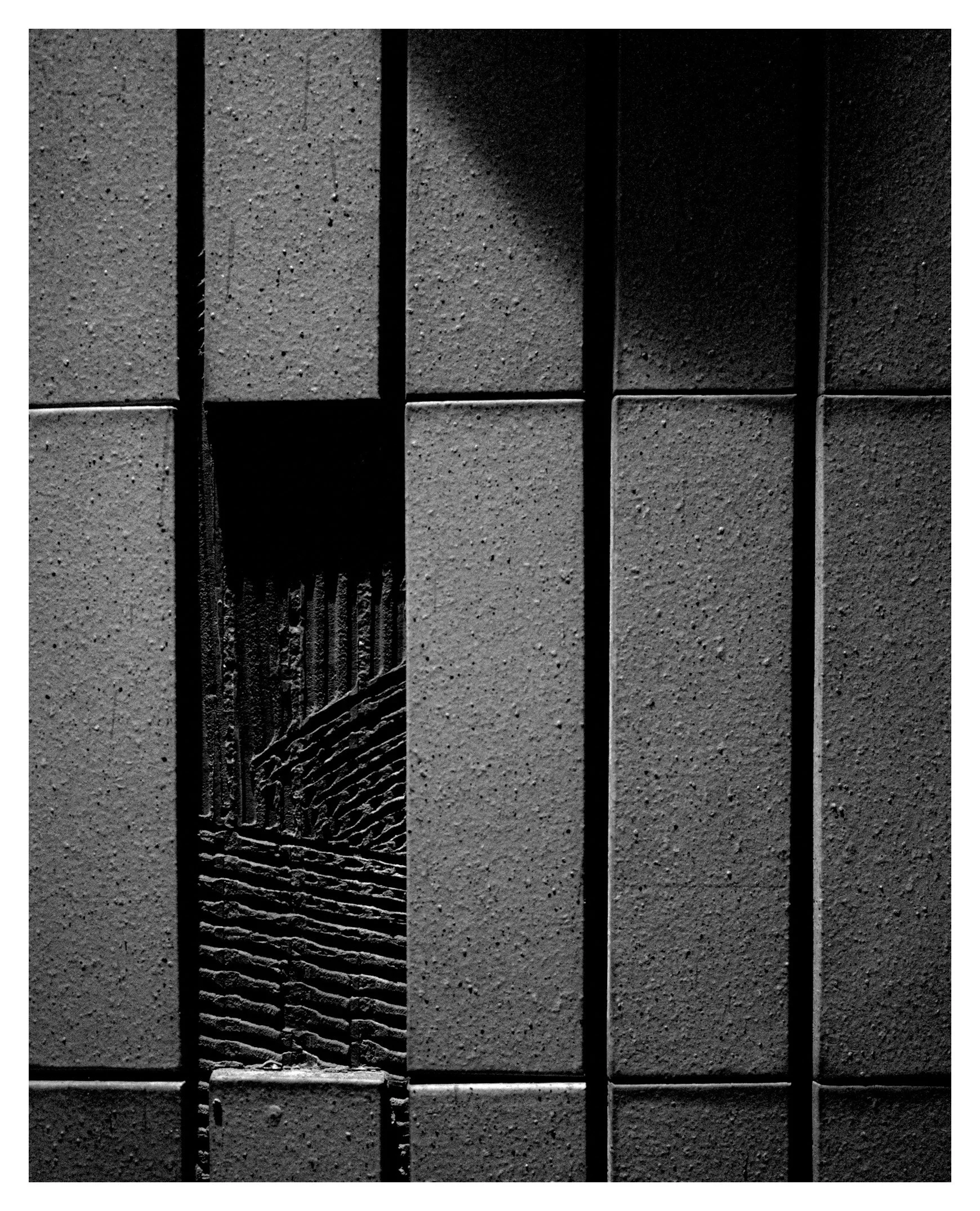
A row of tiled columns marches across the frame in disciplined rhythm — until one panel is simply gone, revealing raw structure beneath. A study in grids, texture, and the disruption that gives a minimalist composition its meaning.
EXIF Data
Camera Model: Ricoh GR III
Shutter Speed: 1/100 sec
Aperture: f/2.8
ISO: 3200
The Critique
This photograph belongs to a tradition of architectural typology that runs from Bernd and Hilla Becher’s disciplined grids through to the New Topographics movement’s fascination with the built environment’s overlooked surfaces. What makes it work is precisely what your question points to: the missing tile. A regular rhythm of vertical concrete or stone panels, separated by dark mortar lines, establishes a strict visual grammar in the frame’s opening seconds of reading — and then one panel simply isn’t there. In its place, a dark cavity reveals a corrugated, textured surface behind, something closer to raw structural material than finished facade.
That gap is the entire photograph. Without it, this would be a competent but inert study of repetition — pleasant tonal variation across gray panels, nothing more. With it, the image becomes a meditation on concealment and revelation, on what a building’s finished skin is hiding underneath. There’s a genuine formal intelligence in how the missing panel sits slightly left of center, breaking the grid’s symmetry just enough to create tension without abandoning the underlying order entirely. The eye registers the pattern, catches the interruption, and is pulled directly into that dark irregular texture — rough, ribbed, almost organic against the flat, sanded regularity of the surrounding tiles.
The black-and-white treatment is the correct decision here, and an important one. Color would have turned this into a documentation of materials; stripped to tone, it becomes about form, light, and the psychological weight of that dark absence. The diagonal shadow bleeding across the upper right quadrant adds a second, subtler disruption to the grid, giving the eye a place to rest before it’s pulled back down to the central gap. Exposure control deserves credit too — at f/2.8 and a full stop underexposed, the panels hold rich midtone gradation without losing the cavity to pure black, keeping just enough texture visible in that ribbed interior to reward a close look.
If there’s a shortfall, it’s in the frame’s edges. The composition reads slightly arbitrary at its boundaries — the crop doesn’t clearly justify why it stops where it does on either side, and a viewer’s eye searches briefly for a reason the grid ends there rather than one panel earlier or later. There’s also a question of whether the full-bleed grid across the whole frame, with the disruption positioned exactly where it is, might have been even more powerful cropped tighter, isolating fewer columns and letting the gap dominate more completely.
How This Image Could Be Improved
• Reconsider the crop’s logic. Try tightening around three or four columns rather than six, so the missing panel becomes even more central to the frame’s geometry rather than one disruption among many neutral repetitions.
• Watch the ISO/noise tradeoff. At ISO 3200, there’s visible grain in the panel surfaces; a longer exposure on a supported camera, if the scene allowed it, would have preserved more of the concrete’s subtle texture.
• Explore the same wall in different light. Return at a different hour to see how the shadow crossing the upper right shifts — a lower sun angle might rake across the tile texture even more dramatically.
• Consider a level horizon check. A very slight vertical correction may tighten the grid’s rigor further, since minimalist architectural work rewards near-perfect alignment.
Becoming a Better Photographer Over Time
Architectural abstraction is a genre that rewards a slower, more analytical way of looking than street photography does:
• Train yourself to spot disruption in pattern. The strength of this image comes entirely from the interruption in an otherwise regular grid. Practice actively scanning repetitive surfaces — tiled walls, window grids, stacked materials — for the one element that breaks the rhythm.
• Log your black-and-white conversions against the originals. Not every image benefits from monochrome, but pattern-and-texture work almost always does. Build intuition for which color images want to lose their color.
• Study negative space and cropping as separate disciplines. Architectural abstraction lives or dies on the edges of the frame. Spend dedicated time reviewing your crops in isolation from the rest of the image-making process.
• Return to reliable surfaces repeatedly. Unlike a street scene, a wall doesn’t move. Revisit textured or patterned surfaces at different times of day to build a genuine education in how light transforms static geometry.
Photographers to Study
• Bernd and Hilla Becher — for the discipline of typological, grid-based documentation of industrial and architectural structures.
• Aaron Siskind — for his abstract, high-contrast studies of walls, peeling surfaces, and urban texture as pure form.
• Lewis Baltz — for his minimalist, deadpan documentation of industrial architecture central to the New Topographics movement.
• Hiroshi Sugimoto — for his disciplined, meditative approach to architecture, tone, and minimalism.
• Robert Adams — for his restrained, quietly critical eye toward the built environment.
Books Worth Reading
• Bernd and Hilla Becher: Typologies of Industrial Buildings
• Aaron Siskind: Photographs
• Lewis Baltz: The New Industrial Parks Near Irvine, California
• New Topographics (exhibition catalog, George Eastman Museum)
• Hiroshi Sugimoto: Black Box
Videos Worth Watching
• Ray Scott, “Exploring Black and White Photography — Using Shadows” — directly relevant to the tonal and shadow decisions at play in this image.
• Ray Scott, Visual Art Photography Tutorials channel — broader grounding in finding abstraction in ordinary surfaces.
• Ted Forbes, The Art of Photography channel — for historical context on the Bechers, New Topographics, and minimalist architectural traditions.
• Sean Tucker’s channel — his videos on intentionality and slowing down apply well to the patient, observational habits this genre demands.