

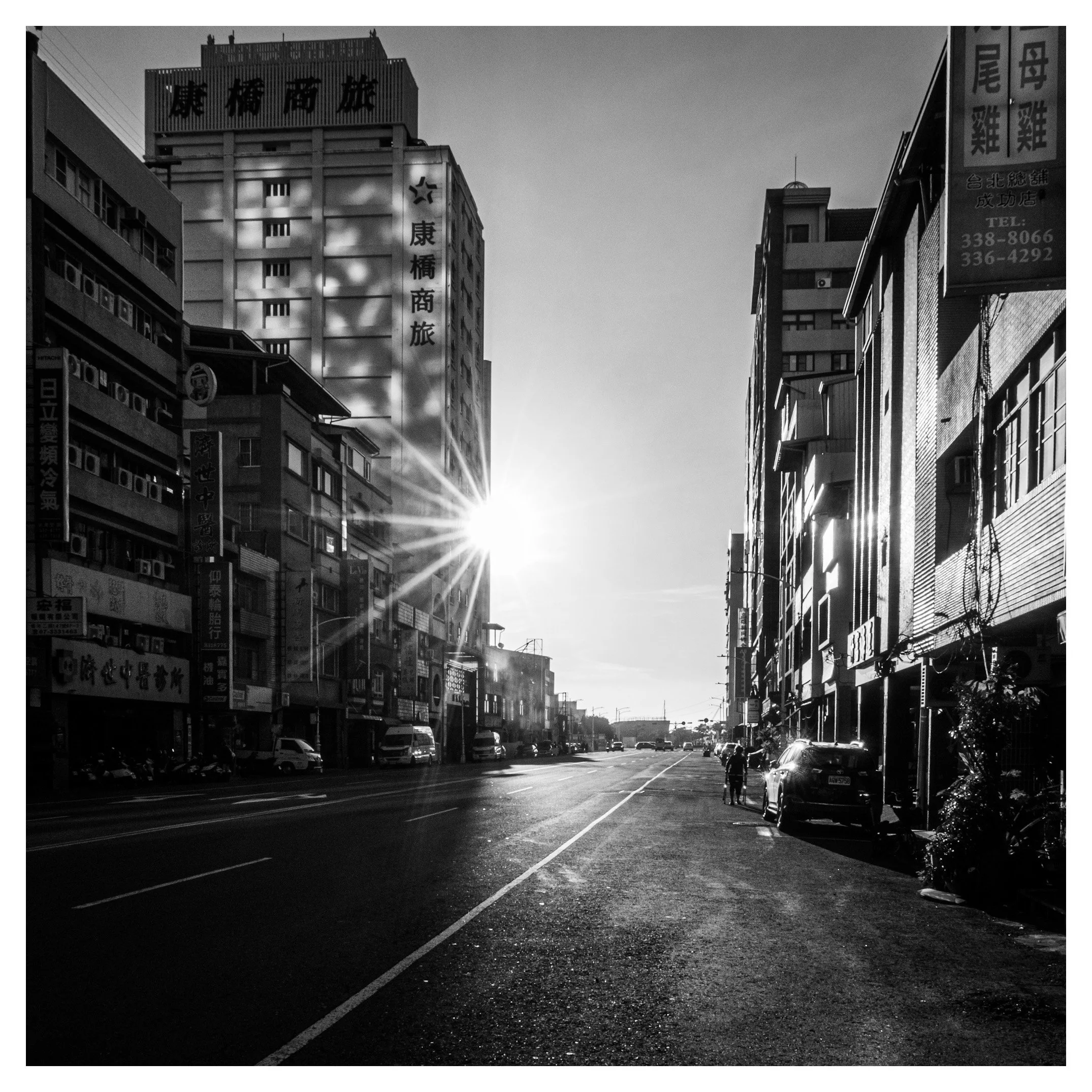
Sun-drenched canyons, long shadows, and the pulse of the city—you’ll learn why embracing "imperfect" light can be the key to unlocking a truly cinematic urban narrative.
The Technical Profile
Camera Model: Leica D-Lux 8
Shutter Speed: 1/200
Aperture: f16
ISO: 200
The Critique
This is a bold, high-contrast exploration of the urban landscape that leans heavily into the graphic potential of monochrome. By shooting directly into the sun at f16, you’ve created a magnificent "starburst" effect that acts as a secondary sun against the facade of the Kang Bridge Hotel. The long, converging shadows on the asphalt create a powerful sense of depth, pulling the viewer’s eye toward the horizon.
However, the composition feels slightly "heavy" on the left. While the hotel signage provides a strong vertical anchor, the right side of the street feels somewhat neglected by comparison. The contrast is extreme—characteristic of the "Provoke" era of Japanese photography—but it has resulted in a complete loss of detail in the deep shadows and the brightest highlights.
Refinement & Growth
To improve this specific image, I would recommend a slightly lower camera angle to emphasize the texture of the road and make the starburst feel more looming and ethereal. If your goal is to maintain the "inkiness" of the shadows while keeping some form in the highlights, consider exposing for the highlights and lifting the shadows slightly in post-processing.
Becoming a Data-Driven Photographer
To evolve, you must move beyond the "lucky shot." Start a photography log (or use the metadata in your books_database) to track your "hit rate" with specific settings.
• Analyze Your Patterns: Do you find your best starbursts happen at f11 or f16?
• The "Practice Session" Rule: Dedicate one walk a week purely to technical experimentation—shooting without the intention of keeping any photos—to master how your Leica handles extreme backlight.
Curated Inspiration
Photographers to Study
• Fan Ho: The absolute master of using dramatic light and shadows in Hong Kong’s urban alleys.
• Daido Moriyama: Look at his work for a lesson in how "rough, grainy, and blurred" (Are-Bure-Boke) can create a more emotional urban reality.
• Trent Parke: Specifically his book Minutes to Midnight, for his incredible use of "blown-out" light to create dreamlike atmospheres.
Books to Read
• Bystander: A History of Street Photography by Colin Westerbeck: This is your "bible" for understanding how the genre evolved from candid snapshots to fine art.
• Magnum Contact Sheets by Kristen Lubben: Seeing the "failed" shots before a masterpiece will teach you more about the process than any final image ever could.
Videos to Watch
• Black & White Street Photography - Alan Schaller Style: Excellent for learning how to find "pockets of light" in the city.
• Why Black & White Minimalistic Street Photography Works: A guide on seeing in tones rather than colors.