

Day 104/365 Ink & Identity: The Environmental Portrait
EXIF Data
Leica D-Lux 8
1/200
f5.6
ISO200
The Critique
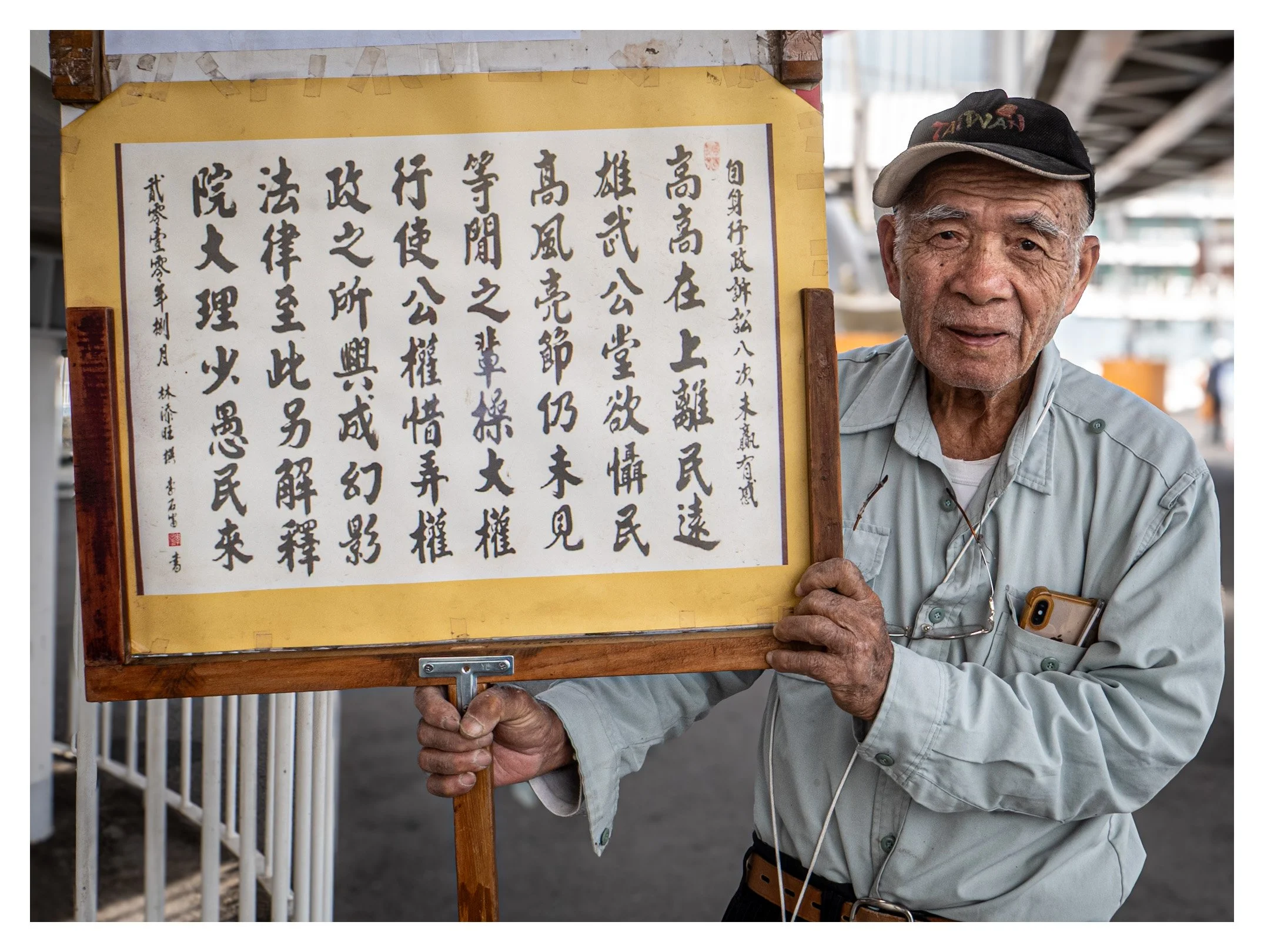
You have presented a photograph that feels instantly classic, yet distinctly grounded in its locale. The subject’s weathered face and the "Taiwan" cap provide an immediate narrative anchor, while the calligraphy board he holds acts as both a shield and a proclamation. The horizontal framing is appropriate here; it respects the width of the scroll and gives the subject space to breathe within the frame.
The lighting is the unsung hero of this image. The soft, even illumination—likely from open shade under the bridge structure—renders the details of the paper and the man’s skin with exquisite clarity, avoiding the harsh contrast that direct sunlight would create. The colors are cohesive: the yellow of the scroll complements the warm skin tones, while the cool greys of the shirt and background structure provide necessary separation.
However, the background remains the image's primary tension point. The vertical white bars of the railing on the left are visually aggressive. They mimic the vertical lines of the calligraphy text, creating a "stutter" in the visual rhythm that distracts the eye. Furthermore, the modern architectural elements in the top right corner pull the viewer away from the timeless quality of the man's face. The image hovers between a snapshot of a moment and a deliberate portrait; pushing it towards the latter requires stricter control of the environment.
Improving the Image
To refine this photograph and others like it, consider these actionable adjustments:
• Subtractive Composition: The "Taiwan" hat is a strong signifier, but the background noise dilutes it. In the future, move the subject. Rotating him just 45 degrees might have placed the darker water or a solid concrete pillar behind him, providing a cleaner canvas that would make the yellow scroll pop.
• Aperture Control: At f/5.6, you have retained detail in the background. Opening up to f/2.8 or f/1.7 (if your lens allows) would render those white railings into soft, abstract shapes, keeping the sharp focus strictly on the text and the eyes.
• The "Paused" Expression: The subject is looking at you, but he appears to be waiting for the shutter. To get a more evocative expression, keep the camera at eye level but lower it slightly from your face to maintain eye contact. Ask him to read the first line of his poem. Capture him in the act of possessing his words, rather than just displaying them.
The "Variable" Log: Compiling Data for Growth
You asked how to improve over time. The secret is not just shooting more, but analyzing why you shot. You must treat your metadata as a dataset for improvement.
I recommend creating a spreadsheet or using a notebook to log "Variables" that your camera does not record. For every 100 shots, select the best 5 and log:
1. The Distraction: What is the one thing in the frame you wish wasn't there? (e.g., "White railing," "Bright car"). Tracking this will train you to spot distractions before you click.
2. The Interaction: Scale of 1-10. Did you speak to them? Did you just smile? You will likely find your best images correlate with higher interaction scores.
3. The Anchor: What is the visual anchor? (e.g., "The Hat," "The Eyes," "The Text"). If you can't name it, the photo lacks a point.
Reviewing this data quarterly will reveal your blind spots. You might discover you consistently ignore background distractions or that your best work comes from high-interaction encounters.
Recommended Study Material
To broaden your visual vocabulary beyond the standard canon, I recommend the following photographers and books. These selections focus on the relationship between people, their environments, and their cultural markers.
Photographers to Research
• Josef Koudelka: A master of chaotic composition and exile. He photographs subjects that are often marginalized, integrating them seamlessly into complex environments. His work will teach you how to handle busy backgrounds by making them part of the story rather than a distraction.
• Bruce Davidson: Specifically his subway work. He used flash and color in gritty environments to isolate subjects, a technique you could adapt for high-contrast street situations.
• Jason Eskenazi: His work captures a sense of lost time and transition, much like the mood in your image.
Books to Read
• Gypsies by Josef Koudelka: Essential for understanding how to photograph people within their own chaotic, transient environments without losing the dignity of the subject.
• Subway by Bruce Davidson: A masterclass in using color and flash to create intense, focused portraits in cluttered public spaces.
• Wonderland: A Fairytale of the Soviet Monolith by Jason Eskenazi: This book is a journey through a changing cultural landscape. Study it for how he sequences images to tell a story of a nation in transition.
• Sentimental Journey by Nobuyoshi Araki: While often controversial, his raw, personal approach to the "daily diary" format will inspire you to document the mundane with intensity.
Videos to Watch
• Josef Koudelka: Shooting Holy Land - Watch how he moves. He doesn't just stand still; he crouches, tilts, and adjusts his body to align the background elements perfectly.
• Bruce Davidson on Street Photography - Listen to how he approaches subjects. He speaks of "entering their world," which is exactly what you did with the calligrapher.