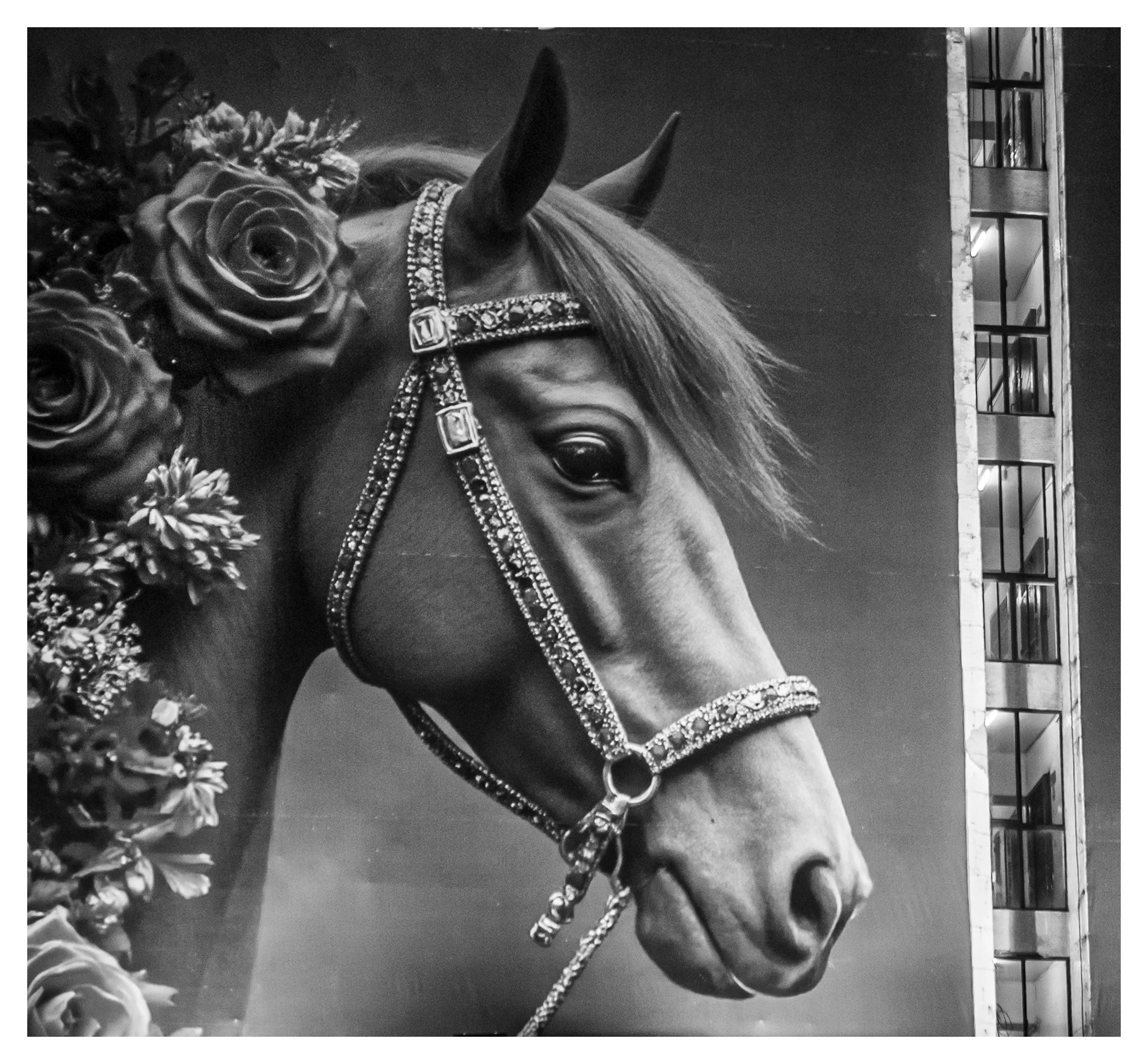
Day 103/365 The Billboard Gaze: When Advertising Meets Architecture
EXIF Data
Camera Model: Leica D-Lux 8
Shutter Speed: 1/60
Aperture: f/2.5
ISO: 250
Critique
My apologies for the earlier misreading; looking closer, the narrative here is far more interesting than a mere statue. What you have captured is a collision of realities: the "perfect," manufactured reality of the advertisement on the cladding versus the functional, utilitarian reality of the stairwell on the right.
The horse, likely a blown-up commercial print, represents a fantasy—adorned, retouched, and larger than life. It is flattened by the nature of the cladding. In stark contrast, the stairwell strip on the right offers deep, geometric shadows and the suggestion of human transit. The irony is palpable: the inanimate ad feels more "alive" and emotive than the sterile, concrete structure inhabited by actual people.
The framing, however, creates a friction that feels slightly unresolved. Because the stairwell is cut so thinly on the edge, it feels squeezed out by the dominance of the advertisement. The conversation between the flat surface (the cladding) and the deep space (the stairwell) is the strongest part of this image. To improve this, you need to give the "reality" side of the frame more weight. A 60/40 split, rather than this 90/10 split, would emphasize the encroachment of commercial imagery onto our living spaces.
Developing Your Eye: The "Meta-Data" Log
You asked how to improve over time. The secret is not just shooting, but analyzing. You must compile data on your images that goes beyond the EXIF data.
Create a spreadsheet where you log your best shots with the following columns. This is about tracking your psychology, not just your settings:
1. The Trigger: What stopped you? (e.g., "Irony," "Light," "Texture").
2. The Constraint: What was limiting you? (e.g., "Time," "Angle," "Security Guard").
3. The Vibe: What was your energy level? (e.g., "Meditative," "Aggressive," "Tired").
Over a year, you might find that your best street work happens when you are in a "Meditative" state looking for "Irony," whereas your worst shots happen when you are "Aggressive." This allows you to curate your own mindset before you even pick up the camera.
Recommendations
To deepen your understanding of how to photograph the surreal nature of urban environments and cultural landscapes, I have selected the following resources based on your style.
Photographers to Research
• Shen Chao-Liang: Since you are shooting in Taiwan, Shen is essential study. His series STAGE documents stage wagons with a focus on color and the "cultural landscape". He captures the surreal, temporary nature of entertainment structures in the night, which parallels your capture of this temporary advertisement.
• Michael Wolf: Specifically his work Tokyo Compression. Wolf mastered the art of capturing "claustrophobia" and "modernism". His work will teach you how to frame architecture (like your stairwell) not just as a background, but as an oppressive force.
• Daido Moriyama: A master of the "Provoke era," known for "gritty" and "high contrast" work. His snapshot aesthetic in A Hunter captures the chaotic texture of the city, which can help you loosen up your framing of rigid urban structures.
• Chien-Chi Chang: A Magnum photographer known for The Chain and his focus on "alienation" and "environmental portraiture". While his subjects are human, his compositions often emphasize the separation between the subject and their environment.
Books to Read
• Ravens by Masahisa Fukase. This is considered a masterpiece of "abstract" and "dark" photography. It demonstrates how to project intense personal emotion onto animal subjects, even those that are merely symbolic.
• The Chain by Chien-Chi Chang. Use this to study "alienation". Note how he places subjects within a wider context, which might help you balance your composition between the horse and the building.
• Stage by Shen Chao-Liang. This monograph focuses on "surreal" stage wagons and "night photography". It is a masterclass in photographing artificial structures that look like they don't belong in their environment.
Videos to Watch
• Daido Moriyama: The Mighty Power of the Snapshot. This video explores his wandering style and how he captures the texture of the city.
• Magnum Photos: The Art of Street Photography. Look for segments featuring Chien-Chi Chang or similar Magnum photographers to understand the concept of alienation in the frame.
• Michael Wolf on Life in Cities. Use this to understand how to photograph the density of apartment blocks and windows.