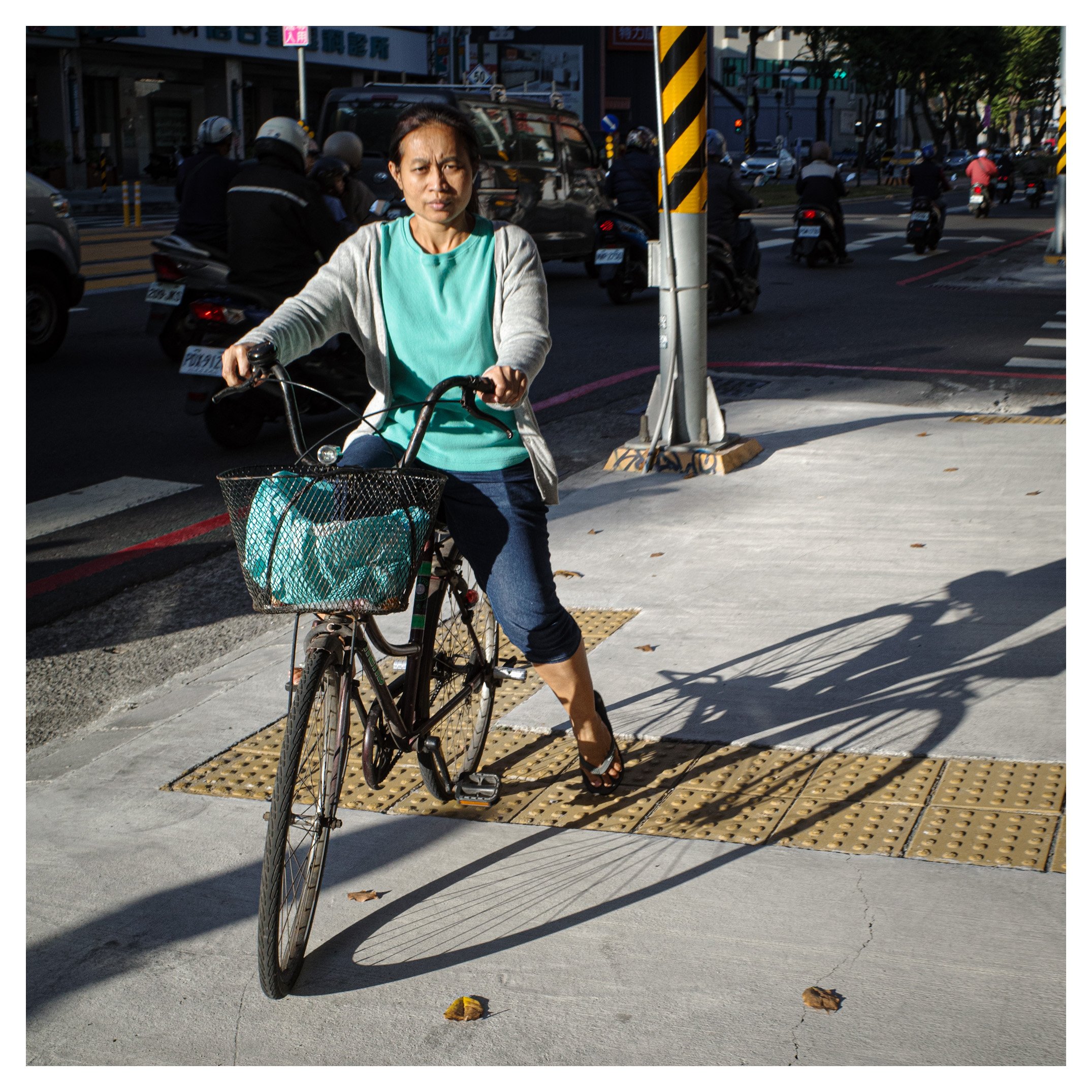
Day 107/365 Shadows of the Commute: Finding Art in the Daily Grind
EXIF Data
Camera Model: Ricoh GRIII
Shutter Speed: 1/320
Aperture: f/8
ISO: 250
The Critique
There is a profound honesty in this image that resonates with your description of a "maintenance day." Photography does not always need to be a shout; sometimes, it is a whisper of the daily routine. You have captured a moment of stillness amidst the kinetic energy of Taiwan’s traffic, and that contrast is the image's strongest asset.
The use of harsh, direct sunlight was a bold choice that paid off. The long shadow cast by the cyclist and her machine onto the tactile paving creates a secondary subject—a distorted, elongated echo of the rider herself. This shadow play anchors the composition and gives it a geometric weight that balances the organic form of the woman. Her expression, direct and unvarnished, confronts the viewer with a shared sense of urban fatigue.
However, the image suffers from a common ailment of street photography: background distraction. The scooters and vehicles behind her, while contextual, break the silhouette of her head and shoulders. In a perfect world, a slight change in your position—crouching lower to frame her against the sky or building, or stepping to the right to place her against a darker, cleaner patch of asphalt—would have isolated her more effectively. The clutter competes for attention rather than supporting the protagonist.
The Art of Data: Improving Over Time
You mentioned feeling exhausted, yet you still produced a technically competent image at f/8 and 1/320th. This is where your data becomes a goldmine for growth. By logging not just your settings, but your internal state, you can begin to see patterns in your creativity.
I recommend you add a column to your database for "Mood/Energy Level." You might discover that on low-energy days, you gravitate towards static subjects and graphic shadows (like this one), whereas high-energy days yield more complex, multi-layered candid shots. Knowing this allows you to play to your strengths. If you know you are tired, do not force yourself to hunt for fleeting moments; instead, look for the slow, architectural interactions of light and shadow, just as you did here.
Recommendations for Further Study
To refine your eye for the mundane and the chaotic, look to those who have mastered the art of the everyday.
• Chien-Chi Chang: Since you are shooting in Taiwan, his work is essential. The Chain is a masterpiece of alienation and repetition, themes that echo in your image of the solitary rider. His ability to document the human condition within the specific cultural landscape of Taiwan will serve as a primary guide for you.
• William Eggleston: For understanding how to handle color and the banal, study William Eggleston's Guide. He mastered the art of photographing "nothing" and making it look like everything, often using the dye transfer process to achieve rich, saturated colors that elevate ordinary scenes.
• Matt Stuart: On days when you feel like you are just "maintaining," Think Like a Street Photographer offers excellent mental strategies. Stuart discusses the importance of candid observation and humor, which can help you find wit in the streets even when you are tired.
• Joel Meyerowitz & Colin Westerbeck: To understand where your work fits in the grand timeline, Bystander: A History of Street Photography is the definitive academic reference. It acts as an encyclopedia of the evolution of the genre.
For a deeper dive into managing complex backgrounds and finding order in chaos, I recommend studying the work of Alex Webb. The following video explores his approach to layering and light, which will help you solve the background clutter issue in future shots.
Alex Webb: The Art of Complex Street Photography
This video is relevant because Webb is a master of separating subjects from busy urban environments, a skill that directly addresses the background distractions noted in your critique.