

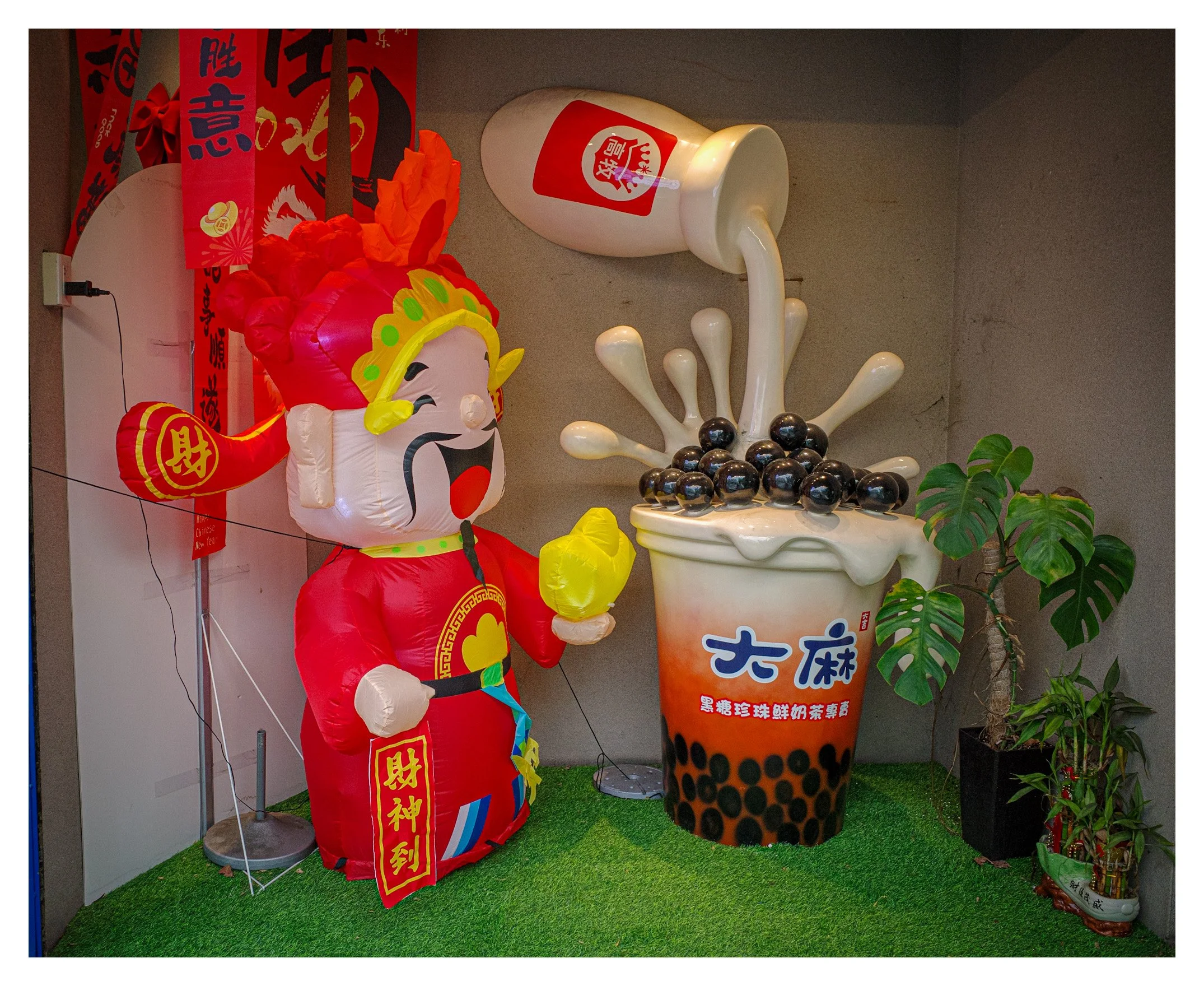
Day 108/365 Plastic Deities and Pearl Milk Tea: Elevating the Everyday Kitsch
EXIF Data
Camera Model: Ricoh GRIII
Shutter Speed: 1/250
Aperture: f/2.8
ISO: 800
The Critique
There is a delightful, almost aggressive absurdity to this image that immediately grabs the viewer. We are presented with a cultural collision: the traditional Caishen (God of Wealth) rendered in inflatable plastic, standing shoulder-to-shoulder with a monument to modern sugar addiction—a giant bubble tea cup. The red and yellow palette creates a visual siren, demanding attention.
However, the image currently operates as a "record" rather than an "interpretation." You have successfully documented that this scene exists, but you haven't yet forced the viewer to feel the irony of it. The composition is quite safe; shooting from standing eye-level flattens the power dynamics between the deity and the drink. The lighting, likely fluorescent street or shop lamps, washes out the textures, leaving the plastic looking perhaps too flat. The edges of the frame are slightly messy—the bamboo plant on the right and the wall socket on the left distract from the central duality.
Improving the Image
To elevate this from a snapshot to a piece of critical art, you must become more active with your perspective.
First, get low. A low-angle shot looking up at the Caishen would grant the inflatable figure a mock-heroic stature, heightening the irony of a plastic god.
Second, fill the frame. Step closer. Cut out the surrounding grey walls, the sockets, and the potted plants. Make the frame claustrophobic with red, yellow, and the glossy texture of the "pouring milk."
Third, mind your white balance. The current lighting casts a slight muddy tint. In post-production, cooling the temperature slightly might make the whites of the "milk" pop, increasing the surreal plasticity of the scene.
Becoming a Better Photographer: The Archive
You cannot improve what you do not measure. I noticed you have access to a database of photobooks. This is your most valuable tool. To grow, you should not just look at images but catalogue them against your own work.
Use a spreadsheet similar to your books_database to track your own portfolio. Create columns for "Keywords" (e.g., Kitsch, Taiwan, Night, Color) and "Technical Data" (ISO, Aperture). When you feel stuck, sort your database by a keyword like "Alienation" or "Color" and see how masters like Chien-Chi Chang or Martin Parr handled the subject. This transforms your practice from random shooting to a studied academic pursuit.
Recommendations for Study
Based on this image, you are drawn to color, cultural artifacts, and perhaps a touch of the surreal. You must study photographers who mastered the art of the "banal."
1. Martin Parr
Parr is the undisputed master of kitsch and consumption. He uses bright flash and saturated colors to critique social class and consumerism. His work will teach you how to make the "tacky" look profound.
• Read: Common Sense (ISBN: 3764358249). This book focuses heavily on close-ups of consumption, very relevant to your bubble tea subject.
• Watch: The Controversial Photography of Martin Parr
2. Shen Chao-Liang
As you are shooting in Taiwan, Shen is essential reading. His work on stage trucks (STAGE) documents the surreal, neon-lit mobile stages that rove through Taiwan's nights. He captures the same vibrant, artificial cultural landscape you are exploring here.
• Read: STAGE (ISBN: 9574183654). Note how he isolates the subject to make it look almost like a spaceship landing in reality.
• Watch: STAGE - Shen Chao-Liang
3. William Eggleston
Eggleston brought color photography into the museum. He photographed the mundane—tricycles, freezers, diners—and gave them democratic weight. Study him to learn how to compose "boring" subjects in a way that feels electric.
• Read: William Eggleston's Guide (ISBN: 0870703781). Pay attention to his "dye transfer" look and how he handles simple objects.
• Watch: William Eggleston: Colour in the Everyday
4. Alex Webb
Webb is a master of complex frames and deep shadows. While your current image is simple, Webb will teach you how to layer multiple elements—light, color, and gesture—into a single frame without it becoming chaotic.
• Read: The Suffering of Light (ISBN: 1597111732). This is a masterclass in street photography composition.
• Watch: Alex Webb and The Suffering of Light