

Day 112/365 The Saffron Rider: Tradition Amidst the neon
EXIF Data
Ricoh GRIII
1/125
f8
ISO 2500
The Critique
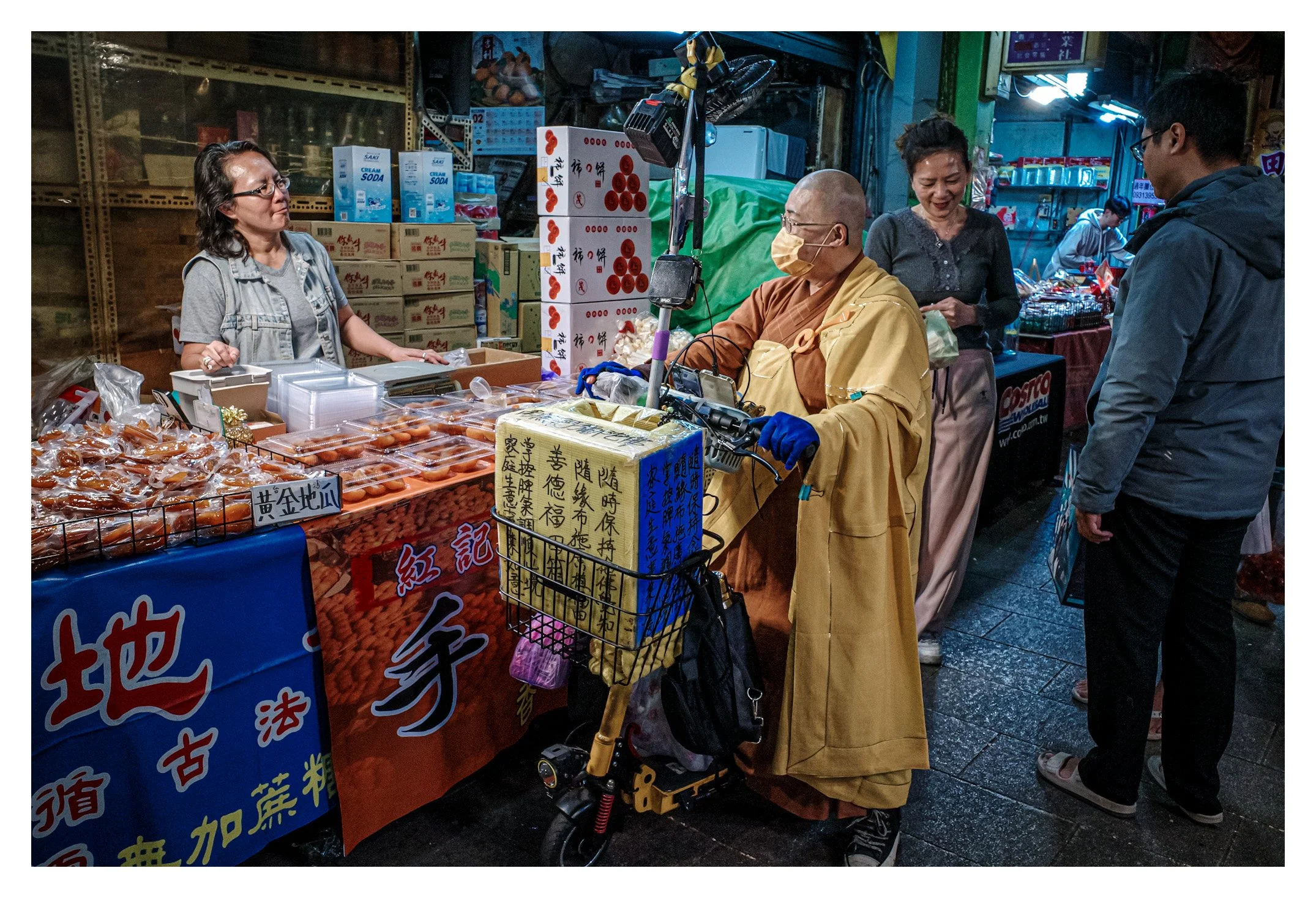
You have captured a moment that feels distinctly "Taiwan." The juxtaposition is immediate and striking: a Buddhist monk, draped in traditional saffron robes, navigating the secular chaos of a night market on a modern electric scooter. It is a collision of worlds—the spiritual and the material—that defines the island’s visual identity.
The narrative strength here lies in the details. The alms box strapped to the scooter suggests a mobile temple, a spiritual hustle that mirrors the commercial hustle of the vendor to his left. The vendor's gaze, slightly weary and directed at the monk, adds a layer of human connection. Is she judging? Is she respectful? Is she simply waiting? That ambiguity is the heart of good street photography.
Compositionally, you are working with a "maximalist" frame. There is text everywhere—on the boxes, the scooter, the tablecloths, even a "Costco" sign peeking out in the back. This visual noise creates a sense of claustrophobia that works well to convey the atmosphere of a busy market, but it also risks swallowing your subject. The blue table on the left competes heavily for attention against the monk’s robes.
Technically, your settings were prudent. f8 gave you the depth of field needed to keep both the foreground snacks and the background shoppers relatively sharp, which is essential for this kind of environmental portraiture. ISO 2500 on a GRIII introduces grain, but in this context, the grit serves the aesthetic; it feels like street photography, not a studio shot.
How to Improve This Image
1. Manage the Color Contrast
The blue tablecloth in the bottom left is luminous and saturated, pulling the eye away from the monk. In post-production, I would advise desaturating that blue channel slightly and burning (darkening) the corners. This will create a subtle vignette that forces the viewer's eye toward the center where the interaction is happening.
2. Separation is Key
The monk’s head overlaps with the white boxes behind him. In the future, a slight step to the right might have placed his head against the darker background of the green tarp, creating better figure-to-ground separation. I realize this is a fleeting moment, but developing the instinct to "sidestep" for separation is what distinguishes a snapshot from a photograph.
3. Crop for Focus
There is a figure on the far right in a blue jacket who is cut off by the frame. He adds mass but no meaning. A slight crop from the right side would remove him and tighten the relationship between the vendor and the monk.
Becoming a Better Photographer: The Data Approach
To improve over time, you must treat your photography as a dataset. You cannot simply shoot and hope.
• Create a "Keeper" Database: Tag your best images not just by location, but by lighting condition (e.g., "Mixed Artificial," "Golden Hour") and subject distance. You will likely find a pattern where your best shots occur at specific distances (e.g., 1.5 meters).
• Analyze Your Misses: Create a folder called "Almost." Why did they fail? Was the shutter speed too slow (motion blur)? Was the ISO too high (ruining shadow detail)? If you find you are consistently missing focus at f2.8, stop shooting at f2.8.
• Track Your Focal Length: The GRIII is a fixed 28mm equivalent. If you find yourself constantly cropping 50% of the image, it is data telling you that you need to get closer with your feet or switch to a 50mm focal length (like the GRIIIx).
Recommendations
To refine your eye for this kind of dense, cultural street photography, I recommend the following resources based on your style and the database you provided.
1. Photographer to Study: Shen Chao-Liang
Since you are shooting in Taiwan, Shen is essential. His work, particularly the STAGE series, deals with the surreal, colorful, and mobile aspects of Taiwanese culture. He understands how to photograph the "spectacle" of Taiwan without mocking it.
• Book: STAGE by Shen Chao-Liang
• Video: Shen Chao-Liang: Darkening/Drifting Chronicle
2. Photographer to Study: Alex Webb
Your image is full of layers and color. No one masters complex, chaotic color frames better than Magnum photographer Alex Webb. Study how he uses deep shadows to hide distractions and light to highlight subjects.
• Book: The Suffering of Light by Alex Webb
• Video: The Impossible Street Photography of Alex Webb
3. Photographer to Study: Martin Parr
For the commercial aspect—the boxes, the branding, the consumption. Parr’s work (like The Last Resort) is often satirical and flash-heavy, but his ability to frame clutter is unparalleled.
• Book: The Last Resort by Martin Parr
• Video: Martin Parr: A Visual Tribute