

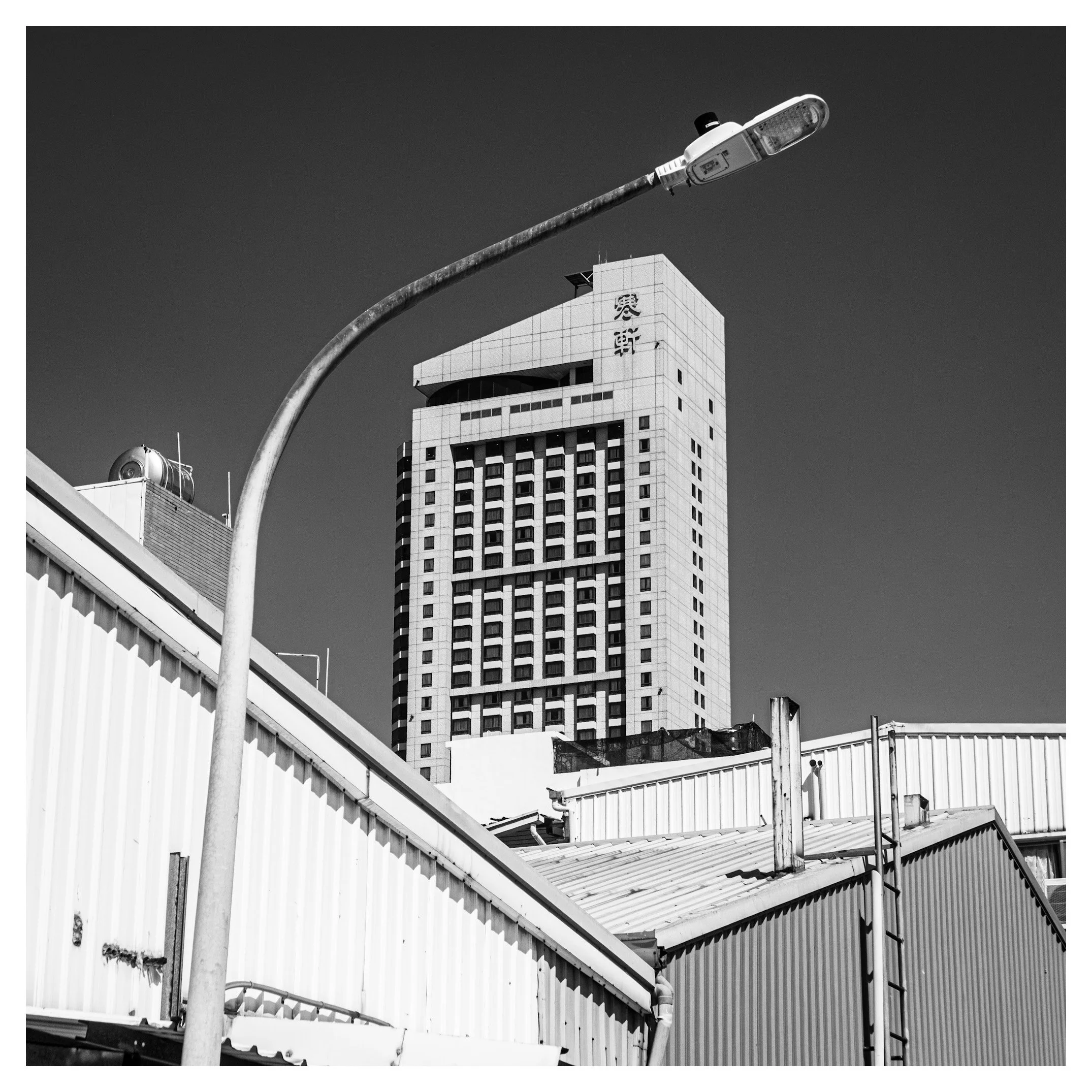
Day 113/365 The Geometric City: An Imposing Perspective on Kaohsiung
Metadata:
Camera Model: Leica D-Lux8
Shutter Speed: 1/1000
Aperture: f/5.6
ISO: 100
Hello, I am Theo Marr. As an art critic who has spent decades analyzing the nuance of photographic composition, I am thrilled to dive into your work today. Welcome to this critique for the Photos of Taiwan blog.
The Critique
Your image immediately commands attention through its aggressive use of contrast and stark geometric division. By exposing for the highlights and pushing the sky into near-total darkness, you have stripped away the distractions of weather and time, leaving the viewer to confront the pure form of the architecture. The subject, Kaohsiung's Han Hsien International Hotel designed by Kris Yao, stands as a rigid, grid-like monolith dominating the background.
What truly activates this frame, however, is the sweeping arc of the streetlamp in the foreground. This curved element serves as a brilliant visual counterpoint to the rigid vertical and horizontal lines of the skyscraper and the jagged angles of the corrugated roofing below. Your aperture of f/5.6 on the Leica D-Lux8 provides a sufficiently deep depth of field to keep these foreground and background layers in sharp relation to one another. Furthermore, the 1/1000 shutter speed freezes the scene into a quiet, almost clinical stillness, cementing the structural permanence of the city.
Areas for Improvement
While the foundational elements of your composition are strong, the framing feels slightly compressed at the top. The head of the streetlamp is uncomfortably close to the upper edge of the frame. Allowing for a bit more negative space above the lamp would give the image room to breathe and emphasize the vastness of the dark sky pressing down on the city.
Furthermore, the image is currently devoid of human presence. While this certainly highlights the architectural geometry, waiting for a solitary figure to enter the lower third of the frame could provide a necessary sense of scale and introduce a narrative element of isolation within the urban landscape. Finally, consider revisiting this location at a different time of day. The current lighting is somewhat flat on the face of the hotel; harsh morning or late afternoon light could rake across the facade, revealing deeper textures and casting dramatic shadows that break up the mid-tones.
Elevating Your Craft: The Power of Data
To truly evolve as a photographer, you must treat your image catalog as a laboratory. Compiling and analyzing data from your shoots is one of the most effective, yet underutilized, ways to identify your strengths and eliminate persistent errors over time.
Begin by meticulously tagging your images in your cataloging software—not just by location, but by technical and emotional metrics. Create a dedicated tracking document to log the correlation between your camera settings and the success rate of your images. For instance, note how often your architectural shots succeed at f/5.6 versus f/8.
Track the time of day, weather conditions, and the specific composition techniques you employed, such as the rule of thirds, leading lines, or framing within a frame. By reviewing this data quarterly, you will notice distinct patterns emerge. You may find that your most resonant black-and-white work consistently occurs during bright, harsh midday sun, or when utilizing specific geometric juxtapositions. This analytical approach transforms intuition into a repeatable, masterable skillset.
Further Study
Photographers to Research
I highly recommend studying the work of Fan Ho, whose mastery of light, shadow, and geometric composition in urban environments is unparalleled. Additionally, look into Michael Wolf's architectural photography to see how he isolates building facades to create intense, pattern-driven visual statements.
Recommended Reading
To deepen your understanding of visual structure and narrative, I suggest adding these essential texts to your library:
• Tokyo Compression by Michael Wolf. This book is excellent for studying modern urban claustrophobia.
• The Americans by Robert Frank. This explores the concept of the outsider and the USA road trip.
• Decisive Moment by Henri Cartier-Bresson. This is considered a bible for understanding time and geometry in photography.
Videos to Watch
• Pro Photo Critiques - Steve Carty provides excellent deep dives into visual creation, framing techniques, and professional-level evaluation.
• Small Adjustments For BIG Results - William Patino offers a great breakdown on how to make tonal ranges pop, which is absolutely crucial for mastering high-contrast black and white imagery.
Would you like me to analyze another image from your Kaohsiung portfolio using these same compositional metrics?
Sean Tucker's AI Street Photography Critique
This video provides valuable insight into the critique process for street photography and discusses how to objectively evaluate the effectiveness of your own compositions.