

Day 117/365 Chasing the Intersecting Lines: A Lesson in Urban Geometry
Technical Breakdown
Camera Model: Leica D-Lux 8
Shutter Speed: 1/320
Aperture: f/8
ISO: 500
The Critique: Balance in the Chaos
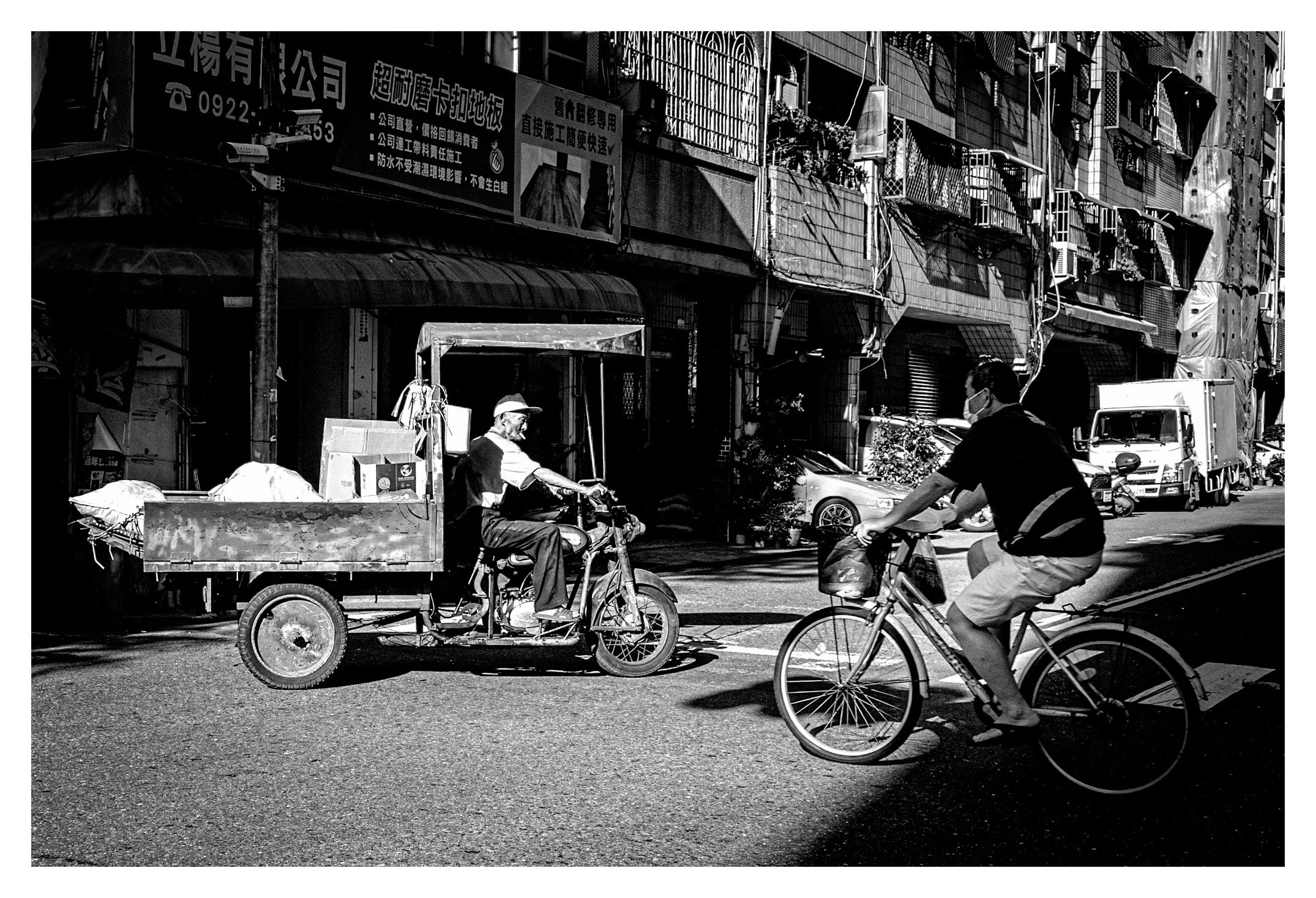
This image captures a quintessentially Taiwanese moment—the friction between the old-world labor of the motorized trike and the modern, everyday commuter on a bicycle. The high-contrast monochrome conversion emphasizes the grit of the street, turning the messy background into a series of textures and patterns.
The "collision" point in the composition is where the strength lies. The diagonal line created by the shadow in the foreground acts as a stage, highlighting the cyclist just as he enters the light. However, the frame feels a bit tight on the left; giving the trike more "room to drive" into the frame would enhance the sense of motion. The f/8 aperture was a wise choice here, ensuring that the signage and the architectural details remain sharp, providing vital cultural context to the scene.
How to Improve Your Vision
• Anticipate the Intersection: When you find a strong background like this, "fish" for your subject. Wait for two subjects to overlap or mirror each other. The tension here is good, but a moment later, when their wheels might have aligned with the vertical lines of the building, would have been sublime.
• Manage Your Highlights: In harsh daylight, be careful with pure whites. The bags on the trike are slightly blown out. Lowering your exposure by 1/3 of a stop might preserve those details, allowing the Leica's sensor to capture the subtle textures of the fabric.
Becoming a Better Photographer Through Data
To grow, you must move beyond just taking photos and start curating them. I recommend building a personal database (using tools like Notion or even a specialized spreadsheet) to track your work.
• Tag by Intent: Don't just track EXIF data; tag images by "Mood," "Success Level," and "Missed Opportunity."
• Analyze Your Patterns: Do you always shoot at f/8? Try a month at f/1.7 to force yourself to think about depth.
• The "Kill Your Darlings" Audit: Every quarter, look at your top 20 images. Identify the common thread. Is it the light? The geometry? Double down on that strength in your next session.
Study the Masters
To refine your eye, look to those who mastered the "organized chaos" of the street:
• Photographers to Research: * Fan Ho: For his unparalleled use of dramatic shadows and geometric urban scales in Hong Kong.
• Alex Webb: For his mastery of complex, layered compositions where multiple stories happen in a single frame.
• Books to Read: * The Decisive Moment by Henri Cartier-Bresson: The "Bible" for understanding timing and geometry.
• Magnum Contact Sheets: To see the mistakes and the "near misses" that lead to a masterpiece.
• Videos to Watch:
• How Alex Webb Turns Chaos Into Art
This video provides a deep dive into how to manage multiple subjects and complex lighting, which is a perfect next step for your work in Taiwan.