

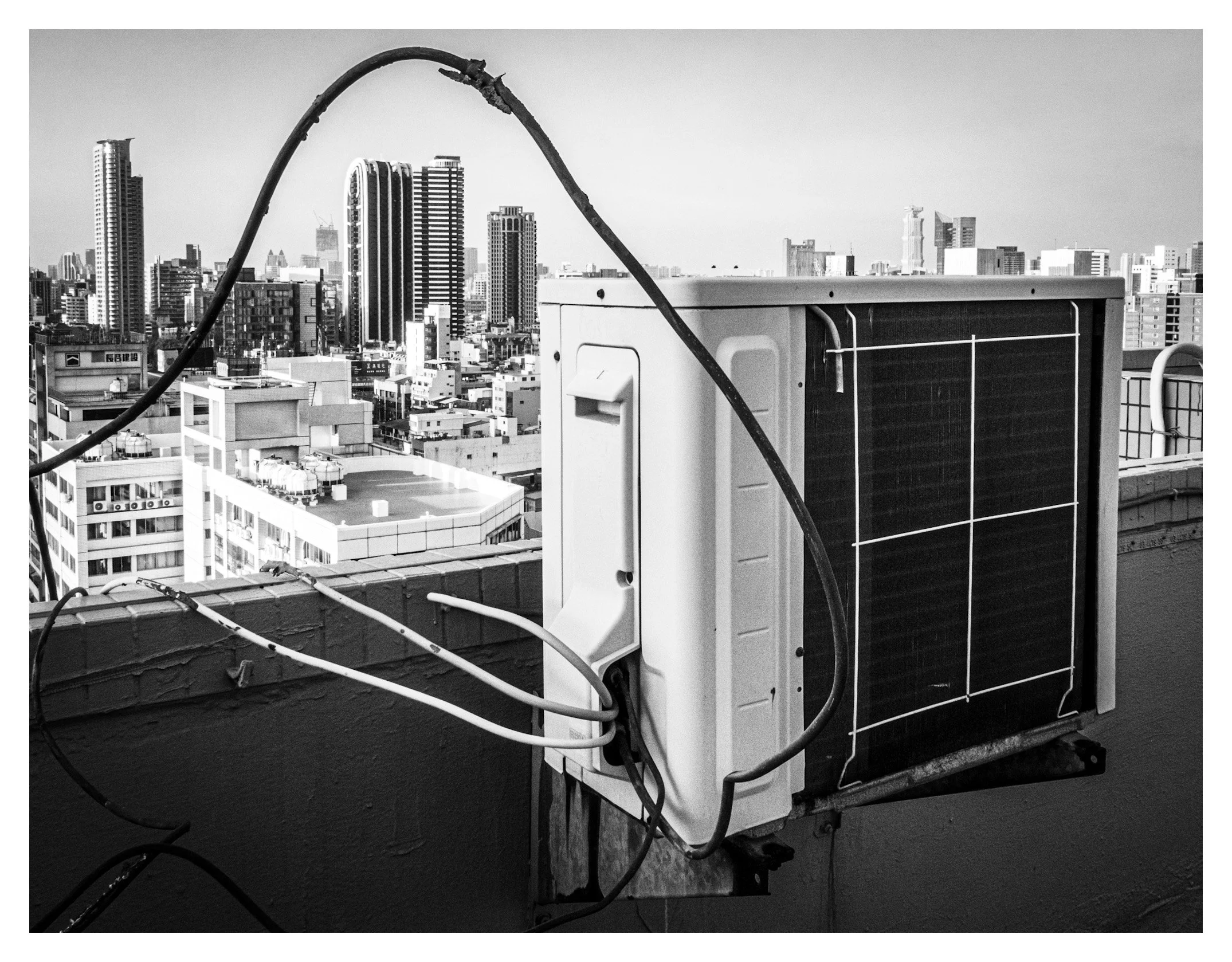
Day 118/365 The Steel Pulse: A Monochrome Study of Kaohsiung’s Industrial Geometry
EXIF Data
Camera Model: Leica D-Lux8
Shutter Speed: 1/125
Aperture: f16
ISO: 1000
The Critique
There is an undeniable, heavy humidity in the air of Kaohsiung that often translates into a beautiful, atmospheric haze when viewed against the city’s tiered skyline. In this frame, you have successfully leveraged that southern grit. By selecting a high-contrast black and white treatment, you’ve transformed a mundane rooftop air conditioning unit into a monumental industrial anchor. The arched cable serves as a brilliant "frame within a frame," a technique often associated with the geometric precision found in Henri Cartier-Bresson’s The Decisive Moment.
The choice of f16 has kept the entire scene in sharp focus, from the mechanical textures of the cooling fins to the distant skyscrapers of Lingya District. However, shooting at ISO 1000 has introduced a digital grain that, while adding to the "raw" aesthetic, threatens to muddy the finer architectural details in the background. It is a bold, "Provoke" style reminiscent of Daido Moriyama’s A Farewell to Books.
Advice for Improvement
To take this urban study to the next level, I suggest focusing on "Environmental Purity":
• ISO Management: Given the strong daylight, try to bring your ISO down to 100 or 200. This would preserve the micro-contrast in the skyline while keeping the blacks of the machinery deep and clean.
• Perspective Shift: A slightly lower angle would allow the AC unit to tower over the city, emphasizing the theme of human industry supporting the urban sprawl.
• Temporal Texture: Shooting during the "Golden Hour" would cast long, horizontal shadows through the cooling fins, adding a layer of rhythmic geometry to the foreground.
Mastering Your Visual Database
Your existing database reveals a sophisticated interest in themes of alienation and cultural landscapes. To truly evolve, you should use your tracking data to bridge the gap between technical settings and artistic intent:
1. Contextual Linking: When you shoot in Kaohsiung, reference the work of Chien-Chi Chang. His seminal work The Chain was documented right here in Greater Kaohsiung at the Long Fa Temple. Compare your urban "alienation" to his humanitarian perspectives.
2. Keyword Correlation: Your database already tracks terms like "claustrophobic" and "grit". Start tagging your own shots with these keywords to see if your technical choices (like high ISO or f16) are consistently supporting your intended mood.
3. Process Analysis: Study the "behind the scenes" methodology in Kristen Lubben’s Magnum Contact Sheets to learn how to "work" a rooftop scene before committing to a single frame.
Recommended Research
Photographers to Study
• Chien-Chi Chang: Focus on his use of framing to depict the tension between subjects and their environments, particularly in his Taiwan-based series.
• Michael Wolf: His Tokyo Compression series is the gold standard for finding beauty in the dense, modern "clutter" of Asian megacities.
• Fan Ho: For a masterclass in how to use light and shadow to simplify complex urban streets into poetic, monochrome geometry.
Books to Read
• A Farewell to Books by Daido Moriyama: Study this for its embrace of "grit" and high-contrast urban energy.
• STAGE by Shen Chao-Liang: An essential look at the "cultural landscape" of Taiwan through a highly stylized lens.
• Bystander: A History of Street Photography by Colin Westerbeck: This provides the academic foundation every street photographer needs to understand the evolution of the genre.
Videos to Watch
• Fan Ho: The Art of Light, Shadow, and Humanism – A deep dive into how he transformed Hong Kong's streets into cinematic art.
• Daido Moriyama: The Photographer Who Didn't Look Through the Viewfinder – Explore the radical "Provoke" era techniques that align with your current high-contrast style.
• Chien-Chi Chang: Chinatown and Beyond – An interview with the Magnum master on immersion and documenting the invisible worlds of his subjects.