

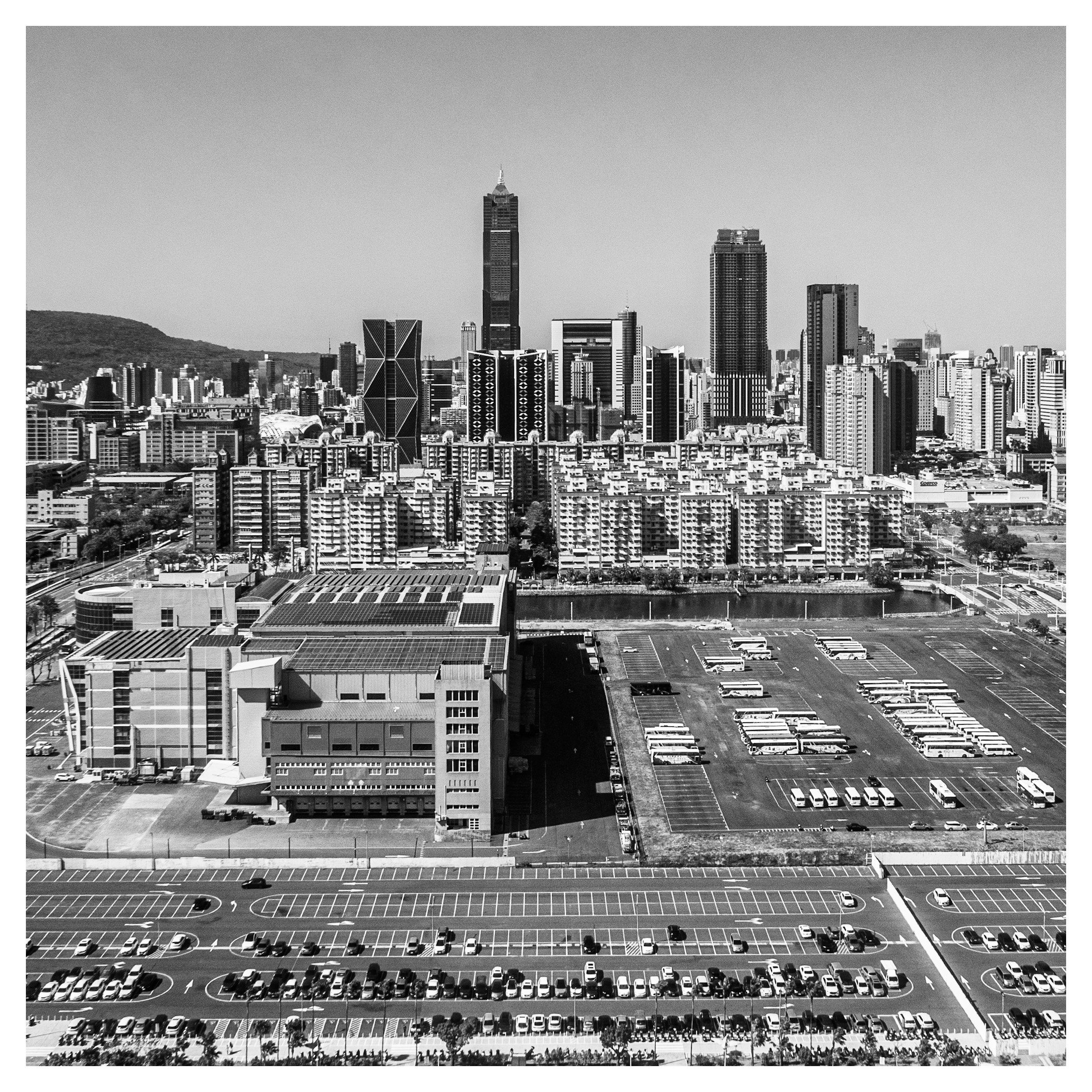
Your capture from the Kaohsiung Eye offers a compelling, high-altitude perspective of Taiwan’s maritime capital. By choosing a monochrome treatment, you’ve stripped away the distractions of city haze and colorful signage, forcing the viewer to engage directly with the structural rhythm of the city.
Technical Data
Camera Model: Leica D-Lux 8
Shutter Speed: 1/500
Aperture: F8
ISO: 200
Critical Analysis and Improvements
This image succeeds in its layered compression. The foreground parking lot provides a grounding, repetitive pattern that leads the eye toward the mid-ground residential blocks, finally culminating in the iconic 85 Sky Tower.
However, to elevate this from a documentary cityscape to a fine-art architectural study, consider the following:
• Mind the Mid-tones: While the black and white conversion is clean, the middle of the frame feels a bit "gray." To add drama, I recommend increasing the local contrast in the skyscraper textures. In post-processing, use a graduated filter to slightly darken the sky, which will make the silhouettes of the towers pop against the horizon.
• The "Dead" Space: The large, empty parking area in the lower third is a double-edged sword. It provides scale, but it lacks a singular "hero" element. If you can return at a different time, look for a moment when the light creates long, diagonal shadows across those parking lines—this would add a third dimension to an otherwise flat plane.
• Lens Compression: Shooting at F8 was a wise choice for maximum sharpness across the depth of field, but at this distance, atmospheric haze can still soften your background. A slight increase in "Dehaze" or "Clarity" specifically on the 85 Sky Tower would give the image a sharper focal point.
The Path to Mastery
To grow as a photographer, you must move beyond taking "good shots" and begin building a visual vocabulary.
1. Compiling Your Personal Database
Start a "Shooting Diary" alongside your digital archives. For every session, note not just the EXIF data, but the environmental conditions.
• Did you feel the F8 was too sharp, or did it lack the "dreamy" quality you wanted?
• Over six months, look for patterns: Do your best images consistently happen at a certain ISO or time of day?
Compiling this data turns "luck" into a repeatable process.
2. Photographers to Study
• Fan Ho: Look at how he used shadows and light in 1950s Hong Kong to turn urban chaos into minimalist masterpieces.
• Michael Wolf: Specifically his Architecture of Density series. It will change how you look at high-rise buildings and repetition.
• Bernd and Hilla Becher: For their "Typologies." They photographed industrial structures with a clinical, grid-like precision that matches your interest in urban geometry.
3. Recommended Reading
• "The Decisive Moment" by Henri Cartier-Bresson: The bible of timing and composition.
• "Genesis" by Sebastião Salgado: To see how grand-scale landscapes and cityscapes can maintain an emotional heartbeat in black and white.
4. Essential Viewing
• The Art of Black and White Photography (B&H Event Space): Watch here — This explores the philosophy behind seeing in monochrome.
• Architectural Photography Masterclass: Watch here — Focuses on how to use leading lines and perspective in a city environment.