

Day 146/365 Nocturnal Symmetries: A Critique of Urban Isolation at Weiwuying
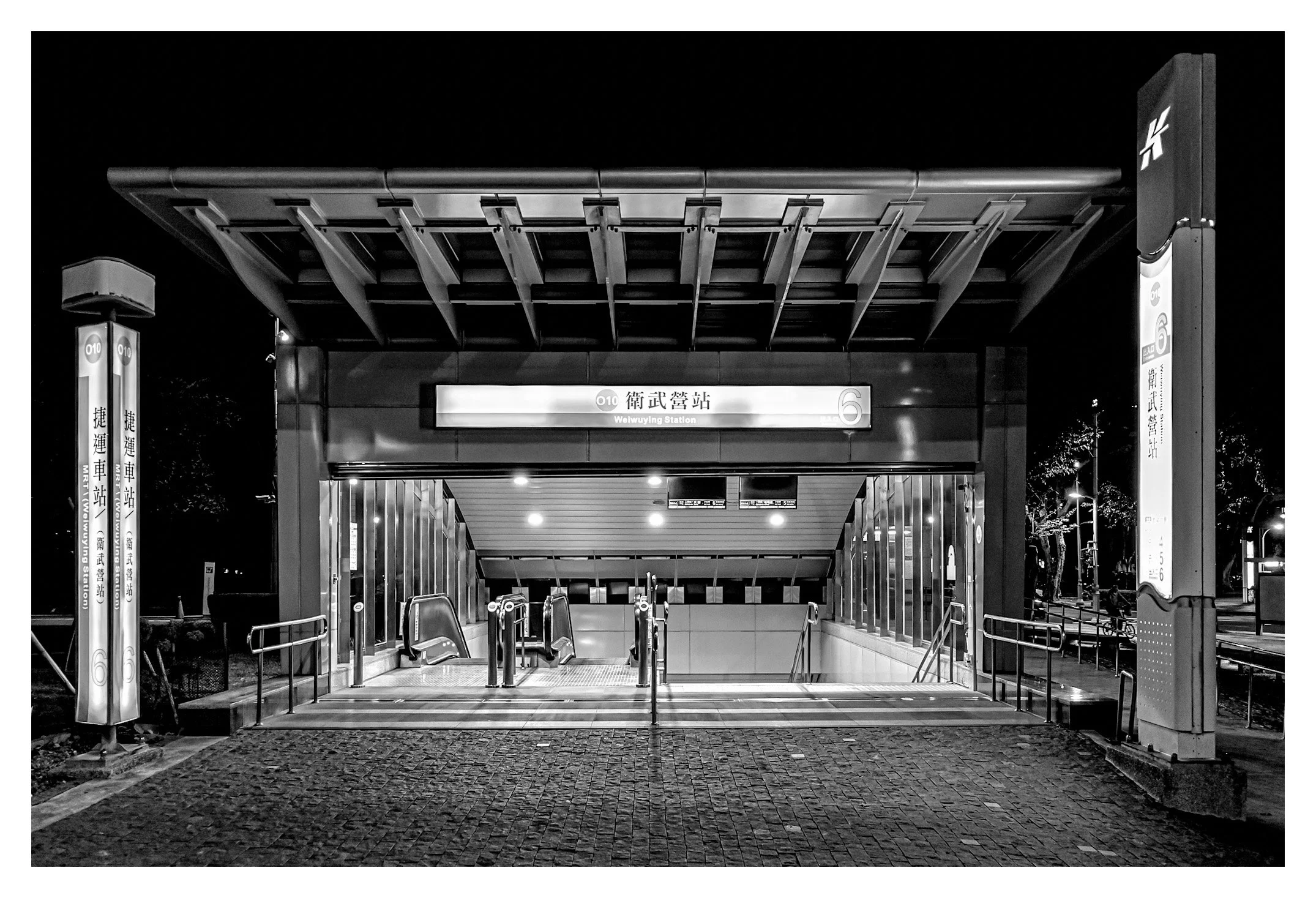
Step into the stark contrast of Kaohsiung's nightscape. In this critique, we examine a striking monochromatic capture of the Weiwuying MRT station, exploring how symmetry and shadow shape urban narratives. You will discover actionable advice on refining architectural street photography and learn why tracking your creative data is essential for long-term growth.
Metadata
Camera Model: Ricoh GRIII
Shutter Speed: 1/50 sec
Aperture: f/2.8
ISO: 800
Critique
Hello there. Theo Marr here. It is always a pleasure to dissect a photograph that immediately asserts its presence, and your shot of Weiwuying Station’s Entrance 6 does exactly that. The first thing that strikes me is the rigorous, almost unrelenting symmetry. By placing yourself dead center, you have allowed the leading lines of the staircase and the sweeping canopy to draw the eye inexorably downward into the illuminated subterranean mouth of the station.
Your choice to render this in high-contrast black and white strips away the distraction of color, distilling the scene into pure geometry. It feels less like a functional transit hub and more like a cinematic stage waiting for an actor.
However, that is precisely where the image falters slightly—it is a stage without a player. While the architectural bones are magnificent, the photograph borders on the clinical. It is a technically proficient document, but it lacks a "punctum"—a focal point of human interest or anomaly to break the rigid perfection and inject narrative tension. Furthermore, at 1/50th of a second, your shutter speed was just slow enough that you ran the risk of motion blur if a human subject had actually appeared, even though the static structure itself is sharp. The highlights on the station's glowing signage are also teetering on being blown out, which flattens the texture in the brightest areas of your frame.
How to Improve
To elevate this from a mere architectural record to a compelling piece of street photography, you need the variable of life. Patience is your greatest tool here. Frame this exact composition, lock your focus, and wait. Wait for a solitary commuter to emerge from the depths, casting a long shadow, or for a stray animal to trot across the foreground. The introduction of an organic, unpredictable element will provide a profound counterpoint to the cold, rigid steel and concrete.
Additionally, I recommend exposing for your highlights. Underexpose slightly in-camera so the signage remains entirely legible, and then gently lift the shadows in post-production. The GRIII has a phenomenal dynamic range; use it to your advantage. If you plan to include moving subjects in night scenes, consider raising your ISO slightly higher than 800 to achieve a faster shutter speed, freezing the action more effectively.
Tracking Data to Become a Better Photographer
To become a master of your craft over time, you must become a student of your own habits. I advise you to compile a dedicated spreadsheet for your photographic outings to track your evolution.
Track the hard data: date, location, camera model, focal length, shutter speed, aperture, and ISO. But more importantly, track the soft data: the time of day, the quality of light, your emotional intent behind the shot, and whether the final image met your expectations.
Over months and years, patterns will emerge. You may discover that your most resonant architectural work happens at f/8 on overcast days, or that your night photography consistently suffers from missed focus at wide apertures. Data removes ego from the equation, allowing you to objectively identify your technical weaknesses and double down on your creative sweet spots.
Recommendations
Photographers to Research:
• Shen Chao-Liang: His work, particularly the STAGE series, focuses heavily on Taiwan and night photography. It is an excellent study of the cultural landscape.
• Fan Ho: The undisputed master of dramatic light, shadow, and architectural scale in monochrome.
• Sean Tucker: A contemporary photographer who brilliantly merges philosophy with the mechanics of capturing light and shadow in urban environments.
Books to Read:
• Portrait of Hong Kong by Fan Ho features classic composition. It focuses on monochrome photography and the masterful use of shadow.
• The Decisive Moment by Henri Cartier-Bresson is an essential text. It will teach you how to master geometry and time.
• Contact Sheets by Kristen Lubben dives into the photographic process. It offers a behind the scenes look at how great photographers select their final frames.
Videos to Watch:
• Fan Ho | the art of light, shadow, and humanism: https://www.youtube.com/watch?v=tjQNFr4FCfI
• Embrace your Shadows: A lesson for Light and Life by Sean Tucker: https://www.youtube.com/watch?v=lBAFTR2lScY