

Day 147/365 Curving Time at Weiwuying: A Study in Urban Isolation
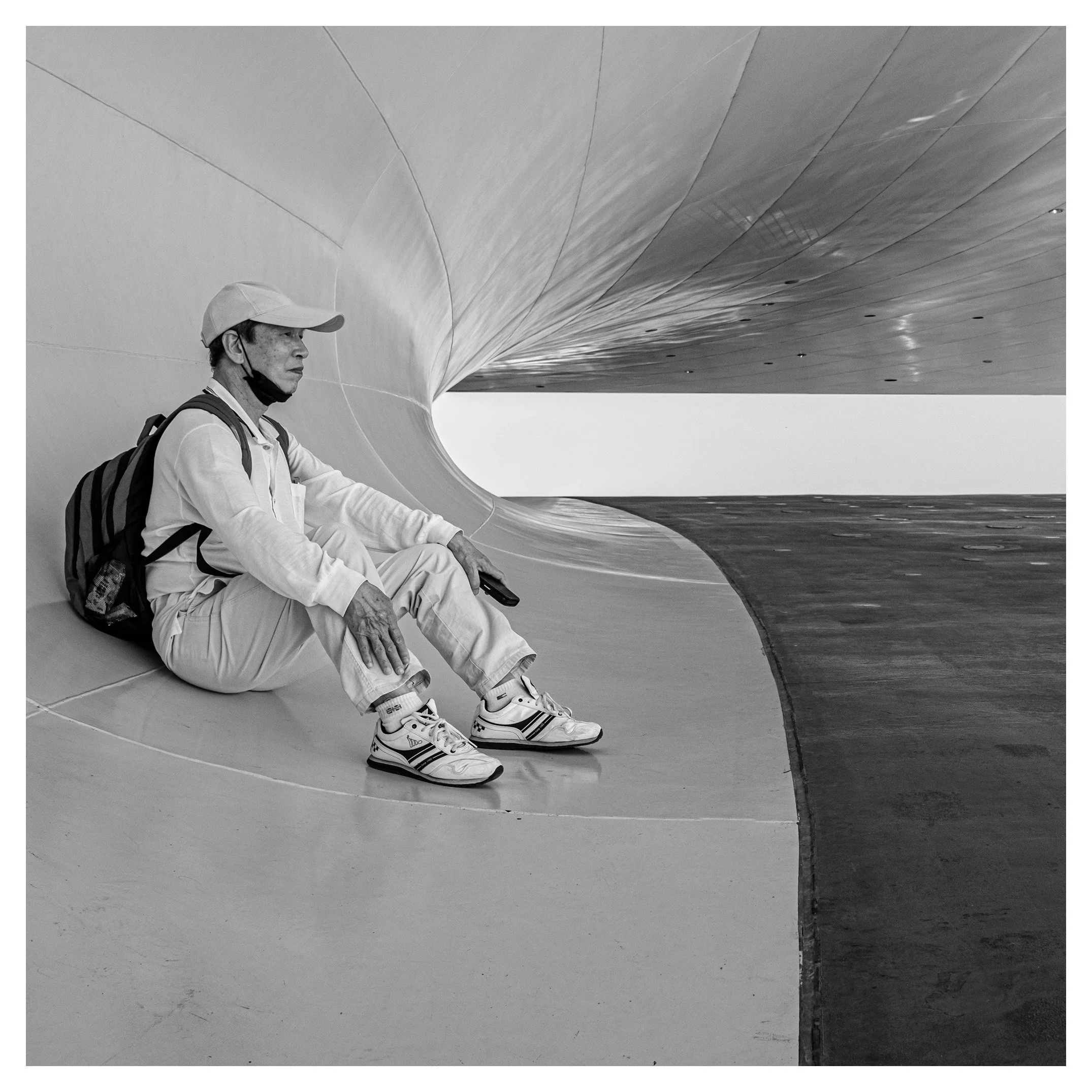
Beneath the sweeping white canopy of Kaohsiung’s architectural marvel, a single traveler pauses. But is this a simple rest, or a profound intersection of geometry and the human spirit? Discover how the tension between futuristic curves and everyday reality creates a narrative that transcends the typical travel snapshot.
Technical Specifications
Camera Model
Fujifilm X-Pro2
Shutter Speed
1/400
Aperture
f/5.6
ISO
200
The Critique: Perspective and Form
In this frame, you have successfully utilized the dramatic architecture of the Weiwuying Center for the Arts to create a sense of scale and futuristic solitude. The choice of monochrome is particularly effective here; it strips away the potential distraction of the structure’s artificial lighting, focusing the viewer entirely on the interplay of light, shadow, and leading lines.
The curve of the wall acts as a powerful compositional tool, drawing the eye from the subject’s back deep into the vanishing point of the architecture. There is a poignant contrast between the subject’s utilitarian gear—the backpack, the sneakers, the face mask tucked under the chin—and the fluid, almost organic smoothness of the building. It suggests a moment of modern stillness within a high-speed world.
Refinement and Improvement
To elevate this work, consider the following adjustments:
• Tonal Depth: While the composition is strong, the mid-tones in the subject’s clothing are slightly flat. Increasing the local contrast (Clarity) or deepening the blacks in the subject’s backpack would help separate him further from the white background.
• Spatial Breathing Room: The subject’s feet are quite close to the bottom edge of the frame. In architectural portraiture, providing a bit more "floor" can ground the subject more firmly within the environment.
• The "Decisive" Gesture: The subject holding a phone adds a contemporary touch, but the hand position is somewhat ambiguous. Waiting for a more intentional gesture—perhaps looking directly into the "eye" of the curve or adjusting his cap—could add a layer of narrative intentionality.
Growth through Data and Curation
Becoming a master of the craft requires more than just a keen eye; it requires rigorous self-analysis. Start a Digital Contact Sheet practice. Instead of just saving your final edits, archive the frames immediately before and after the "hero" shot.
Analyze your data to find patterns: Are you consistently shooting at f/5.6? Try pushing to f/11 for deeper structural detail or f/2 for isolation. If your metadata shows you favor the 10mm end of your lens, challenge yourself to shoot an entire session at 24mm to see how it forces you to re-evaluate your distance from the subject.
Curated Recommendations for the Aspiring Eye
To further your development, I recommend immersing yourself in the following masters and resources:
Photographers to Study
• Fan Ho: For his unparalleled mastery of shadows and light within urban environments.
• Chien-Chi Chang: Study his "The Chain" series to understand how he captures alienation and the human condition in Taiwan.
• Trent Parke: Look at "Minutes to Midnight" to see how high-contrast monochrome can turn a street scene into something dreamlike.
Literature for the Library
• The Decisive Moment by Henri Cartier-Bresson: The foundational text for timing and geometry in photography.
• Bystander: A History of Street Photography by Joel Meyerowitz: An essential reference for the evolution of the genre.
• Thoughts on Solo Photography: For a philosophical approach to the craft and the wisdom of the lens.
Visual Learning
• The Art of Photography - The Decisive Moment: A deep dive into composition and timing.
https://www.youtube.com/watch?v=hy00v_v0GTo
• Joel Meyerowitz - What makes a great picture?: Insights from a master on the "frozen" moment.