

Day 148/365 The Geometry of Absence: Finding Stillness in Motion
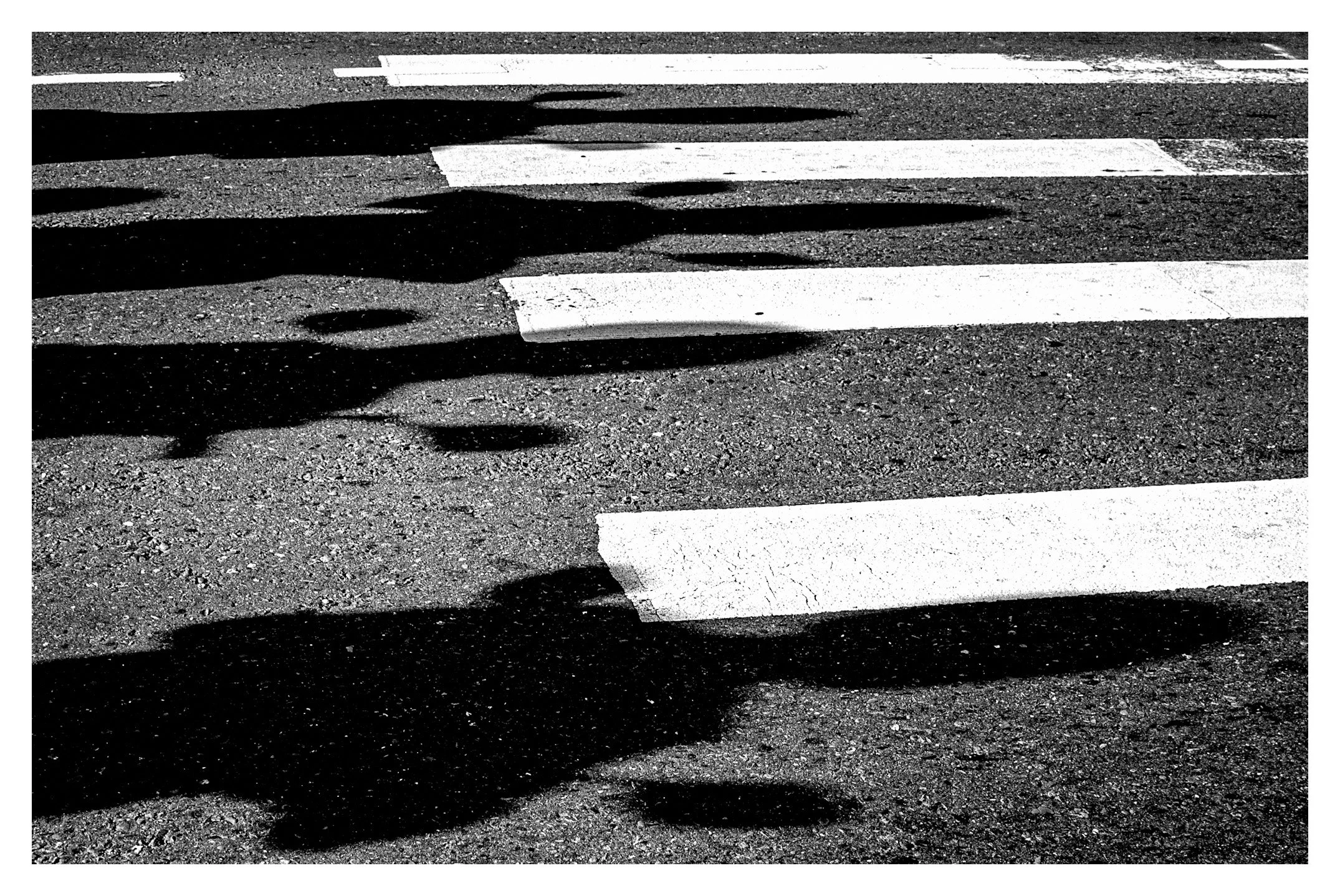
Street photography often focuses on the face, but what happens when we look only at the ground? Discover how a simple crosswalk in Taiwan becomes a canvas for high-contrast abstraction. You’ll learn why intentional "looking down" might be the key to unlocking a more sophisticated, graphic eye in your urban compositions.
EXIF Data
Camera Model: Ricoh GRIII
Shutter Speed: 1/320
Aperture: f8
ISO: 640
The Critique: An Exercise in High-Contrast Minimalism
This image is a masterclass in seeing the world as a series of graphic weights rather than literal subjects. By utilizing a high-contrast black-and-white treatment, you have stripped the street of its mundane clutter, leaving behind a rhythmic, percussive interplay between the white paint of the crosswalk and the elongated, anamorphic shadows of pedestrians.
The strength of this frame lies in its compression and abstraction. The shadows act as ink blots, reminiscent of Rorschach tests, which force the viewer to reconstruct the human form from darkness alone. The texture of the asphalt provides a necessary grit that balances the blown-out purity of the white stripes. Using the f8 aperture was a wise choice here, ensuring that the granular detail of the road surface remains sharp from edge to edge, grounding the ethereal nature of the shadows in a tangible reality.
Paths to Improvement
To elevate this specific study, I would suggest experimenting with timing and layering. While the current rhythm is strong, waiting for a "punctum"—a moment where a shadow interacts uniquely with a stripe (perhaps a hand reaching into a white space or a shadow perfectly bisected)—can add a narrative anchor to the abstraction.
Additionally, pay close attention to your black point. In this digital age, it is easy to "crush" blacks until all detail is lost. While that works for this graphic style, ensuring there is just a hint of tonal variation in the deepest shadows can add a sense of three-dimensional volume to what is currently a very flat, though effective, image.
Becoming a Master through Data
To improve over time, you must become a scientist of your own habits. I recommend maintaining a digital "Contact Sheet Diary" where you tag images not just by location, but by Compositional Intent.
• Audit your focal lengths: Since you are using the GRIII's fixed 28mm equivalent, track how often you crop in post-production. If you find yourself cropping 50% of your shots, it is a sign you need to physically move closer to your subjects.
• Light Mapping: Categorize your best shots by the "Sun Angle." You will likely find a data-backed preference for the long shadows of early morning or late afternoon, which will help you schedule your shoots more effectively.
Recommended Research
Photographers to Study
• Fan Ho: Look at his work "Portrait of Hong Kong." He was a grandmaster of using shadows and geometric light to create cinematic drama in urban environments.
• Ray K. Metzker: His "Composites" and street work will show you how to push the boundaries of high-contrast abstraction and architectural rhythm.
• Trent Parke: Specifically his "Minutes to Midnight" series. He uses the harsh Australian sun to turn pedestrians into silhouettes of light and dark.
Required Reading
• The Decisive Moment by Henri Cartier-Bresson: The definitive text on geometry and timing in photography.
• Bystander: A History of Street Photography by Joel Meyerowitz and Colin Westerbeck: This will provide the historical context of why we look at the street the way we do.
Watch and Learn
• The Genius of Fan Ho - A deep dive into how he utilized light and shadows.
• The Photography of Daido Moriyama - To understand the "Provoke" era's approach to grit, grain, and high contrast.
• Masters of Photography: Henri Cartier-Bresson - On the importance of the "internal geometry" of a frame.