

Day 155/365 The Urban Familiar: Capturing the Spirit of QQ
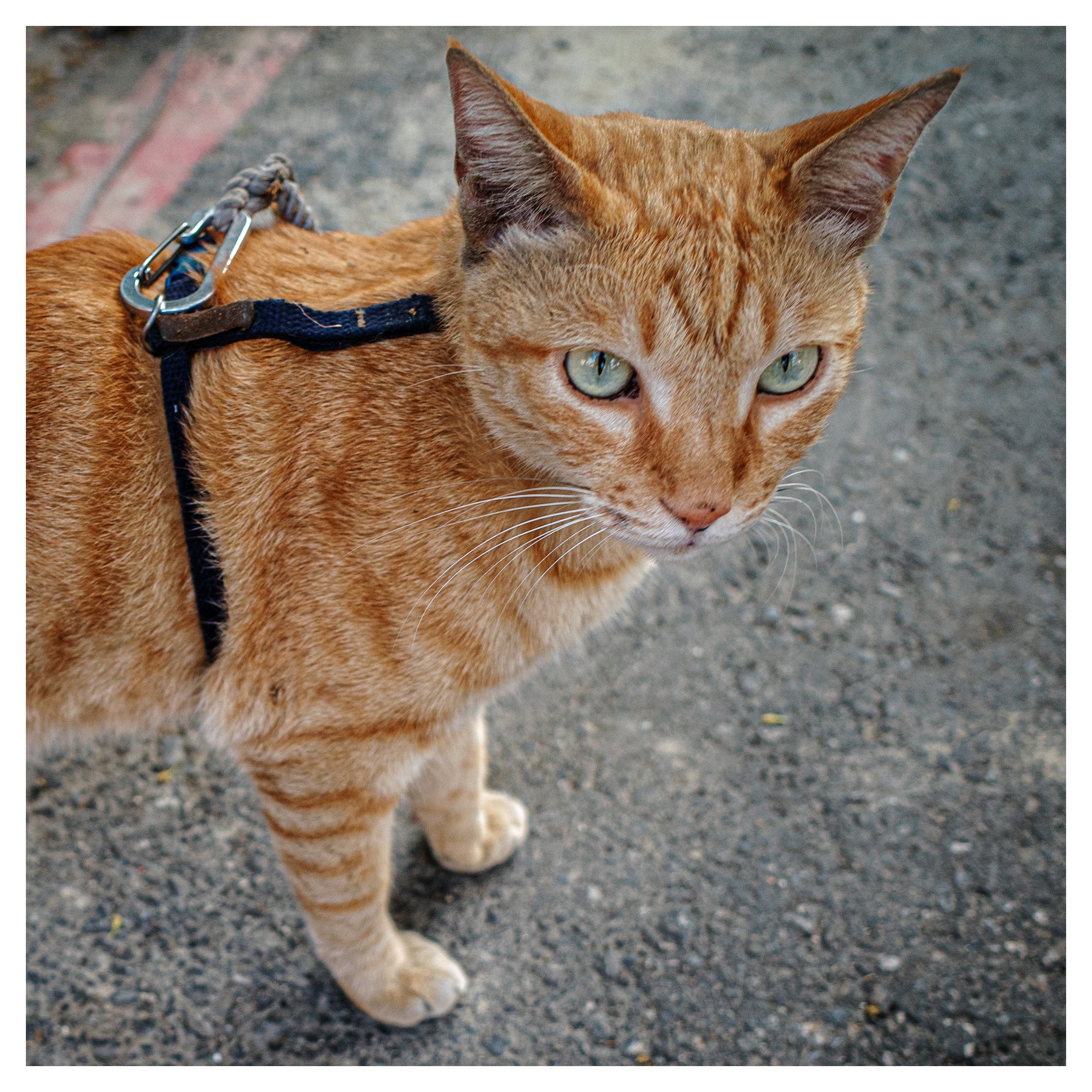
Street photography is often about the extraordinary, but what about the familiar? I analyze a candid encounter with a local ginger cat named QQ to show you why emotional resonance matters. You will learn why changing your physical perspective can transform a simple greeting into a compelling urban portrait.
Camera Model: Ricoh GRIII
Shutter Speed: 1/320
Aperture: f2.8
ISO: 400
The Critique: Texture and Connection
There is a profound difference between a photograph of a cat and a photograph of this cat. While you humbly note this isn't a masterpiece, the Ricoh GRIII—a legendary tool for street photography—has done exactly what it was designed to do: it has captured the tactile reality of an urban encounter.
The strength of this frame lies in the texture. The contrast between the soft, ginger fur of QQ and the abrasive, granular asphalt creates a sensory pull. We feel the scratchiness of the ground and the presumed softness of the subject. The harness adds a layer of narrative; it suggests a life that is both domestic and adventurous, a "street cat" with a home. Your choice of a wide aperture (f2.8) provides just enough separation to keep our focus on those striking green eyes, which carry a look of calm recognition rather than the flighty panic of a stray.
Refining the Vision
To elevate a "snapshot of meaning" into a "photographic statement," consider these adjustments:
• The Perspective Shift: You are currently looking down at QQ from a human height. In animal photography, the power dynamic changes when you get the lens down to their eye level. It invites the viewer into QQ’s world rather than observing it from above.
• Edge Awareness: The silver carabiner and the rope at the top left are high-contrast elements that pull the eye away from the cat's face. When shooting fast on a bike, this is hard to manage, but a slight change in your standing position could have tucked those mechanical elements behind the cat’s silhouette.
• The "Decisive" Background: The red curb line in the upper left is a great "anchor" for the eye, but it’s cut off. Using the lines of the street to lead toward the subject—rather than having them compete with the subject—creates a more intentional composition.
Evolution Through Data
To become a better photographer, you must treat your catalog as a textbook. I suggest you start a "Metadata Journal." Every three months, export your most successful images and look for patterns.
Are your best shots always at f2.8? You might be over-relying on "bokeh" to save a messy background. Are your shutter speeds consistently high? You might be missing the poetic beauty of motion blur. By analyzing your metadata, you identify your "comfort zone." Once you know where it is, you can intentionally step out of it.
Curated Inspiration
Photographers to Study
• Masahisa Fukase: Specifically his work The Solitude of Ravens. While dark and abstract, it demonstrates how an animal can become a vessel for deep human emotion and "masterpiece" status.
• Fan Ho: Look at his use of "monochrome" and "shadow" to turn everyday Hong Kong streets into "classic compositions".
• William Eggleston: A pioneer of "dye transfer" color. Study how he makes the mundane—like a cat on a street—look monumental through color saturation and framing.
Required Reading
• The Decisive Moment by Henri Cartier-Bresson: The "bible" of timing and "geometry" in photography.
• Bystander: A History of Street Photography: An essential "academic reference" for understanding how street photography "evolved".
• The Americans by Robert Frank: A masterclass in being an "outsider" looking at the "social" landscape.
Essential Viewing
• The Mind of a Photographer - Daido Moriyama: Understanding the "Grit" and "High Contrast" of the Provoke era. https://www.youtube.com/watch?v=W92pS9vN_6A
• The Art of Street Photography - Magnum Photos: Insights into "behind the scenes" processes and educational "masterclasses." https://www.youtube.com/watch?v=S_Y27-Tsh9k