

Day 156/365 Midnight Market Dynamics: The Art of the Night Stall
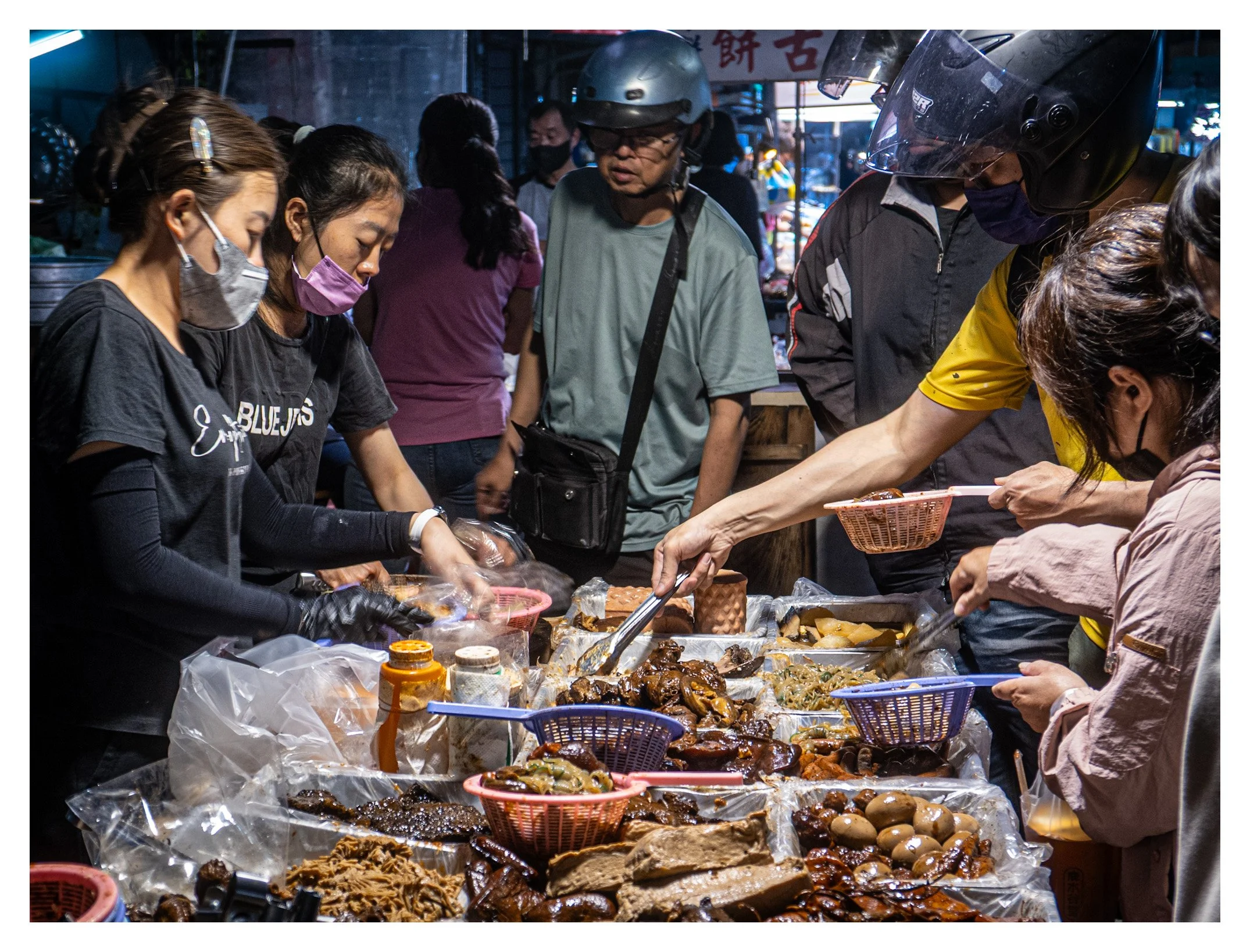
The vibrant chaos of a night market is a rite of passage for any street photographer. In this critique, we dissect a candid moment captured at a Taiwanese food stall. You will learn why managing depth of field and shutter speed is the difference between a snapshot and a masterpiece.
Image Metadata
Camera Model Leica D-Lux8
Shutter Speed 1/30
Aperture f/2.4
ISO 100
The Critique: Capturing the Pulse of the Street
Your image, The Choosing, captures a quintessential slice of life in Taiwan. There is a palpable sense of communal energy here. The way the light spills across the various braised delicacies creates a rich, tactile texture that serves as a strong visual anchor for the frame.
The inclusion of the motorcyclists, still helmeted while they graze or wait, adds a layer of modern urban realism that is uniquely Taiwanese. It speaks to the "fast-paced convenience" culture that defines these night markets. However, at a shutter speed of 1/30, you are dancing on the edge of motion blur. While it works here to convey a sense of bustling movement, a slightly faster shutter would have rendered the hands—the primary actors in this scene—with much-needed sharpness.
Advice for Improvement
• Elevate the Perspective: Currently, the camera is at chest height, looking slightly down. Try crouching lower to get closer to the level of the food or the vendors' hands. A lower angle would make the subjects appear more heroic and immersive.
• Manage Your Backgrounds: The figure in the purple shirt in the center-left is slightly distracting. In street photography, wait for a "gap" in the crowd or move your position so that the background figures don't compete with your primary subjects.
• Embrace Higher ISO: On a Leica D-Lux8, don't be afraid to push your ISO to 800 or 1600. This would allow you to move from 1/30 to 1/250, freezing the decisive action of the tongs and the exchange of money, which are the "heartbeats" of this image.
The Path to Mastery: Data and Discipline
To become a better photographer, you must move from "taking" photos to "making" them. Start a Photography Journal where you compile data from your shoots. Don't just look at the EXIF data; note the weather, the time of day, and your emotional state. Over time, you will see patterns—perhaps your best work happens at dusk or when you use a specific aperture. Analyze your "misses" as much as your "hits" to identify technical habits that are holding you back.
Recommended Research and Inspiration
Photographers to Study
• Fan Ho: For his unparalleled ability to use light and shadow to create drama in busy Asian street scenes.
• Chien-Chi Chang: A Magnum photographer whose work in Taiwan, specifically The Chain, explores the complexities of human connection and alienation.
• Alex Webb: To learn how to manage complex compositions with multiple layers and "gestures" within a single frame.
Required Reading
• The Decisive Moment by Henri Cartier-Bresson: Often called the "Bible" of photography, it teaches the art of timing and geometry.
• Uncommon Places by Stephen Shore: An essential study on how to find beauty and significance in the mundane, everyday environment.
• Magnum Contact Sheets edited by Kristen Lubben: This book is a masterclass in the creative process, showing how great photographers work a scene to find the final image.
Videos to Watch
• The Mindful Photographer: Understanding the Visual Language
• The Art of Street Photography: The Decisive Moment in Action
• Leica Masterclass: Working with Low Light and Shadows