

Day 164/365 The Human Paradox at Glory Pier
Metadata
Camera Model Leica D-Lux8
Shutter Speed 1/250
Aperture f4.5
ISO 200
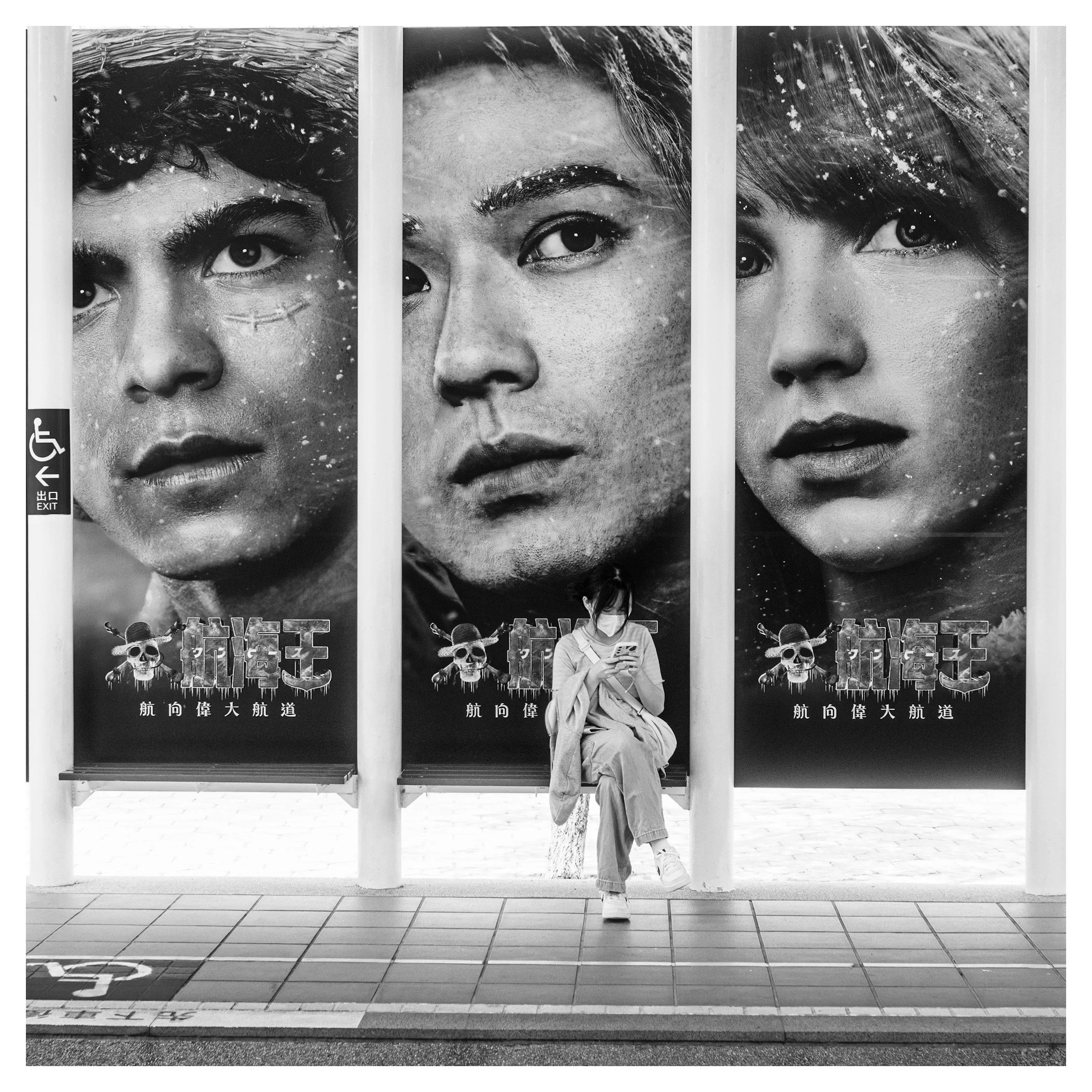
Street photography often captures a collision between the grand and the mundane. At the Glory Pier Light Rail Station, a single commuter sits beneath the gaze of giants, raising a profound question: in an age of epic narratives, why do we remain so captivated by the small glow of our screens?
The Critique: Scale and Silence
This is a compelling exercise in social observation. By utilizing a square crop and a monochromatic palette, you have stripped away the visual noise of the station to focus on a striking architectural and cultural irony.
The composition is dominated by three triptych-style posters of the One Piece live-action cast—larger-than-life figures looking into the distance with heroic intensity. Beneath them, centered and diminished by their scale, sits a real human being. The contrast is palpable. While the fictional characters "look out" toward adventure, the subject "looks in" toward their device. This creates a powerful commentary on modern isolation amidst mass-marketed heroism.
The technical execution is clean. The vertical pillars provide a natural frame that mimics a film strip or a gallery wall, effectively sectioning the "actors" from one another while trapping the subject in the central void. The black and white conversion is necessary here; it unifies the disparate textures of the printed posters and the physical environment, emphasizing form over advertisement.
Paths to Improvement
To elevate this specific shot, consider your timing and depth.
• Wait for the Interaction: The shot is successful because of the subject's posture, but a version where the subject looks up at the poster, or where another person enters the frame to break the symmetry, could add a layer of narrative tension.
• Aperture and Focus: At f4.5, the background (the posters) and the subject are both relatively sharp. To further emphasize the "loneliness" of the subject, opening the aperture slightly more would have softened the texture of the posters, making the human subject the only "real" element in a sea of soft-focus fiction.
• The Lower Third: The tactile pattern of the tactile paving in the foreground is excellent, but ensure your horizontal lines are perfectly level. A slight tilt in street photography can break the "observer" illusion.
Growing Through Data
To improve over time, I recommend you start a Quantitative Journal for your shoots. Don't just look at the "keepers." Export the metadata from every shot you took at Glory Pier.
Are you consistently shooting at 1/250? You might find that at 1/500, you capture more decisive micro-expressions. By tracking your most used focal lengths and apertures, you will identify your "comfort zone." Once identified, spend a month shooting at the exact opposite settings to force a change in perspective.
Curated Study Materials
To further your education, I suggest looking into the following masters who dealt with scale, urban isolation, and the "human vs. the environment" motif.
Photographers to Research
• Michael Wolf: Specifically his "Tokyo Compression" series. He mastered the art of capturing the psychological state of commuters within the rigid structures of public transit.
• Fan Ho: For his use of scale and shadows in urban environments. His work in Hong Kong during the 1950s is a masterclass in using architecture to frame human emotion.
• Chien-Chi Chang: Look at "The Chain." His work often deals with alienation and the psychological distance between people in structured environments.
Recommended Reading
• The Americans by Robert Frank: This book changed photography by looking at the "spaces in between"—the mundane, the lonely, and the quiet moments of a culture.
• Bystander: A History of Street Photography by Joel Meyerowitz and Colin Westerbeck: An essential academic reference to understand how the genre evolved from candid snapshots to social commentary.
• The Decisive Moment by Henri Cartier-Bresson: Often called the "bible" of photography, it will help you understand the geometry of a frame and the importance of timing.
Essential Viewing
• The Mind of a Master - Fan Ho: A short documentary on how he used light and patience to transform the streets into a stage. Watch on YouTube
• The Beauty of the Mundane - William Eggleston: This video explores how Eggleston found art in the ordinary, which will help you find more stories in locations like light rail stations. Watch on YouTube