

Day 163/365 Prehistoric Shadows: The Surreal Stage of Weiwuying
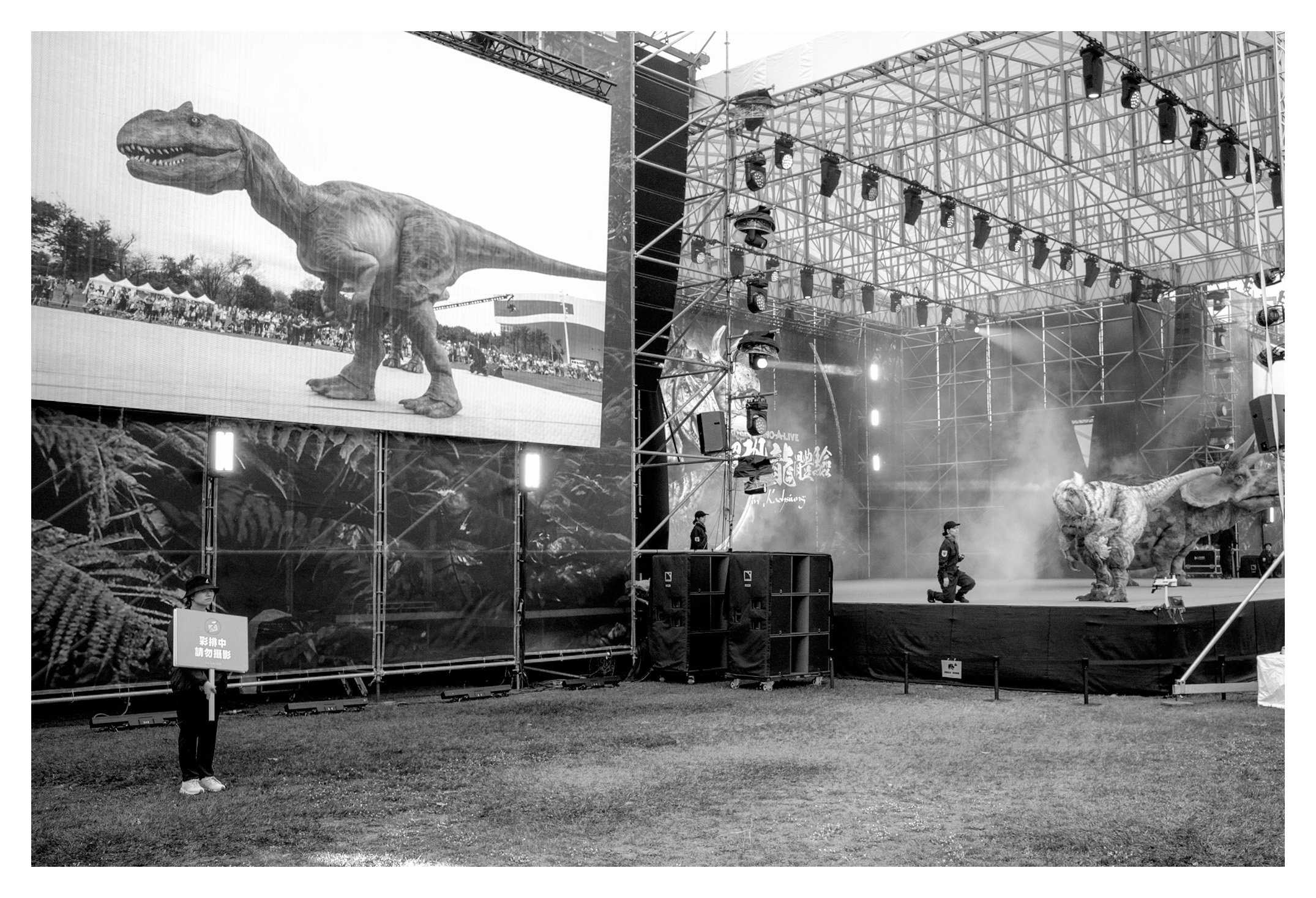
You’ll learn why this blend of mechanical artifice and human presence creates a hauntingly modern landscape. We explore how a simple performance in Kaohsiung can mirror the complexities of the "decisive moment" in our digital age.
Camera Model: Ricoh GRIII
Shutter Speed: 1/320
Aperture: f5.6
ISO: 500
The Critique
There is a delicious irony in using a Ricoh GRIII—the quintessential tool for "snapshot" realism—to capture a scene of such overt artifice. You have framed a fascinating collision of scales. On the left, a digital dinosaur looms in a high-definition void; on the right, the "real" animatronic version is engulfed by stage smoke and industrial scaffolding.
The inclusion of the staff member on the far left is the photograph's anchor. She provides the human scale that turns a "show photo" into a "documentary photograph." To answer your curiosity about the sign she is holding: it translates to "No Filming or Photography During the Performance." The fact that you captured this while breaking (or at least skirting) that very rule adds a layer of street-photography subversion that I find quite witty.
Points for Improvement
• The Foreground Void: The bottom third of the image is dominated by relatively uninteresting grass. In post-processing, a slight crop or a shift in perspective during the shoot—getting lower to the ground—could have used that grass to create more leading lines or simply tightened the tension between the figures and the screens.
• Tonal Separation: While the black and white conversion is moody, the animatronic dinosaur on the right gets a bit lost in the scaffolding. Increasing the local contrast (Clarity) or dodging the dinosaur slightly would help it pop against the complex background.
Growth and Data Compiling
To improve over time, I suggest you start a Metadata Journal. Since you are using a GRIII, pay attention to how often you use "Snap Focus." Note the distance settings in your EXIF data and correlate them with your "hit rate" for sharpness. Compiling this data allows you to see if you are consistently misjudging distances or if your shutter speed is lagging for the pace of Taiwanese street life.
Recommendations for Study
Photographers to Research
• Shen Chao-Liang: Specifically his STAGE series. He documents the elaborate, surreal mobile stages in Taiwan. His work will show you how to find the "cultural landscape" within theatrical setups.
• Fan Ho: For his mastery of light, shadow, and scale in a Chinese context.
• Garry Winogrand: Study his ability to manage "chaos" within a frame. He was a master of the wide-angle lens, similar to your GRIII's 28mm equivalent.
Books to Read
• "The Decisive Moment" by Henri Cartier-Bresson: The bible of timing and geometry.
• "Magnum Contact Sheets" edited by Kristen Lubben: Seeing the frames before and after the masterpiece is the best way to understand the process of "hunting" a shot.
• "Bystander: A History of Street Photography" by Colin Westerbeck: A comprehensive look at the evolution of the genre you are currently exploring.
Videos to Watch
• The School of Photography: Excellent for technical breakdowns and understanding light behavior.
• Joe Redski: He uses the Ricoh GRIII specifically to create "Cinematic Street Photography." This is highly relevant to your setup.