

Day 166/365 The Decisive Moment at Lotus Pond: A Study in Urban Paradox
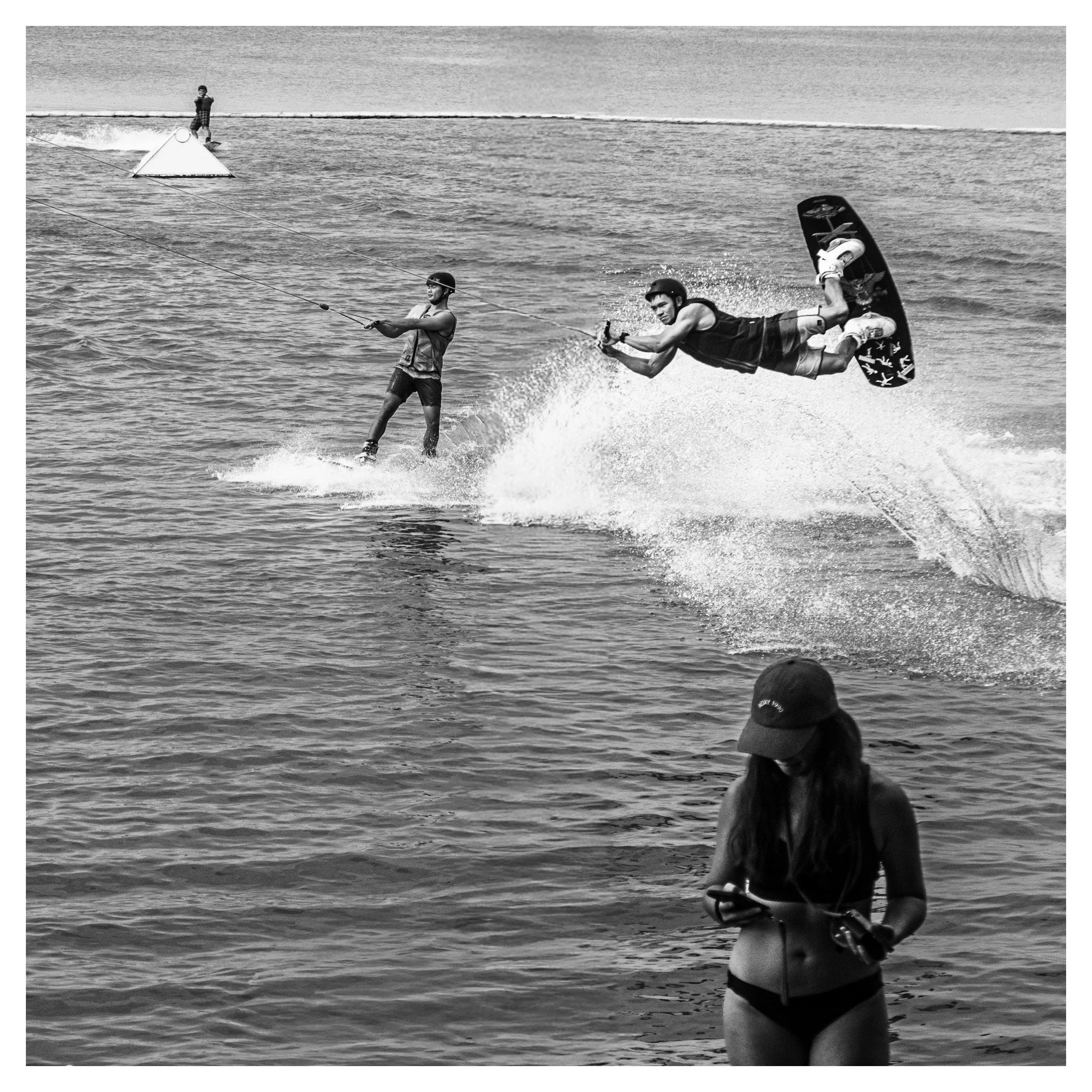
At Kaohsiung's historic Lotus Pond, a single shutter click captures the jarring collision between high-octane athleticism and digital isolation. You will learn how the interplay of black-and-white tones and deliberate layering transforms a simple vacation snapshot into a profound commentary on the modern human condition.
EXIF Data
Camera Model: Leica D-Lux8
Shutter Speed: 1/200
Aperture: f4
ISO: 320
The Critique: Synchronicity and Stagnation
In this monochrome capture from Kaohsiung, we are presented with a fascinating triptych of human activity. The Leica D-Lux8 has rendered a scene that is less about the water sport itself and more about the invisible walls we build in public spaces.
The composition is anchored by a remarkable mid-air feat. The wakeboarder’s body, parallel to the horizon, creates a powerful horizontal vector that leads the eye directly across the frame. This kinetic energy is contrasted sharply by the foreground figure—a woman looking down at her phone. This "bystander" effect creates a narrative tension; while one individual is physically transcending gravity, the other is digitally anchored.
The choice of black and white is essential here. It strips away the likely distractions of colorful swimwear and murky pond water, forcing the viewer to focus on the textures of the spray and the structural lines of the tow ropes. However, the 1/200 shutter speed has left a slight softness in the wakeboarder’s limbs. While this conveys motion, a faster speed might have "frozen" the water droplets into a more crystalline, surreal backdrop.
Paths to Improvement
To elevate this work from a lucky "street" encounter to a masterpiece of timing, consider the following:
• Depth of Field Management: At f4, the foreground figure is slightly soft. While this separates the layers, stopping down to f8 would have brought the woman in the hat into sharper focus, emphasizing the "split-screen" reality of the two subjects.
• The Power of the Edge: The wakeboarder is dangerously close to the right edge of the frame. Giving the athlete more "room to move" into the frame would enhance the sense of flight.
• Shadow Detail: In your post-processing, look to open up the shadows on the central figure holding the rope. The contrast is striking, but we lose the human expression that connects the athlete to the effort.
The Long Game: Compiling Your Vision
Becoming a master is a process of data analysis. I recommend maintaining a Digital Contact Sheet. For every hundred images, select five and tag them with specific metadata: not just the technicals, but the Emotional Intent (e.g., "Loneliness," "Speed," "Irony"). Over six months, patterns will emerge. You may find you gravitate toward specific geometries or lighting conditions, allowing you to move from "taking" photos to "constructing" them.
Curated Research for the Developing Eye
To further your education, I suggest immersing yourself in these specific resources that echo the themes of your Kaohsiung work:
Photographers to Study
• Fan Ho: Master of the "decisive moment" in Asian urban environments. Study his use of light and shadow to simplify complex scenes.
• Garry Winogrand: For his ability to capture the chaotic energy of people in public spaces and his masterful use of the wide-angle lens.
• Chien-Chi Chang: Specifically his work The Chain. His ability to document alienation within Taiwan provides a localized context for your own explorations.
Essential Reading
• The Decisive Moment by Henri Cartier-Bresson: The "bible" of timing and geometry in photography.
• Bystander: A History of Street Photography by Joel Meyerowitz: An academic and visual reference for how the role of the observer has evolved.
Video Insights
• The Beauty of Monochrome: A deep dive into how black and white changes our psychological perception of a scene. Watch on YouTube
• Composition Masterclass - The Art of Layering: Learn how to use foreground, midground, and background to tell more complex stories. Watch on YouTube