

Day 167/365 Framing the Geometry of Kaohsiung
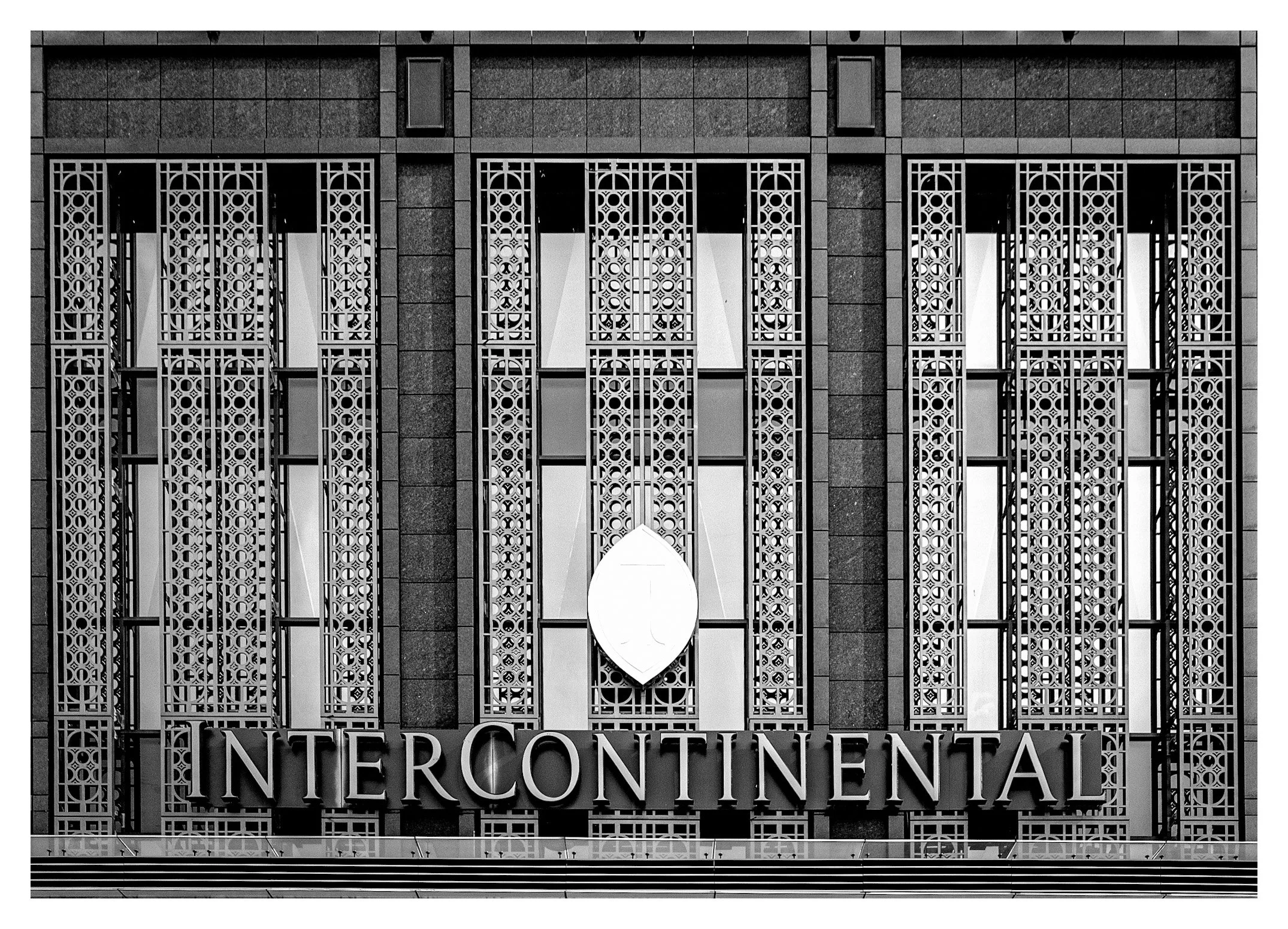
When the modern grid of an international landmark meets the precision of a street photographer's lens, the results are often transformative. You will learn how a simple architectural facade can be turned into a study of rhythm and weight, and where this specific composition succeeds in the realm of high-contrast monochrome.
EXIF Data
Camera Model: Ricoh GRIII
Shutter Speed: 1/320
Aperture: f8
ISO: 400
The Critic's Eye: Architecture as Pattern
In this study of the Intercontinental Hotel in Kaohsiung, you have successfully leaned into the Ricoh GRIII’s greatest strength: its ability to render edge-to-edge sharpness in a compact form factor. By choosing a black and white treatment, you have stripped away the distractions of modern glass and steel to reveal the underlying skeletal rhythm of the building.
The use of f8 was a masterful choice here. It ensures that the intricate lattice work and the bold "INTERCONTINENTAL" typography remain on the same focal plane, creating a flattened, almost graphic design quality rather than a standard three-dimensional architectural shot. The verticality is imposing, and the centered logo acts as a necessary anchor in a sea of repetitive geometry.
Refinement and Elevation
While the symmetry is strong, there are two areas where this image could transcend being a "record" of a building and become a "statement."
1. The Lower Boundary: The very bottom of the frame feels slightly unresolved. We see the top edge of a glass awning or railing. Ideally, you would either include more of the street-level context to ground the image or crop more aggressively to make the frame entirely about the metal patterns. Eliminating that thin sliver of the "real world" at the bottom would enhance the surreal, infinite-pattern quality of the shot.
2. Tonal Depth: Your blacks are solid, but the mid-tones in the stone pillars are quite close in value to the metal screens. Post-processing could be used to push the "silver" tones of the screens higher, creating a metallic shimmer that separates them from the matte texture of the building’s stone.
The Long Game: Growth Through Data
To evolve as a photographer, you must move beyond the "one-off" shot. Start a Technical Audit Journal. For every twenty images you produce, look at your metadata. Are you always shooting at f8? If so, you are comfortable with deep depth of field. Challenge yourself to find an architectural detail at f2.8 to see how bokeh can isolate texture.
Furthermore, categorize your work by visual themes rather than locations. Instead of a "Kaohsiung" folder, create a "Geometric Repetition" folder. This allows you to see if your style is consistent across different cities and subjects.
Curated Research for the Developing Eye
To further your understanding of light, shadow, and structure, I recommend the following resources:
Photographers to Study
• Fan Ho: For his unparalleled ability to use shadows to create geometric "rooms" within a city.
• Michael Wolf: Specifically his "Tokyo Compression" or "Architecture of Density" series, which explores the claustrophobic beauty of urban grids.
• Bernd and Hilla Becher: Their "typology" approach to industrial structures will teach you the power of deadpan, objective framing.
Essential Reading
• "The Decisive Moment" by Henri Cartier-Bresson: The bible of timing and geometry.
• "Uncommon Places" by Stephen Shore: To see how mundane architecture can be elevated through precise composition.
Educational Viewing
• The Art of Photography: The Photography of Fan Ho
https://www.youtube.com/watch?v=L_6p6YjX1S8
• The World Through My Lens: Bernd and Hilla Becher
https://www.youtube.com/watch?v=F3pTzZ7f36k
Your eye for order is evident. Now, focus on how you can disrupt that order to tell a deeper story about the urban experience.
When the modern grid of an international landmark meets the precision of a street photographer's lens, the results are often transformative. You will learn how a simple architectural facade can be turned into a study of rhythm and weight, and where this specific composition succeeds in the realm of high-contrast monochrome.
Camera Model: Ricoh GRIII
Shutter Speed: 1/320
Aperture: f8
ISO: 400
The Critic's Eye: Architecture as Pattern
In this study of the Intercontinental Hotel in Kaohsiung, you have successfully leaned into the Ricoh GRIII’s greatest strength: its ability to render edge-to-edge sharpness in a compact form factor. By choosing a black and white treatment, you have stripped away the distractions of modern glass and steel to reveal the underlying skeletal rhythm of the building.
The use of f8 was a masterful choice here. It ensures that the intricate lattice work and the bold "INTERCONTINENTAL" typography remain on the same focal plane, creating a flattened, almost graphic design quality rather than a standard three-dimensional architectural shot. The verticality is imposing, and the centered logo acts as a necessary anchor in a sea of repetitive geometry.
Refinement and Elevation
While the symmetry is strong, there are two areas where this image could transcend being a "record" of a building and become a "statement."
1. The Lower Boundary: The very bottom of the frame feels slightly unresolved. We see the top edge of a glass awning or railing. Ideally, you would either include more of the street-level context to ground the image or crop more aggressively to make the frame entirely about the metal patterns. Eliminating that thin sliver of the "real world" at the bottom would enhance the surreal, infinite-pattern quality of the shot.
2. Tonal Depth: Your blacks are solid, but the mid-tones in the stone pillars are quite close in value to the metal screens. Post-processing could be used to push the "silver" tones of the screens higher, creating a metallic shimmer that separates them from the matte texture of the building’s stone.
The Long Game: Growth Through Data
To evolve as a photographer, you must move beyond the "one-off" shot. Start a Technical Audit Journal. For every twenty images you produce, look at your metadata. Are you always shooting at f8? If so, you are comfortable with deep depth of field. Challenge yourself to find an architectural detail at f2.8 to see how bokeh can isolate texture.
Furthermore, categorize your work by visual themes rather than locations. Instead of a "Kaohsiung" folder, create a "Geometric Repetition" folder. This allows you to see if your style is consistent across different cities and subjects.
Curated Research for the Developing Eye
To further your understanding of light, shadow, and structure, I recommend the following resources:
Photographers to Study
• Fan Ho: For his unparalleled ability to use shadows to create geometric "rooms" within a city.
• Michael Wolf: Specifically his "Tokyo Compression" or "Architecture of Density" series, which explores the claustrophobic beauty of urban grids.
• Bernd and Hilla Becher: Their "typology" approach to industrial structures will teach you the power of deadpan, objective framing.
Essential Reading
• "The Decisive Moment" by Henri Cartier-Bresson: The bible of timing and geometry.
• "Uncommon Places" by Stephen Shore: To see how mundane architecture can be elevated through precise composition.
Educational Viewing
• The Art of Photography: The Photography of Fan Ho
https://www.youtube.com/watch?v=L_6p6YjX1S8
• The World Through My Lens: Bernd and Hilla Becher
https://www.youtube.com/watch?v=F3pTzZ7f36k
Your eye for order is evident. Now, focus on how you can disrupt that order to tell a deeper story about the urban experience.