

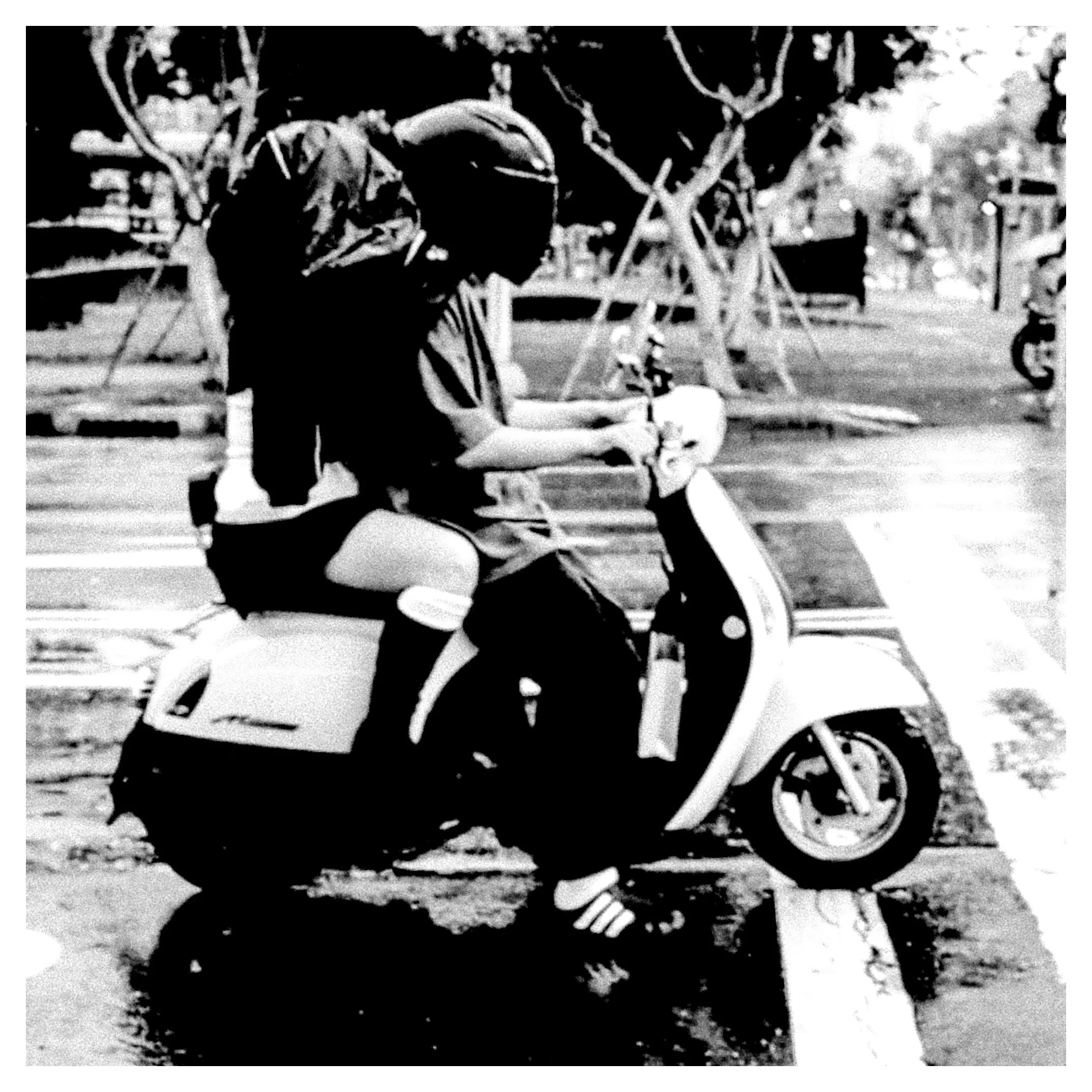
When the urban landscape turns hostile, the line between a street photographer and a casualty of the craft thins. From aggressive canines to treacherous, tile-slick sidewalks, learn why the physical toll of a "bad day" often leaves a deeper mark on your portfolio than the images themselves.
Camera Model: Ricoh GRIII
Shutter Speed: Unknown (Video Frame)
Aperture: Unknown
ISO: Unknown
The Critique: The Visceral Frame
Art is rarely produced in a vacuum of comfort, but your experience is a textbook example of "The Suffering Artist" updated for the modern cyclist. The image you've salvaged takes on a different weight when we know it was preceded by a dog chase and followed by a crash. That "ice-like" sidewalk—a common grievance in urban planning where aesthetic tiles override grip—is now part of the image's DNA.
The high-contrast, grainy output of the video grab perfectly mirrors the jagged, frantic energy of your day. The girl on the scooter, sheltered by her jacket, represents a moment of precarious stasis before the chaos. The deep shadows under the wheels aren't just ink; they are the "black ice" of the wet sidewalk that claimed your shoulder. This isn't just a photo; it’s a survivor's artifact.
Improving the Image
Given the physical and technical trauma involved, the goal is to emphasize the environmental hostility.
• Lean into the Grit: Don't try to smooth out the noise. In street photography, grain is often seen as a surrogate for "truth" or "reality". Increase the contrast to make the wet surfaces look as treacherous as they felt.
• Selective Exposure: Bring down the highlights on the background trees to keep the viewer’s eye locked on the central figure. We want the world around her to feel dark and closing in, mimicking the tunnel vision of a chase.
• The Tonal Narrative: If you are using Lightroom, use a "Cool" tint in the shadows to evoke the slick, cold sensation of that wet tile.
Compiling the Data of Adversity
To grow from this, you need to analyze the contextual data of your shoots, not just the pixels.
1. Map the Danger Zones: Use your "books_database" method to log not just the "Context/Keywords," but "Physical Hazards". If specific districts in Taiwan use those lethal glazed tiles, mark them. This is how pros like Bruce Davidson navigated dangerous subways—by knowing the terrain.
2. The "Chain" of Events: Look at Chien-Chi Chang’s The Chain. His work focuses on mental and physical confinement. Use your database to see if "Physical Pain" or "Hostile Environments" start appearing as recurring themes in your work.
3. Gear Resilience Data: Note how the Ricoh handled the moisture and the impact. This data is as vital as ISO or Aperture. If an app failure caused the video mode, that is a data point that dictates your future workflow—manual over digital interface.
Research and Study
Photographers to Study
• Daido Moriyama: The master of the "stray dog" aesthetic. His work is famously messy, blurred, and raw. He would find the beauty in your crash and the grit in your "failed" video frame.
• Mark Cohen: Known for "Grim Street" and his invasive, close-up style. He often shot from the hip without looking through the viewfinder—a high-energy approach that matches your chaotic bike ride.
• Masahisa Fukase: His book Ravens is a masterclass in dark, obsessive, and lonely photography. It captures the "bad day" vibe better than almost any other work.
Books to Read
• Minutes to Midnight by Trent Parke: A dreamlike, often dark documentary of Australia. It shows how to turn everyday occurrences into something haunting and cinematic.
• The Decisive Moment by Henri Cartier-Bresson: Read it to understand the geometry you did manage to capture, even by accident.
• Early Color by Saul Leiter: While you are shooting in B&W, Leiter’s work through rainy windows and mirrors will teach you how to use "obscured vision" to your advantage.
Videos to Watch
• Daido Moriyama: Near Equal: A documentary on his process of wandering the streets and embracing imperfection. Watch here
• How to Handle Conflict on the Street: Advice for dealing with everything from dogs to difficult pedestrians. Watch here
• The Philosophy of the Flâneur: Understanding the "urban explorer" mindset and why the struggle is part of the art. Watch here