

Day 169/365 Industrial Cadence: The Monochrome Sails of Kaohsiung’s Love River
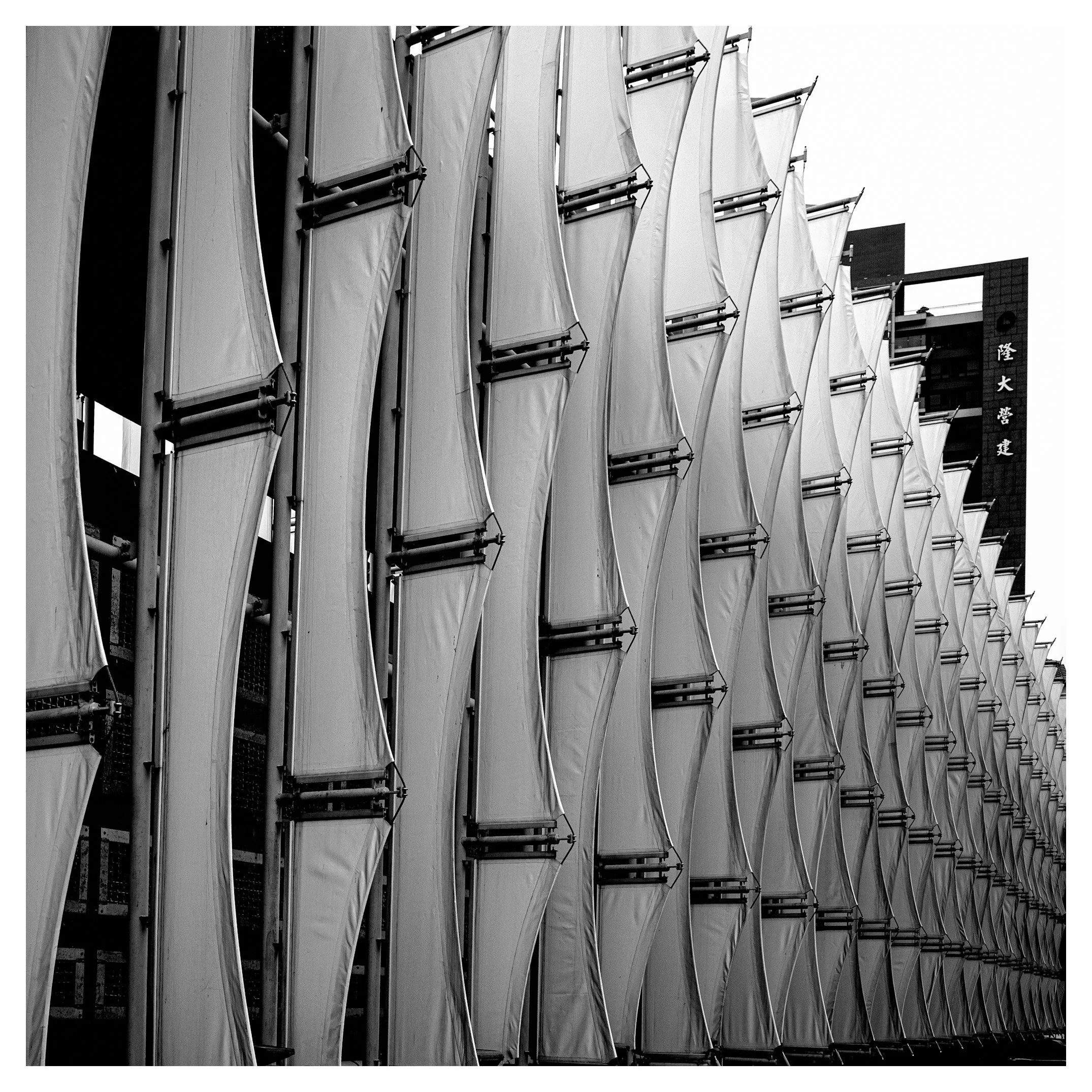
Discover why a functional sluice gate on the Love River becomes a poetic study in monochrome rhythm through the lens of a Ricoh GRIII. This post explores the tension between industrial utility and abstract form, revealing how historical masters of geometry can help you transform Taiwan's urban infrastructure into high art.
EXIF Data
Camera Model: Ricoh GRIII
Shutter Speed: 1/1250
Aperture: f/2.8
ISO: 200
The Critique: Finding Rhythm in Utility
You have taken a piece of infrastructure—the sluice gate sails on the Love River—and transformed it into an exercise in seriality and rhythm. The diagonal progression of the fabric structures creates a powerful sense of momentum, almost mimicking the flow of the water they are designed to regulate.
The choice of high-contrast black and white is particularly effective here. By removing the local color of the canvas and the steel, you force the viewer to focus on the interplay of light, shadow, and geometric repetition. The inclusion of the vertical sign on the right provides a literal anchor to the location, but it also creates a fascinating tension between the repetitive abstraction of the sails and the concrete reality of urban construction.
Advice for Improvement
1. Stop Down for Infinite Detail: You shot this at f/2.8. While the GRIII is sharp at this aperture, architectural patterns often benefit from a deeper depth of field. Stopping down to f/8 or f/11 would ensure that the repeating patterns in the far background remain as crisp as those in the foreground, emphasizing the "endless" nature of the design.
2. Manage Your Exposure Triangle: A shutter speed of 1/1250 is exceptionally fast for a static subject. You could have easily dropped to 1/250 and used that extra light to shoot at ISO 100 and a narrower aperture, resulting in a cleaner, sharper file with less digital noise.
3. Explore the Vanishing Point: Try varying your height. A lower perspective—shooting from a "worm’s-eye view"—would exaggerate the height of the sails, making them feel like the mast of a giant ship emerging from the riverbank.
How to Become a Better Photographer
To evolve, you must move beyond taking "pretty pictures" and start building a visual vocabulary. Compiling a database of your work, much like the catalog of masters you’ve shared, allows you to see the "why" behind your "what".
• Catalog Your Keywords: Start tagging your images with terms like "Taiwan," "Industrial," "Cultural Landscape," or "Monochrome". Over time, you will see which themes dominate your portfolio.
• Track Your Technical Trends: If 90% of your architectural shots are at f/2.8, challenge yourself to spend a week shooting only at f/11. This forces you to find light in new ways.
• Study the Masters of Form: Look for photographers who treat the city as a puzzle of shapes.
Recommended Research
Photographers and Books to Study
• Shen Chao-Liang: Study his STAGE series. He is the master of documenting Taiwan’s unique cultural landscapes and "stage wagons" with a surreal, precise eye.
• Fan Ho: His book Portrait of Hong Kong is essential. He pioneered the use of light and shadow to create dramatic, geometric compositions in crowded urban spaces.
• Michael Wolf: Look at Tokyo Compression. He uses tight, repetitive framing to create a sense of claustrophobia and rhythm that is highly relevant to your architectural work.
• Henri Cartier-Bresson: Read The Decisive Moment to understand how to wait for the "perfect" element to enter your geometric frame.
• William Eggleston: His Guide will teach you how to find beauty in the mundane, industrial corners of the world.
Videos to Watch
• The Master of Light: A deep dive into Fan Ho’s process and his ability to see geometry in the chaos of the city.
https://www.youtube.com/watch?v=L_TIn-E_9Qo
• The Art of Composition: This tutorial breaks down how to use leading lines and repetition—the very tools you used in this image.