

Day 174/365 Echoes in the Glass: The Ghostly Layers of the Kaohsiung Light Rail
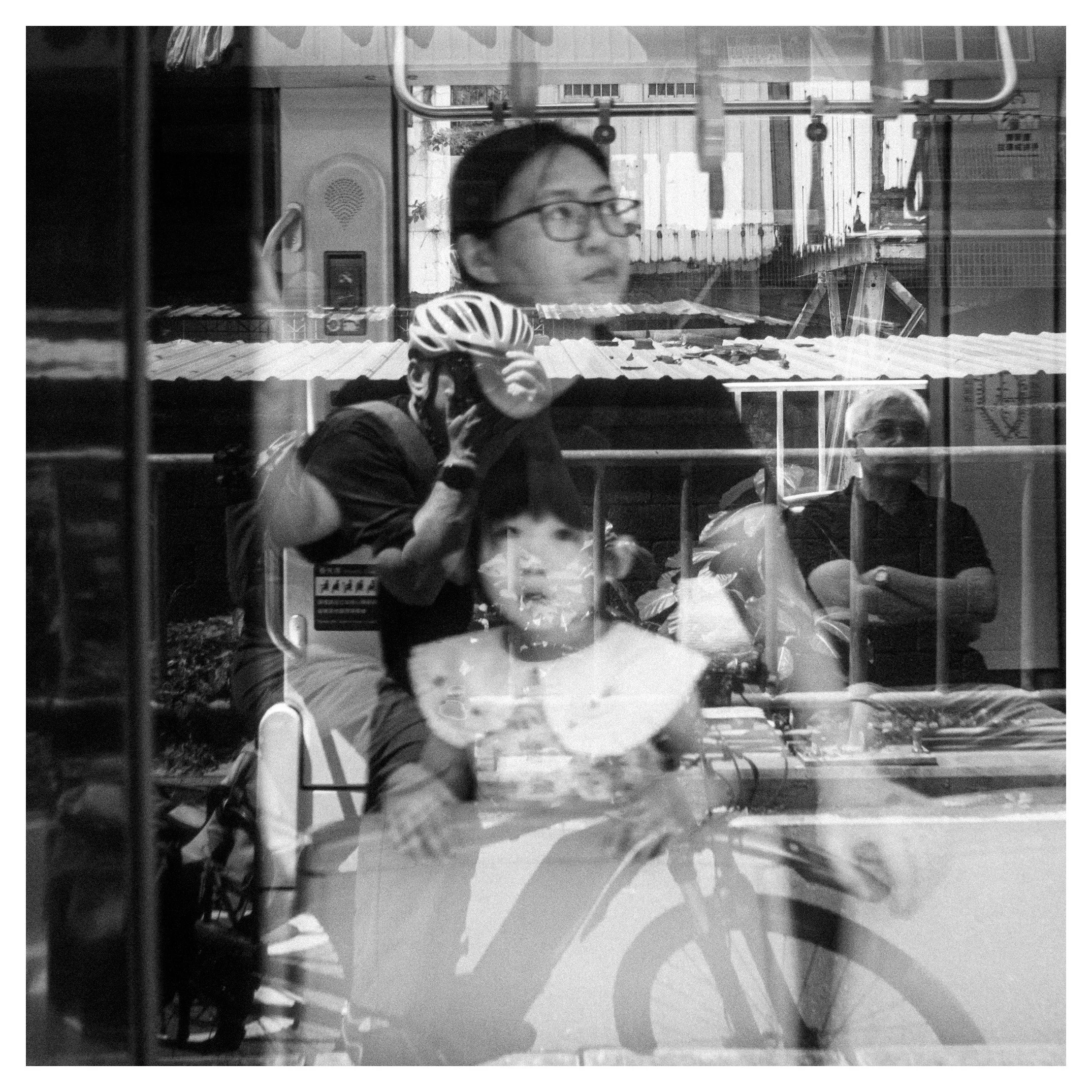
Street photography in Kaohsiung often demands more than just a quick shutter. In this frame, the Yancheng light rail becomes a canvas for a complex layering of urban life. Discover how a single reflection can transform a mundane commute into a haunting, multi-dimensional narrative of the city.
Camera Model: Leica D-Lux8
Shutter Speed: 1/2000
Aperture: f/2.2
ISO: 800
The Critique: A Study in Translucence
Your capture at the Yancheng stop is a compelling example of accidental surrealism. By utilizing the reflective glass of the light rail, you have bypassed the standard "street portrait" and entered the realm of the psychological. The image functions as a triple exposure in a single frame: we see the woman’s face superimposed over the cyclist, who in turn is framed against the seated man in the background.
The strength here lies in the spatial ambiguity. The viewer is forced to work to separate the interior of the train from the exterior reflection. The high shutter speed of 1/2000 was a wise technical choice; while it froze the physical motion of the train, it preserved the "ghosts" in the glass with razor-sharp clarity. The black-and-white conversion focuses the eye on the textures—the metallic sheen of the handlebars, the knit of the child’s collar, and the sharp lines of the bicycle wheel—rather than the distracting colors of urban signage.
Opportunities for Improvement
• Depth of Field Management: At f/2.2, your plane of focus is quite thin. While the woman in the reflection is relatively sharp, the seated man in the background is beginning to soften. In reflection-heavy shots, stopping down to f/4 or f/5.6 (and perhaps dropping the shutter speed slightly) would bring all three "layers" into equal focus, making the visual puzzle even more disorienting for the viewer.
• Edge Awareness: The vertical black bar on the extreme left acts as a heavy anchor, but it cuts off a portion of the reflected cyclist. Being mindful of these framing elements can prevent the composition from feeling unintentionally obstructed.
Compiling Your Photographic Evolution
To become a master, you must move from "taking" photos to "making" them. I recommend maintaining a Shooting Metadata Log. Beyond the numbers (ISO, Aperture, Shutter), record the Environmental Variables:
1. Light Direction: Was the sun hitting the glass directly or was it overcast?
2. Intent vs. Result: You intended to "freeze" the train—did the resulting reflection surprise you?
3. The "Hit" Rate: Note how many frames you fired to get this specific alignment.
Over six months, this data will reveal your subconscious habits. You may find you rely on high shutter speeds even when a motion blur might add more "soul" to the urban chaos.
Theoretical and Practical Curations
Photographers to Study
• Saul Leiter: The undisputed master of shooting through windows and using reflections to abstract the city. Study his use of framing within a frame.
• Fan Ho: Look at his work "Portrait of Hong Kong". His mastery of light and shadow in a dense Asian urban context is peerless for someone shooting in Taiwan.
• Lee Friedlander: Specifically his self-portraits and shop window reflections, which pioneered the "complex" image style you’ve touched on here.
Essential Reading
• Bystander: A History of Street Photography by Colin Westerbeck and Joel Meyerowitz. This is an encyclopedic reference for the evolution of the genre.
• Tokyo Compression by Michael Wolf. This will give you a different perspective on people within the transit system—focusing on the claustrophobia and modern urban life.
• Thoughts on Street Photography: A collection of essays to help you refine the philosophy behind your lens.
Essential Viewing
• The Decisive Moment: A short documentary on Henri Cartier-Bresson’s philosophy.
• https://www.youtube.com/watch?v=hyhMqDss7eM
• The Mind of a Master - Saul Leiter: Understanding how to find beauty in the "unseen" parts of the street.