

Day 175/365 The Exhaustion of the Everyday: A Study in Modern Taiwan
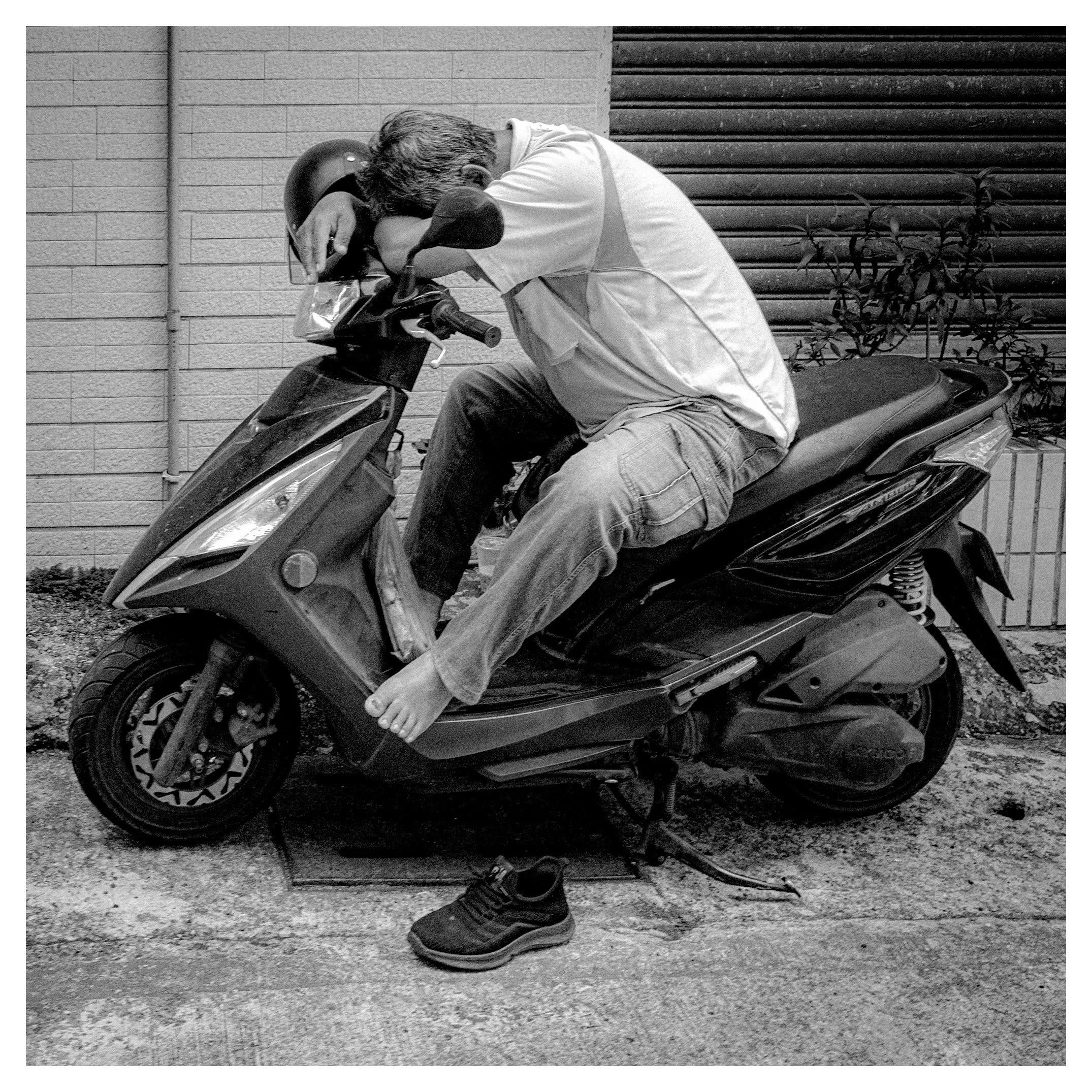
In the quiet corners of Taiwan's bustling streets, a single moment of rest reveals the hidden weight of urban life. You will learn why this specific composition transforms a common sight into a profound social commentary on labor, exhaustion, and the machines we rely on.
Technical Specifications
Camera Model: Ricoh GRIII
Shutter Speed: 1/320
Aperture: f8
ISO: 1250
The Critique
This monochrome study captures a poignant intersection of man and machine. The subject—a laborer slumped over his scooter—is a quintessential scene of contemporary Taiwan, yet the framing elevates it beyond a mere snapshot. The decision to render this in black and white was wise; it strips away the visual "noise" of colorful street signage, forcing the viewer to focus on the texture of the subject’s shirt, the weary arch of his back, and the high-contrast shadows.
The inclusion of the single discarded shoe is the "punctum" of the piece. It suggests a vulnerability that contrasts sharply with the mechanical rigidity of the scooter. The subject isn't just resting; he has partially disarmed himself from his daily uniform, signaling a deep, bone-weary exhaustion.
Areas for Improvement
While the emotional resonance is high, the image feels slightly cramped at the top. The top of the subject's head and the helmet are very close to the edge of the frame. Allowing a bit more "breathing room" above the subject would have provided a more balanced composition.
Additionally, the background—a corrugated metal door and a brick wall—is quite sharp due to the f8 aperture. While environmental context is good, a slightly wider aperture (perhaps f5.6) might have helped separate the subject from the textures behind him just enough to make the silhouette pop without losing the sense of place.
The Path to Mastery: Compiling Your Data
To grow as an artist, you must move beyond the "lucky shot." Start a digital log of your metadata to identify your subconscious habits. If you find you are consistently shooting at high ISOs even in daylight, challenge yourself to master lower speeds. Analyze your "keeper" rate: do your best images share a specific focal distance or time of day? Tracking these metrics will help you understand your unique visual "thumbprint" and allow you to break habits intentionally.
Curated Recommendations for Your Library
Photographers to Study
• Chien-Chi Chang: A master of documenting alienation and the human condition in Taiwan. His work, particularly "The Chain," shows how to frame subjects within restrictive environments to convey a sense of mental or physical confinement.
• Fan Ho: Study his use of "classic composition" and how he used dramatic shadows and light in 1950s Hong Kong to turn everyday street life into a theatrical stage.
• Robert Frank: For a lesson in how to be an "outsider looking in," Frank’s work is essential for understanding the "raw" and "honest" aesthetic of street photography.
Books for Your Shelf
• The Decisive Moment by Henri Cartier-Bresson: Often called the "bible" of photography, this book teaches the geometry of time and the importance of the perfect instant.
• Minutes to Midnight by Trent Parke: This will help you see the street in a more "dreamlike" and "documentary" way, pushing you to experiment with light and motion.
• Think Like a Street Photographer by Matt Stuart: A practical guide to developing your observational skills and finding humor or irony in the mundane.
Videos to Watch
• The Decisive Moment - Documentary on Henri Cartier-Bresson: A look at the philosophy of the man who defined modern street photography. https://www.youtube.com/watch?v=eiK7JvOqV_I
• Daido Moriyama: In Pictures: Explore the "Provoke" era style of grit and high contrast to see how "imperfection" can be a powerful tool. https://www.youtube.com/watch?v=V-p6LAt_9O8
• Fan Ho: Visual Poet of Hong Kong: A short exploration of his lighting techniques and his ability to wait for the subject to enter his pre-composed frame. https://www.youtube.com/watch?v=3S5I4R0W040