

Day 179/365 Casual Stillness in the Concrete Jungle
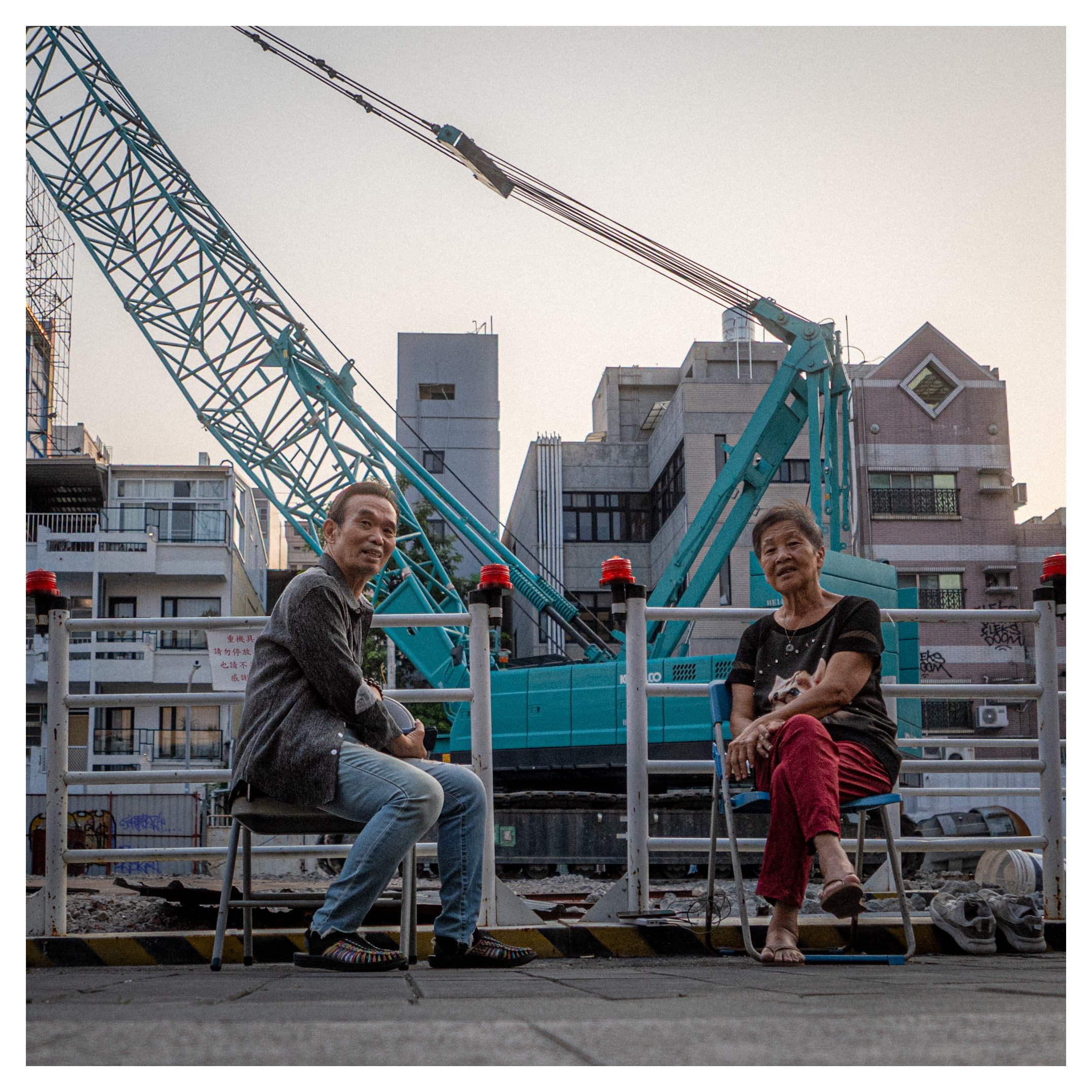
This evocative capture explores the intersection of human leisure and urban expansion in Taiwan. By placing domestic comfort against a backdrop of heavy machinery, the image invites us to reconsider the evolving relationship between the island's aging population and its relentless infrastructural growth.
Camera Model
Leica D-Lux 8
Shutter Speed
1/2500
Aperture
f/1.7
ISO
200
The Critique: Theo Marr's Perspective
There is a striking juxtaposition at play here. You have captured two individuals in a moment of complete repose, seated on casual folding chairs, while the massive arm of a turquoise crane looms over them like a prehistoric predator. This is a classic environmental portrait. The subjects seem entirely unbothered by the construction—a testament to the "lived-in" reality of modern urban spaces.
The low-angle perspective is a wise choice; it elevates the subjects while allowing the crane's geometry to dominate the upper two-thirds of the frame. However, the wide aperture of f/1.7 on a 4/3 sensor (or similar) has created a very shallow depth of field. While this separates the subjects from the background, the crane and the architecture are such vital parts of the narrative that losing their crispness slightly softens the "social landscape" impact of the shot.
Paths to Improvement
• Depth of Field: To lean into the "New Topographics" style, try stopping down to f/5.6 or f/8. In a scene like this, the texture of the buildings and the intricate lattice of the crane are just as important as the expressions on the faces.
• Framing and Tension: The red safety lights on the fence act as interesting anchors. Try to align them more intentionally with the subjects to create a rhythmic "heartbeat" across the horizontal plane.
• Timing the Light: The sky is a bit "blown out" or featureless. Shooting this same scene twenty minutes later during the blue hour would allow the artificial lights of the construction site to pop, adding a cinematic layer to the domestic scene.
Growth Through Data
To evolve, you must become your own archivist. I noticed you are keeping a database of your influences. You should expand this to include a metadata audit of your own work.
Create a log where you track the "Success Rate" of specific settings. For example, if you find that your favorite environmental portraits are consistently shot at wider focal lengths but struggle with background clarity, the data will tell you to experiment with higher ISOs to allow for narrower apertures. Look for patterns in your "Context/Keywords" column to see if you gravitate toward "alienation" or "nostalgia". If "Taiwan" and "Urban" are your most frequent tags, start a specific project folder for that sub-genre to track your progress over years, not just days.
Curated Inspiration
Photographers to Study
• Shen Chao-Liang: Specifically his STAGE series. He excels at capturing the surreal intersection of Taiwanese folk culture and mobile architecture.
• Chien-Chi Chang: Look at The Chain for a masterclass in how to use framing to suggest psychological states within a specific environment.
• Stephen Shore: His book Uncommon Places will teach you how to make the "boring" parts of a city look monumental through precise composition.
Required Reading
• The Decisive Moment by Henri Cartier-Bresson: The "bible" of timing and geometry.
• Bystander: A History of Street Photography: This provides the academic and historical context for the kind of candid work you are doing.
Watch and Learn
• Magnum Photos - Alec Soth Masterclass: Soth is a master of the contemporary environmental portrait and discusses how to interact with strangers.
https://www.youtube.com/watch?v=KshmC6y1_9E
• The Art of Photography - William Eggleston: Understand the "Democratic Camera" and how to find beauty in the mundane.