

Day 178/365 Seeking the Ghost in the Machine: A Study in High-Contrast Street Portraiture
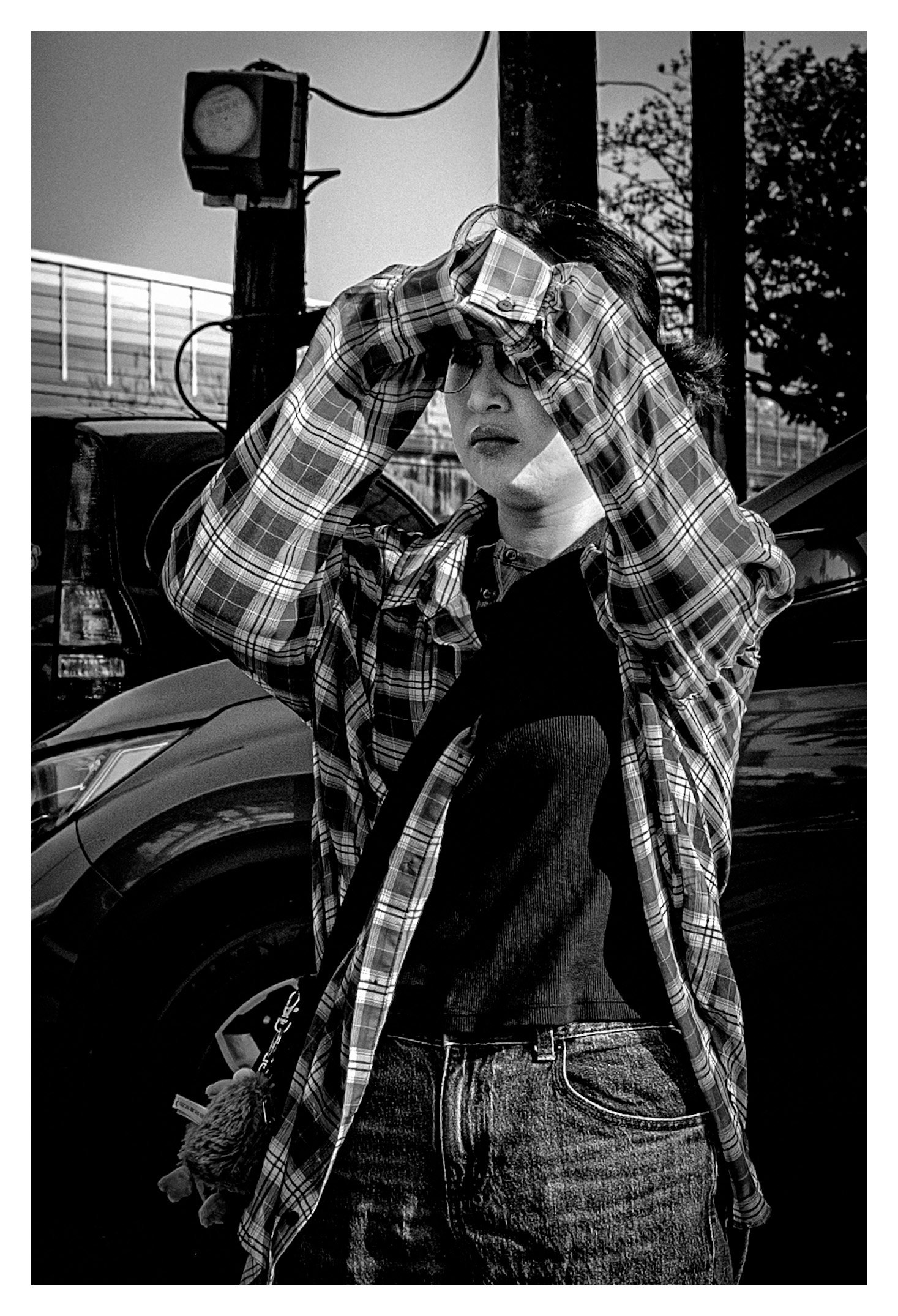
The interplay of harsh light and shadow often reveals more than it hides. In this critique of a striking monochrome street portrait, we explore how technical precision meets raw human emotion. You will discover why certain compositional choices can either anchor a subject or set them adrift.
Technical Specifications
Camera Model: Ricoh GRIII
Shutter Speed: 1/1000
Aperture: f4
ISO: 200
The Critique: Texture and Tension
This image thrives on its aggressive, high-contrast aesthetic—a hallmark of the Ricoh GRIII's "Hard Monochrome" signature. You have captured a moment of peculiar tension; the subject's gesture, shielding their eyes or perhaps adjusting glasses, creates a geometric "mask" that heightens the mystery of the expression.
The choice of a fast 1/1000 shutter speed was vital here. It has frozen the micro-movements of the hands and the texture of the flannel shirt with clinical sharpness. The f4 aperture provides enough depth of field to keep the subject's face and clothing crisp while allowing the background to fall into a slightly less distracting, though still present, urban texture.
However, the composition struggles with "visual noise." The black vertical pillars and the car in the background compete for the viewer’s attention. The dark mass of the car’s roofline nearly merges with the subject's torso, which can "muddy" the silhouette.
Paths to Improvement
• Mind the Merges: To elevate this shot, pay closer attention to where the subject’s silhouette meets the background. Moving six inches to the left might have separated the subject from the dark pole, allowing the shape of the head to pop against the lighter sky.
• The Power of the Crop: Experiment with a tighter vertical crop that eliminates the car's taillight on the left. By forcing the viewer to focus solely on the intersection of the plaid sleeves and the face, you intensify the psychological weight of the portrait.
• Exposure Bias: When shooting in such harsh light, try underexposing by -0.3 or -0.7 EV. This will preserve the highlights in the white squares of the flannel while deepening the blacks, pushing the image toward a more "Provoke-style" aesthetic.
Becoming a Master through Data
To evolve, you must move beyond the "single shot" mentality. Start a Photographic Audit Log. For every 100 images you keep, record the following:
1. Light Quality: Was it harsh midday sun, golden hour, or artificial?
2. Emotional Intent: What did you feel when you clicked the shutter?
3. Success Rate: Did the "Hard Mono" setting enhance the subject or hide a lack of interesting light?
Over time, you will notice patterns. You might find you favor f4 for street work but struggle with background separation. This data-driven approach removes the guesswork from your growth.
Curated Resources for Study
Photographers to Research
• Daido Moriyama: For his revolutionary use of grain, high contrast, and the "blur, shaky, out-of-focus" aesthetic that defined an era of Japanese photography.
• Fan Ho: Observe how he used light and shadow to create geometric perfection within the chaos of the street.
Recommended Reading
• "For a Language to Come" by Takuma Nakahira: A foundational text for understanding the "Provoke" movement and urban alienation.
• "The Decisive Moment" by Henri Cartier-Bresson: To understand the marriage of geometry and timing.
Watch and Learn
• The High Contrast Street Photography Style of Daido Moriyama: https://www.youtube.com/watch?v=VAnu-IByYAc
• The Photography of Fan Ho – Hong Kong Yesterday: https://www.youtube.com/watch?v=3S_vunI6X90