

Day 182/365 Panning through the Pulse of Kaohsiung
Ever wonder why some street photos feel alive while others feel frozen? This critique of a high-speed Kaohsiung encounter explores the delicate balance of shutter speed and tracking. You will learn how technical data can transform your creative output and why the right aperture makes all the difference.
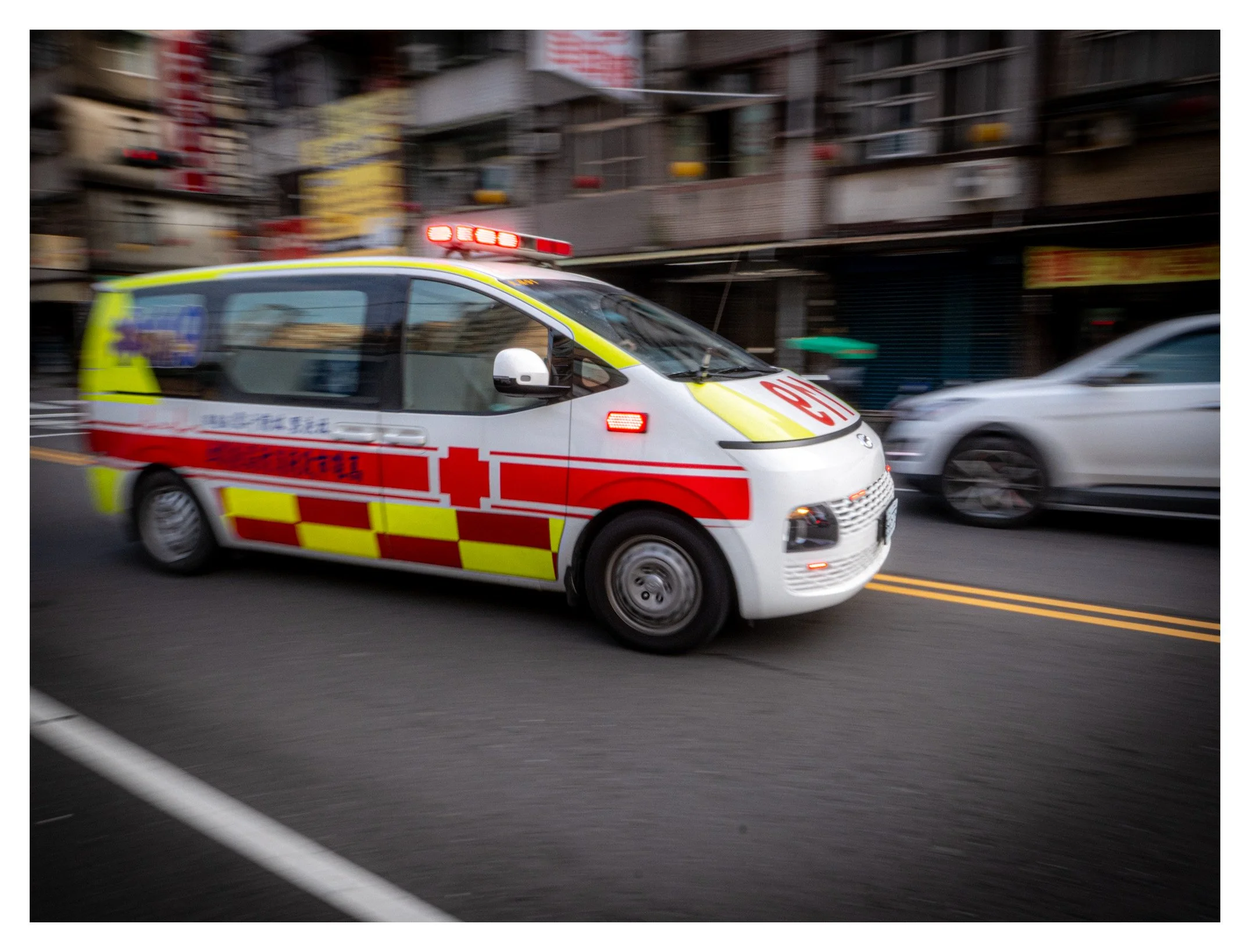
Captured on the move, this frame leans into the kinetic energy of the city. The blurred background and the sharp, central focus on the emergency vehicle create a narrative of urgency and precision amidst the urban chaos.
Technical Profile
Camera Model: Leica D-Lux 8
Shutter Speed: 1/30
Aperture: f/14
ISO: 200
Critical Analysis and Improvement
The image successfully utilizes a panning technique to convey motion. At 1/30 of a second, you have managed to keep the cabin of the ambulance remarkably sharp while the street environment dissolves into linear streaks. This creates a high-stakes, cinematic atmosphere.
Areas for Refinement:
• Compositional Breathing Room: The ambulance is cropped slightly tight at the front. In high-action street photography, leaving more "lead room" in front of the moving object allows the viewer’s eye to follow the direction of the travel, enhancing the feeling of speed.
• Aperture Management: Shooting at f/14 can introduce diffraction, which slightly softens the overall image. To maintain that 1/30 shutter speed in daylight while using a wider aperture (like f/5.6 or f/8) for maximum sensor sharpness, consider using a Neutral Density (ND) filter.
• Color Narrative: The red and yellow livery is iconic. In post-processing, subtly desaturating the background blues or grays can make the primary colors of the emergency vehicle pop even more significantly.
Path to Mastery: Data and Discipline
To evolve as a photographer, you must move beyond the "lucky shot." I recommend keeping a shooting log that correlates your technical settings with your emotional success rate.
• Analyze the Ratios: Track how many "keepers" you get at specific shutter speeds (1/15 vs 1/30 vs 1/60). This builds an intuitive muscle memory for motion blur.
• Metadata Mapping: Use your blog data to see which focal lengths you gravitate toward. If you are always at the wide end, challenge yourself to shoot exclusively at a "normal" 50mm equivalent for a month to force new perspectives.
Curated Resources for Study
Photographers to Research
• Ernst Haas: A pioneer in the use of motion and color blur. His work in the 1950s transformed photography from a static medium into a fluid art form.
• Shen Chao-Liang: Specifically his STAGE series. His work captures the "stage wagons" of Taiwan with a surreal, nocturnal quality that explores cultural landscapes through light and color.
Essential Reading
• The Decisive Moment by Henri Cartier-Bresson: The "bible" of street photography, focusing on the perfect synchronization of geometry and time.
• Uncommon Places by Stephen Shore: Master this for your understanding of the "cultural landscape" and how to find beauty in the mundane structures of the street.
Video Lectures
• The Art of Street Photography (Magnum Photos): A deep dive into the philosophy of capturing life as it happens.
• Panning Technique Masterclass: Understanding the physics behind the blur.