

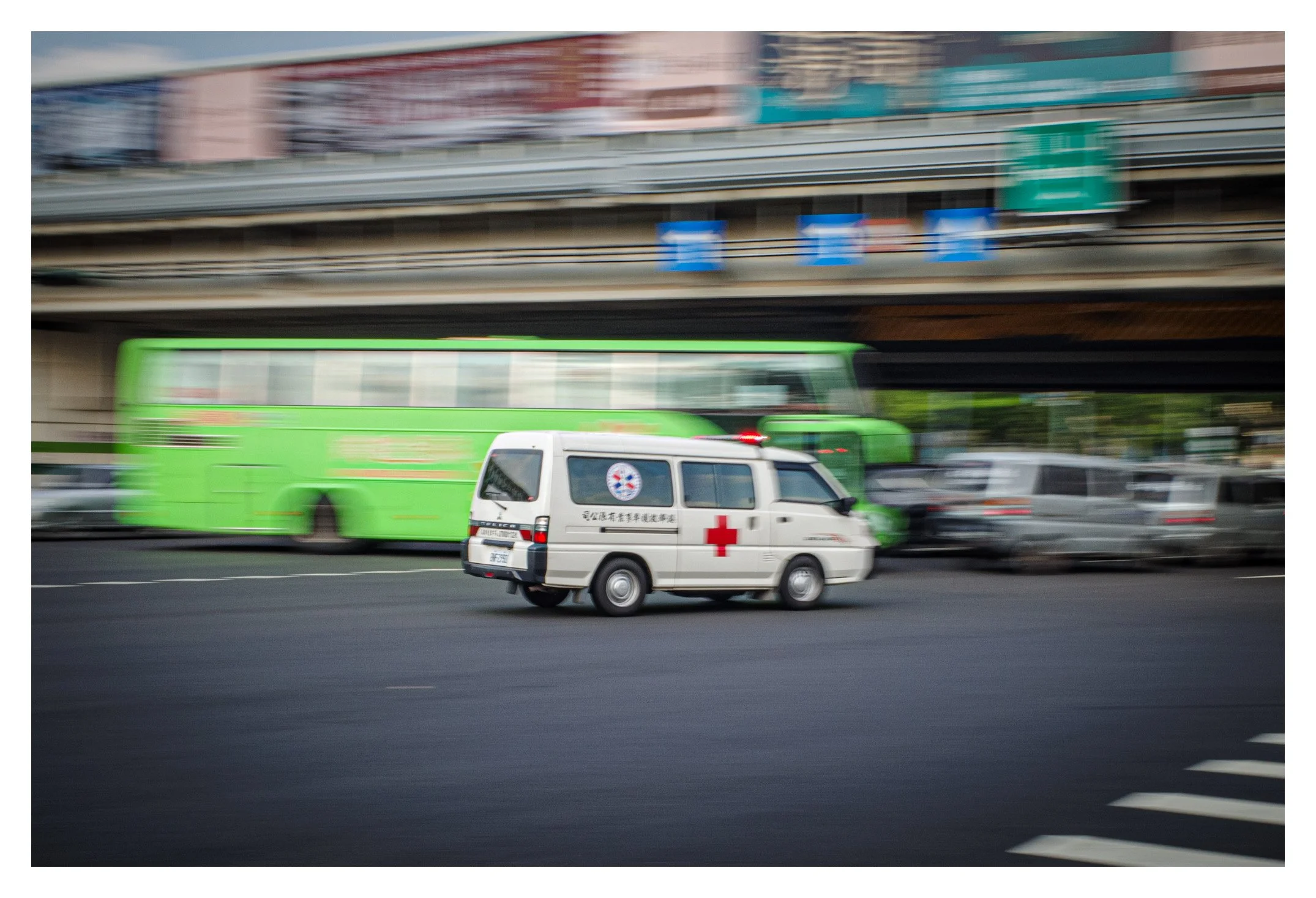
Can a single second define the soul of a city? In this critique of a Kaohsiung street scene, we deconstruct the technical risks of slow-shutter panning. You will learn why choosing the right aperture is the difference between a masterpiece and a blur, and how to refine your urban eye.
Camera Model
Ricoh GR III
Shutter Speed
1/13
Aperture
f16
ISO
200
This frame captures a quintessential urban moment: the friction between emergency and the everyday. By utilizing a slow shutter speed of 1/13, you have transformed the frantic energy of a Kaohsiung intersection into a painterly study of motion. The ambulance remains our anchor, while the neon-green bus and the architectural backdrop dissolve into streaks of velocity, creating a compelling narrative of a "city in flux."
Technical Critique and Room for Growth
While the sense of motion is palpable, a few adjustments could elevate the formal qualities of the work:
• The Diffraction Trap: At f16, most lenses—including the sharp optic on your Ricoh—begin to suffer from diffraction, which softens the image. To maintain that "bite" in the details of the ambulance, try using a Neutral Density (ND) filter. This would allow you to keep your 1/13 shutter speed while opening the aperture to a "sweet spot" like f5.6 or f8.
• Vertical Stability: Panning is a horizontal art. There is a slight vertical "jitter" in the blur of the background. To refine your technique, keep your elbows tucked into your ribs and rotate from the hips in one fluid, clock-like motion.
• Color Grading: The green of the bus is quite dominant. Consider desaturating the greens slightly or warming up the asphalt to ensure the red of the ambulance's cross remains the primary focal point of the viewer's eye.
Compiling Your Vision: The Path Forward
To grow from a hobbyist to a master, you must treat your digital archive as a laboratory.
1. Metadata Tagging: Use your blog or a local database to track which shutter speeds work best for specific vehicle types (e.g., scooters vs. buses).
2. Success Rate Analysis: Record the "keeper" ratio of your panning shots. Over time, you’ll notice if you’re more successful panning left-to-right or right-to-left, allowing you to choose your street corners more strategically.
3. Thematic Categorization: Don't just look at single shots. Group images by "Motion," "Geometry," or "Color." Seeing your work in a series will reveal your true subconscious interests.
Inspiration for Your Library
Photographers to Study
• Alex Webb: A master of "complex" frames. Study how he uses vibrant colors and layers to create depth in street scenes.
• Takuma Nakahira: Research his "provoke" era work. His "Are, Bure, Boke" (grainy, blurry, out-of-focus) aesthetic will give you a deeper philosophical appreciation for intentional motion blur.
• Fan Ho: Specifically for his use of light and shadow in urban environments to create a sense of timelessness.
Books to Read
• The Decisive Moment by Henri Cartier-Bresson: The "bible" of photography. It will teach you the exact moment when geometry and emotion intersect.
• Thoughts on Street Photography: A collection of essays that explores the philosophy and theory behind the lens.
• The Americans by Robert Frank: Essential for understanding how to capture the "soul" of a place through an outsider's perspective.
Videos to Watch
• The Art of Panning (Masterclass): How to Master Panning Photography
• Ricoh GR III Street Photography: Samuel Streetlife - Panning with the GR III