

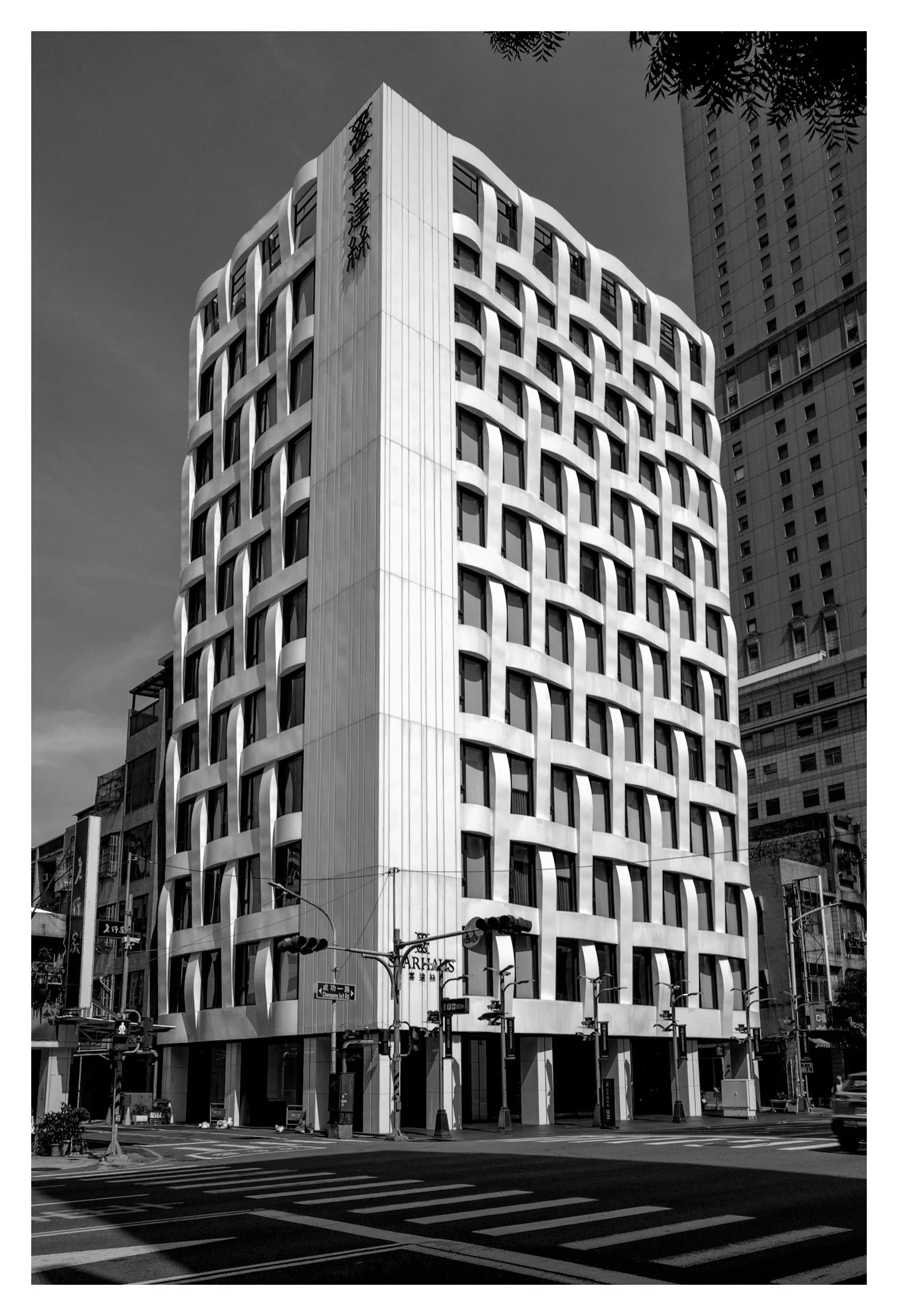
The interplay of vertical and horizontal lines in Kaohsiung creates a mesmerizing "woven" facade that challenges our perception of architectural scale. You’ll learn why a strict monochrome palette is essential for isolating these textures and how to use high apertures to maximize urban detail.
EXIF Data
Camera Model: Ricoh GRIII
Shutter Speed: 1/60
Aperture: f16
ISO: 200
The Critique
This image is a sophisticated study of pattern and rhythm. By stripping away color, you have forced the viewer to engage directly with the building’s unique "basket-weave" texture. The high-contrast black and white treatment accentuates the shadows within the recessed windows, providing a depth that feels almost tactile.
The verticality is well-handled, but the inclusion of the street-level elements—the traffic lights and signage—creates a tension between the "idealized" geometry of the tower and the chaotic reality of the city. While this provides context, it also competes for the viewer's attention.
How to Improve
• Correct the Perspective: Even with the wide-angle lens of the GRIII, there is a slight "keystone" effect where the building appears to tilt backward. Using a "Transform" tool in post-processing to straighten the vertical lines would give the structure a more monumental, imposing presence.
• Refine the Framing: The small portion of the building on the right and the tree leaves at the very top edge are slightly distracting. Consider a tighter crop or a slightly different vantage point to eliminate these peripheral "anchors" and let the main subject breathe.
• Shadow Detail: At f16, you have incredible sharpness, but the deep blacks in the lower left are somewhat "crushed." A slight lift in the shadows would reveal the street-level textures without sacrificing the overall drama.
Becoming a Master
To evolve as a photographer, you must treat your work like a scientist treats data. Since you are already recording metadata, start a Photography Audit Log. For every 100 images, identify your "Hero" shot and compare it to the "Misses." Note the common denominators: Is it a specific aperture? A certain time of day? Over time, this data will reveal your subconscious style and technical "blind spots."
Research and Study:
• Photographer: Joel Tjintjelaar. He is a modern master of black and white architectural photography who uses long exposures to create ethereal, clean urban looks.
• Photographer: Fan Ho. Study his work in Hong Kong for his masterful use of shadows and "the decisive moment" within urban environments.
• Book: Architectural Photography, 3rd Edition by Adrian Schulz. This is a definitive guide on composition and the technical nuances of shooting buildings.
• Book: The Americans by Robert Frank. While more "street" than "architecture," it will teach you how to capture the soul of a place through its structures and inhabitants.
Watch:
• 5 Tips For Great Architectural Photography – A great primer on stacking buildings and capturing reflections.
• Architecture Photography Post-Processing – Essential for learning how to manage the "straight lines" and tonal balance I mentioned earlier.