

Day 190/365 The Geometry of Routine: Red, Green, and the Streets of Kaohsiung
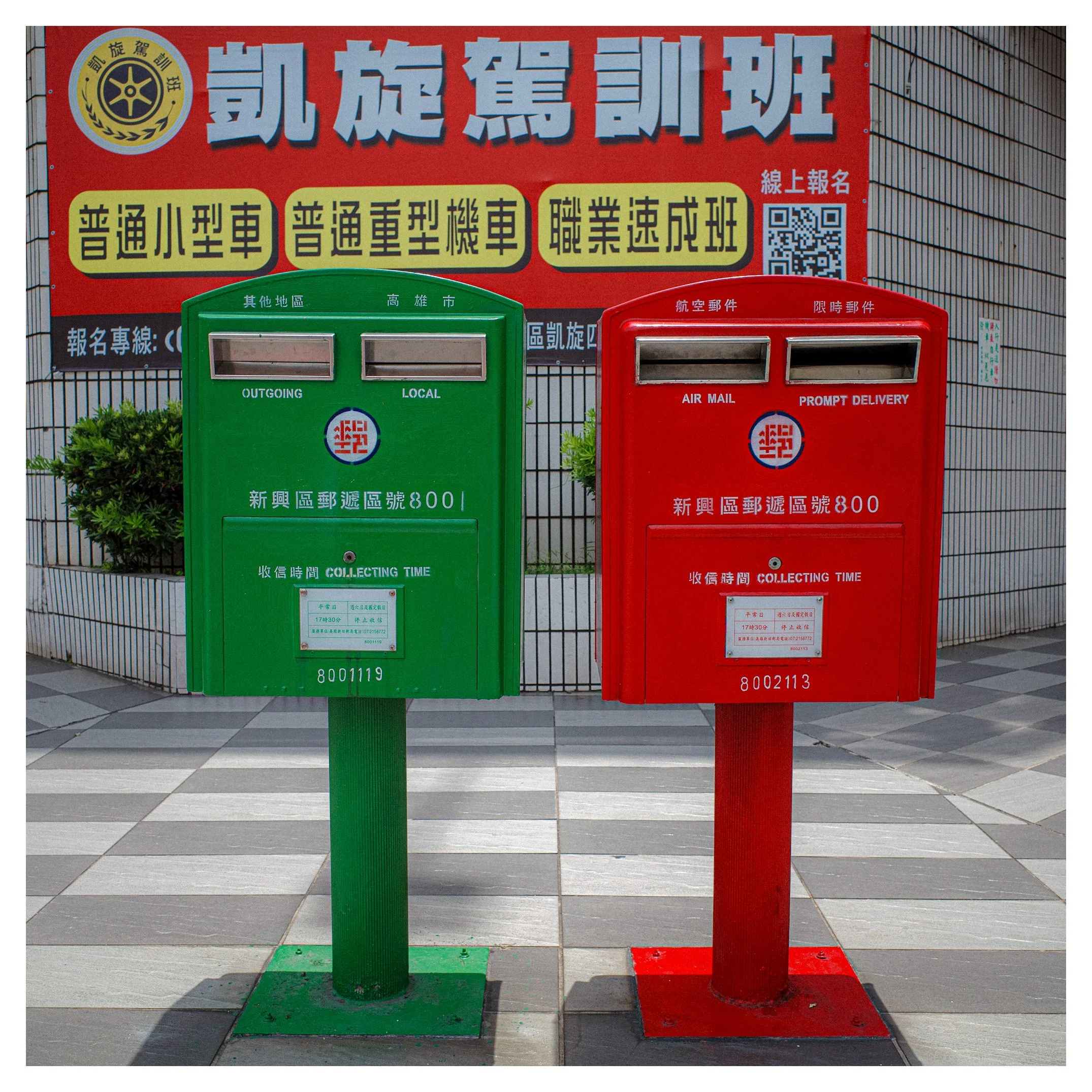
This image captures the stoic symmetry of Taiwan’s postal service, transforming everyday utility into a balanced study of color and form. We explore how a simple Kaohsiung sidewalk reveals the quiet artistry of urban life and the delicate interplay of local tradition.
Image Metadata
Camera Model
Ricoh GRIII
Shutter Speed
1/1125
Aperture
f/4.5
ISO
200
A Critical Perspective
There is a striking, almost Wes Anderson-esque theatricality to this composition. By placing these two iconic mailboxes—the green for local and the red for airmail/prompt delivery—at the center of your frame, you have elevated a mundane street corner into a formalist dialogue. The high contrast between the primary colors of the bins and the desaturated, geometric patterns of the tiled ground creates a satisfying visual anchor.
The "Kaohsiung Driving School" banner in the background adds a layer of local texture. However, as it stands, that banner competes for the viewer's attention. The text is sharp and vibrant, which pulls the eye upward and away from the primary subjects. You have captured a moment where the city's "noise" meets its "order."
Refining the Vision
To improve this specific shot, consider your depth of field. While f/4.5 on a Ricoh GRIII is relatively wide, the small sensor means most of the background remains in focus. To truly make the mailboxes "pop," a tighter crop or a lower angle might have minimized the distracting text of the banner, allowing the silhouettes of the boxes to dominate the frame against the sky or a simpler architectural detail.
Additionally, pay attention to the shadows. The harsh midday light creates short, dark shadows directly beneath the pedestals. Returning during the "Golden Hour" would cast long, elegant shadows across the tiles, adding a sense of time and movement to an otherwise static scene.
The Path to Mastery: Compiling Your Data
To evolve as a photographer, you must move beyond the "single shot" mentality. Start a Technical Audit Journal. For every 500 photos you take, use your metadata to identify patterns:
• Aperture Trends: Are you shooting everything at f/4.5 because it is a "safe" middle ground? Force yourself to spend a week at the extremes—wide open or fully stopped down—to understand how your lens renders the world.
• Focal Length Consistency: Even with a fixed 28mm equivalent like the GRIII, analyze your proximity. Are you always standing the same distance from your subject? Data will show you if you are becoming "physically lazy."
• Light Mapping: Tag your photos by "Light Type" (Overcast, Midday, Harsh, Neon). You will soon see which environments your eye naturally gravitates toward and where you need more practice.
Curated Inspiration
To further your education, I recommend looking into the following masters and resources who excel at finding the extraordinary within the ordinary.
Photographers to Study
• Fan Ho: Specifically his work in Portrait of Hong Kong. His mastery of light and shadow in urban environments is unparalleled.
• William Eggleston: Study his Guide. He is the pioneer of making the "boring" colorful objects of daily life (like these mailboxes) look like fine art.
• Chien-Chi Chang: Look at his series The Chain to see how a Taiwanese master handles repetition and social context within a frame.
Essential Reading
• "The Decisive Moment" by Henri Cartier-Bresson: This is the "bible" of street photography, focusing on geometry and timing.
• "Uncommon Places" by Stephen Shore: A masterclass in how to photograph the built environment with intentionality.
Video Resources
• The Art of Street Photography (Magnum Photos): A deep dive into the philosophy of the craft. Watch here
• The Control of Color - William Eggleston: Understanding how to use vibrant primaries in a composition. Watch here