

Day 189/365 Rising from the Underground: The Phoenix at Central Park
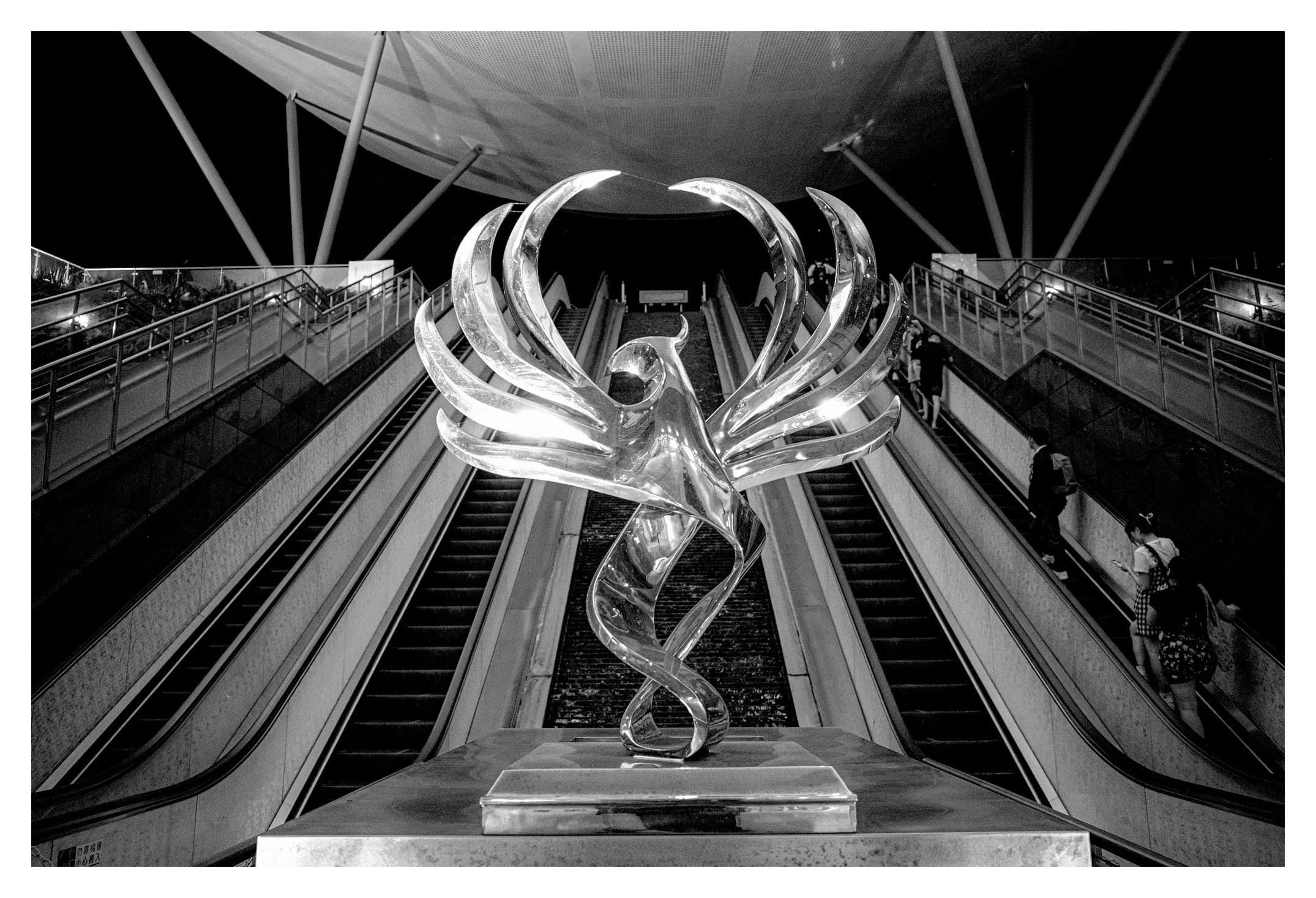
The steel wings of "The Phoenix" create a striking silhouette against the urban machinery of Kaohsiung. You will learn why this specific composition works to elevate industrial subjects and how analyzing your metadata can turn a single snapshot into a career-defining technical masterclass.
The Metadata
• Camera Model: Ricoh GR III
• Shutter Speed: 1/100
• Aperture: f/2.8
• ISO: 200
Critical Analysis and Improvement
Your use of the Ricoh GR III—a master’s tool for street and urban work—shines here through the lens's sharpness and the rendering of light on the sculpture's metallic surfaces. The black and white conversion emphasizes the graphic quality of shadows and highlights, turning the escalators into leading lines that guide the eye directly to the avian focal point.
Recommendations for Improvement:
• Depth of Field Management: While f/2.8 provides a beautiful blur in close-up portraits, for architectural subjects with deep receding lines (like these escalators), consider stopping down to f/5.6 or f/8. This would sharpen the background textures, adding a more "environmental" grit to the composition.
• Symmetry and Leveling: In urban photography, even a 1^\circ tilt can disrupt the viewer’s immersion. Ensure your horizon is perfectly level and your centering is precise to lean into the formal, almost religious symmetry of the "Phoenix".
• Long Exposure experimentation: Since the Ricoh GR III has built-in stabilization, you could attempt a slower shutter speed (around 1/15 or 1/25) to capture the "ghostly" motion of commuters on the escalators while the Phoenix remains tack-sharp, creating a contrast between the eternal and the ephemeral.
Building Your Photographic Vision
To grow, you must move beyond the "single shot" and begin compiling and analyzing your data. Review your library and look for patterns: do you consistently shoot at f/2.8? If so, you are relying on bokeh rather than composition. Are your best shots always at ISO 200? You might be missing opportunities in high-contrast, high-ISO night scenes where the GR III’s "grit" can be a stylistic asset.
Recommended Photographers to Study
• Fan Ho: For his legendary use of light, shadow, and geometric composition in urban environments.
• Chien-Chi Chang: Specifically his work in The Chain, to understand how to frame subjects within restrictive or repetitive environments.
• Daido Moriyama: To see how high-contrast, grainy black and white can breathe life into cold, urban structures.
Essential Reading
• "The Decisive Moment" by Henri Cartier-Bresson: The bible of timing and geometry.
• "Think Like a Street Photographer" by Matt Stuart: For practical, modern advice on finding humor and layering in public spaces.
• "Magnum Contact Sheets" edited by Kristen Lubben: To see the "failures" that led to the masterpieces, teaching you the value of the process.
Watch and Learn
• Ian Plant: Mastering Composition – A deep dive into organizing visual elements beyond the "Rule of Thirds": https://www.youtube.com/watch?v=7lXUQU48NNc.
• How Composition and Light Can Instantly Improve Your Photos – Essential for understanding how framing affects narrative: https://www.youtube.com/watch?v=mNUwfb2Tenc.