

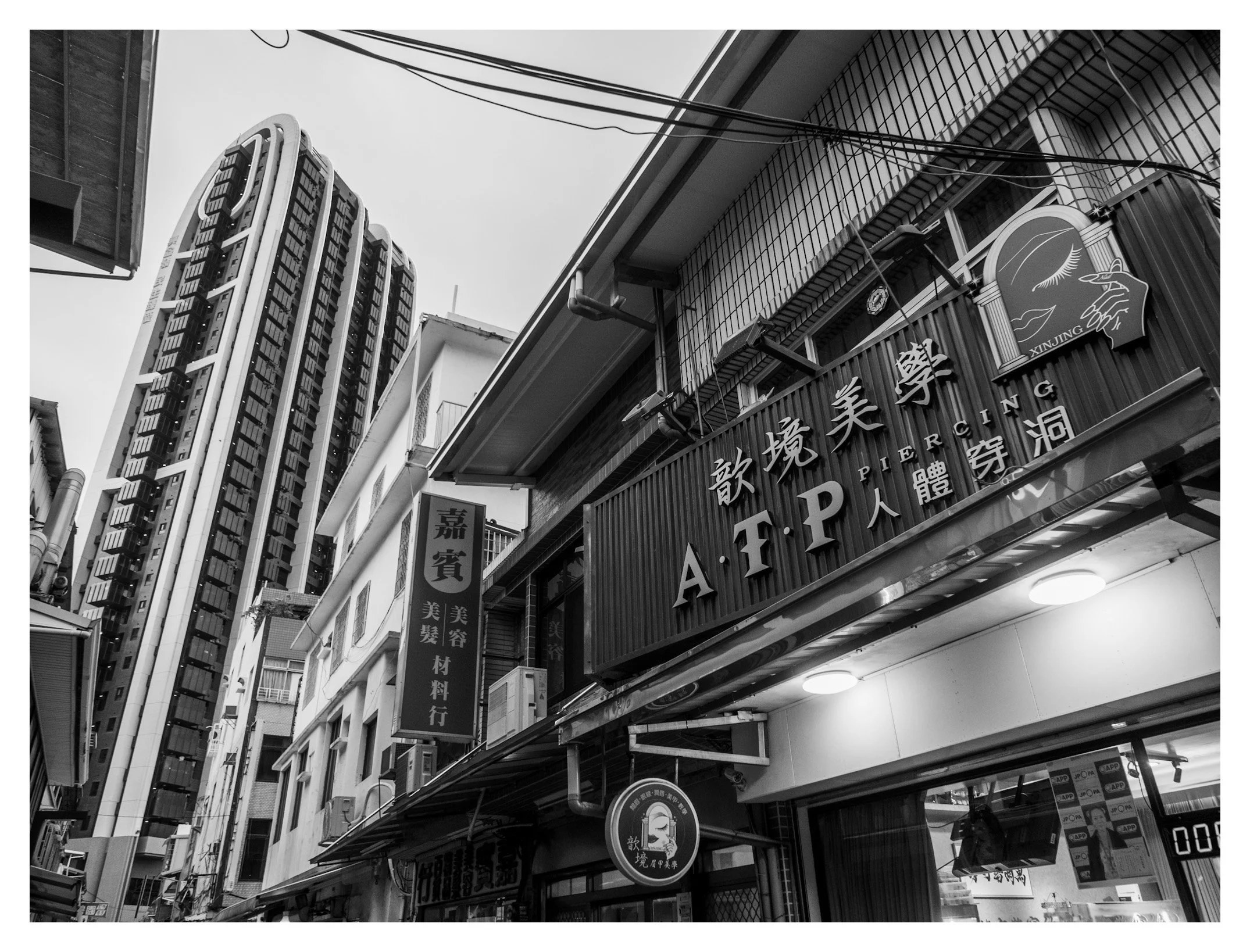
The tension between Taiwan’s traditional street-level grit and its soaring modern ambitions creates a unique visual friction. In this critique, we examine how a low-angle monochrome perspective transforms a Kaohsiung storefront into a dramatic study of urban layers. Discover how framing these structural contradictions can redefine your street photography.
EXIF Data
Camera Model: Leica D-Lux 8
Shutter Speed: 1/125
Aperture: f2.8
ISO: 200
The Critique: Deep Focus on the Concrete Jungle
This image thrives on diagonal energy. By positioning yourself at a low vantage point, you have turned the mundane—a piercing studio and a beauty supply shop—into a launching pad for the eye. The leading lines of the electrical wires and the roof eaves slice through the frame, creating a kinetic movement toward that towering residential monolith in the background.
The choice of monochrome is your strongest asset here. In a city as color-saturated as Kaohsiung, the "visual noise" of competing neon signs often distracts from the geometry. Stripping away the color forces the viewer to focus on the textures: the corrugated metal of the ATP sign, the repetitive window patterns of the skyscraper, and the chaotic tangle of utility lines.
However, we need to talk about scale and separation. While the perspective is dramatic, the transition between the mid-ground white building and the background skyscraper feels slightly compressed. The Leica D-Lux 8 is a powerhouse, but at f2.8 in broad daylight, you are flirting with a loss of micro-contrast in the sky.
How to Improve This Image
• Stop Down for Structural Integrity: While f2.8 is tempting for light, architectural street scenes often benefit from f5.6 or f8. This would sharpen the peripheral details of the signage and provide a more "clinical" bite to the textures of the buildings.
• The Human Element: The composition is technically sound but emotionally "still." Waiting for a single figure to exit the ATP studio or a scooter to pass in the lower third would provide a sense of scale and a "heartbeat" to the architectural geometry.
• Manage the Highlights: The sky is a bit "hot" near the upper left. Using a polarizing filter or slightly undervaluing your exposure would allow you to pull more detail out of those high-key areas during post-processing.
Evolution Through Data: The Path Forward
To grow from a hobbyist to a master, you must stop treating images as isolated events and start treating them as data sets.
• The 500-Frame Audit: Every six months, export your metadata. Look for patterns. Are you always shooting at the widest aperture? Are you leaning on 24mm because it’s easy? If 80% of your shots are wide-angle at f2.8, challenge yourself to shoot a "Telephoto Month" at f11. Forcing yourself out of your technical comfort zone is how style is born.
• Keyword Tagging: Use your database to tag "Emotional Intent." Was this shot about alienation, chaos, or beauty? Over time, you will see which themes produce your strongest work.
Research and Study
Photographers to Study
• Fan Ho: Master his use of light and shadow in urban environments. He turned the streets of Hong Kong into a stage of dramatic silhouettes.
• Michael Wolf: Specifically his "Architecture of Density" series. It will change how you perceive the repetitive patterns of high-rise living.
• Lee Friedlander: Study how he incorporates "social landscape" elements—signs, wires, and reflections—into complex compositions.
Required Reading
• The Decisive Moment by Henri Cartier-Bresson: The "Bible" of street photography. Focus on his theories regarding geometry and timing.
• The Americans by Robert Frank: Essential for understanding how to photograph a culture from the perspective of an "outsider" or observer.
• Thoughts on Street Photography: Deepen your philosophical approach to the craft through essays on the "why" behind the "what."
Watch and Learn
• The Beauty of Monochrome: A deep dive into tonal range and why black and white remains a powerful tool for modern cityscapes.
• Mastering Black and White Photography
• Compositional Theory: Understanding how to use leading lines and "The Golden Ratio" in street environments.