

Day 203/365 Ferris Wheels and False Horizons: An Urban Critique
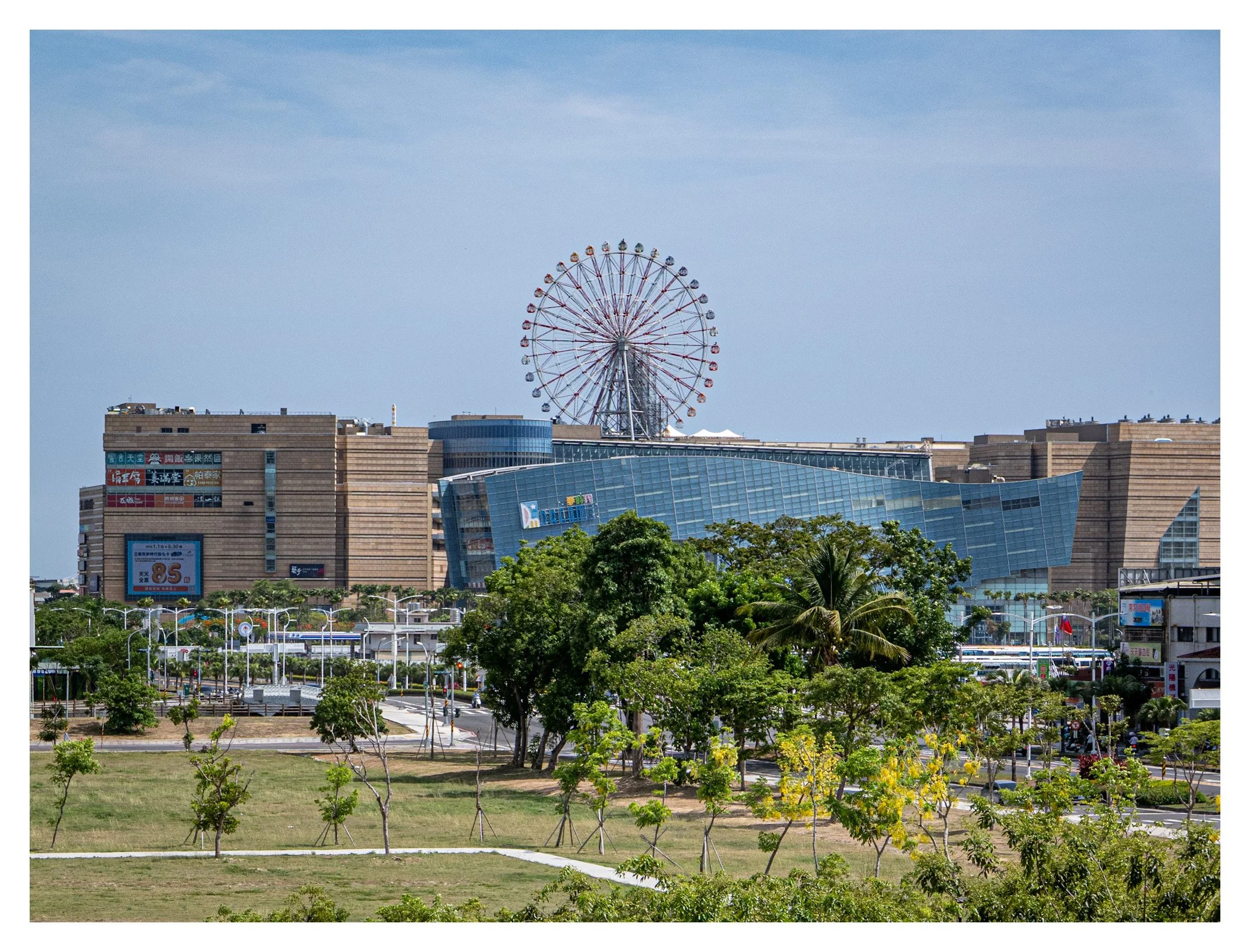
Capturing the scale of Kaohsiung’s Dream Mall requires more than just pointing at the skyline. You’ll learn why a midday sun might be sabotaging your architectural shots and how a simple shift in your perspective can transform a standard city view into a compelling narrative of urban life.
Image Metadata
Camera Model: Leica D-Lux 8
Shutter Speed: 1/640
Aperture: f/5.6
ISO: 200
The Critique: Finding the Narrative
The Dream Mall is a titan of Kaohsiung’s landscape, and capturing it with the Leica D-Lux 8 allows for a beautiful rendering of detail. However, this image suffers from a common urban photography pitfall: the competing subject.
The Ferris wheel is naturally the "eye-catcher," yet it is physically dwarfed by the massive glass facade of the mall in the mid-ground and partially obscured by the lush greenery in the foreground. This creates a visual tension where the viewer’s eye struggles to settle. The lighting, typical of high-noon or early afternoon, is flat and somewhat harsh, which washes out the textures of the mall’s stone-like siding and the intricate metalwork of the wheel.
Improving the Frame
• The Golden Hour Shift: Return to this spot at approximately 5:30 PM. As the sun sets, the "cinematic beauty" of Kaohsiung emerges; the mall’s glass will reflect the twilight blue and gold, and the Ferris wheel will likely be illuminated, providing a much-needed pop of color and light against the darkening sky.
• Compression vs. Depth: You are using a wide-to-mid focal length here. Consider moving closer or zooming in to use the foreground trees as a deliberate frame rather than a barrier.
• The User Profile Advantage: Since you are shooting with the D-Lux 8, set up a specific "Landscape" or "Architecture" user profile. This allows you to lock in settings—perhaps a slightly narrower aperture like f/8 for maximum sharpness across the plane—so you can focus entirely on the composition when the light is changing rapidly.
Becoming a Better Photographer
To evolve, you must stop taking "pictures" and start making "observations". Compiling data is your strongest tool. Start a digital database of your work—categorizing them by subject and style—to identify where you are consistent and where you are merely "experimental".
Photographers to Study
• Shen Chao-Liang: Specifically his STAGE series. He masterfully captures Taiwanese cultural landscapes and "stage wagons" at night, using light to turn ordinary structures into surreal masterpieces.
• Chien-Chi Chang: Look at The Chain. While the subject matter is heavy (portraits of mental asylum inmates), his use of consistency and vision within a series is a masterclass in photographic storytelling.
• Fan Ho: For his 1950s Hong Kong street photography. His mastery of "nostalgia, shadow, and monochrome" will teach you how to find geometry and soul in a crowded urban environment.
Recommended Reading
• Light — Science & Magic: This is the definitive guide to understanding how light works. Applying these principles will turn your lighting "upside-down" in the best way possible.
• On Photography by Susan Sontag: A collection of essays that will make you think about the ethics and the "control mechanism" of the camera itself.
• The Decisive Moment by Henri Cartier-Bresson: The "bible" of timing and geometry in photography.
Videos to Watch
• The Art of Photography (Ted Forbes): Excellent for deep dives into the history and philosophy of the medium.
• Sean Tucker: Focuses on the "why" of photography and finding your personal voice.
• Thomas Heaton: Essential for landscape inspiration and seeing the "behind-the-scenes" process of finding a shot.