

Day 208/365 Echoes in the Architecture: A Symmetrical Critique at Kaohsiung Harbour
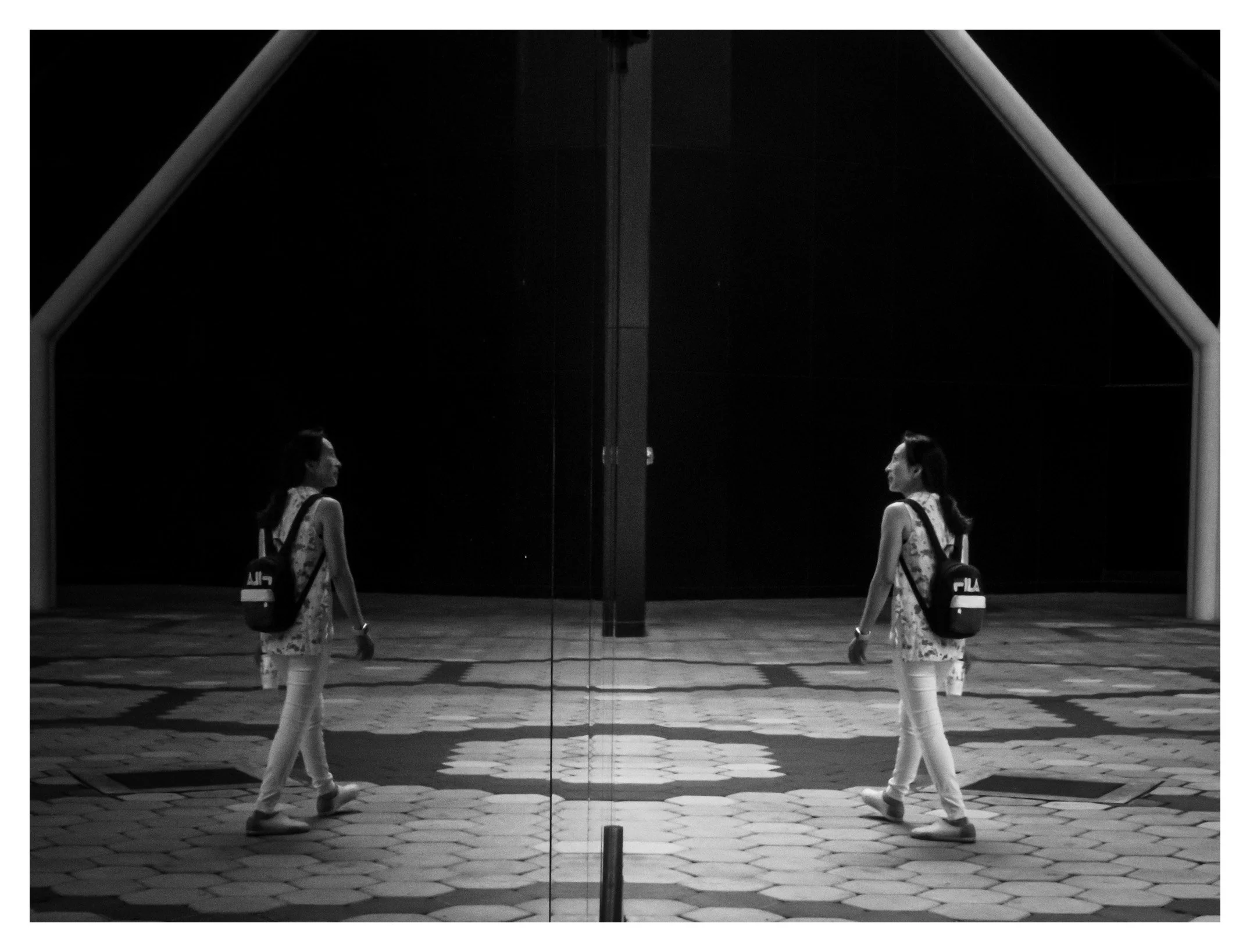
Discover how a single step can split reality in two. We dissect a striking monochrome frame from Kaohsiung Harbour to learn why your choice of aperture might secretly be working against your street photography goals.
This black-and-white photograph offers an exceptional study in symmetry, urban architecture, and existential pacing. The frame captures a singular figure in mid-stride, duplicated through a pristine glass or mirrored reflection, creating a compelling visual dialogue between reality and its twin.
Before diving into the conceptual and aesthetic layers of this piece, let us look at the technical foundation.
Technical Metadata
• Camera Model: Leica D-Lux 8
• Shutter Speed: 1/125s
• Aperture: f/16
• ISO: 2500
• Location: Kaohsiung Harbour, Taiwan
The Critique: Symmetry and Alienation
The immediate strength of this image lies in its precise geometric construction. The structural white beams frame the top corners like a proscenium arch, transforming the public space of Kaohsiung Harbour into a theatrical stage. By bisecting the frame with the vertical seam of the reflective surface, you have created a classic rorschach effect that forces the viewer's eye to oscillate between the left and right subjects.
The choice of monochrome is vital here; it strips away the distracting modern colors of the subject's clothing and the environment, emphasizing texture instead—the hexagonal pavers on the ground, the deep void of the dark background, and the stark contrast of the white trousers and sneakers. The subject’s posture, caught in a synchronized stride where both figures face inward toward the center axis, suggests a theme of self-confrontation, isolation, or the dual paths of a journey.
However, looking closely at your technical choices reveals a few missed opportunities. Shooting at f/16 has pushed your camera into diffraction territory, softening fine details, while forcing your ISO up to 2500. This introduced noticeable digital noise/grain that, while giving an gritty street feel, undercuts the smooth, clinical precision that this type of architectural geometry usually demands. Furthermore, 1/125s is just barely fast enough to freeze human motion; a slight hint of softness is visible in the feet.
How to Improve the Image
• Optimize Your Exposure Triangle: For street photography in dimming light or shaded structures, prioritize an aperture sweet spot like f/5.6 or f/8. This would have allowed you to drop your ISO to a much cleaner 400 or 800, eliminating noise, while allowing a faster shutter speed (e.g., 1/250s or 1/500s) to crisply freeze the walking motion.
• Refine the Horizon Line: The ground texture slightly tilts toward the right. In highly geometric, symmetrical compositions, even a fraction of a degree off-axis can break the illusion. A minor rotational crop in post-processing will lock the symmetry perfectly.
• Manage the Deep Blacks: The negative space in the upper center is incredibly dense. Consider burning the top edges slightly more to completely blend the structural ceiling into an absolute void, or subtly lifting the shadows to reveal just a hint of the background architectural texture to give the space more depth.
Elevating Your Craft: Compiling Image Data
To transition from taking great individual photos to mastering the medium, you must start auditing your own behavior through data compilation. Keep a photographic journal or a digital spreadsheet of your shoots to track the following metrics:
• The Intent-to-Execution Ratio: Log whether a photo was a "discovered moment" (reactive street photography) or a "pre-visualized frame" (waiting for someone to walk into a composed geometry).
• Metadata Clustering: Track your most used focal lengths, apertures, and ISO settings. If you find you are constantly shooting at f/16 out of habit, force yourself onto an "f/4 only" assignment for a month to break your comfort zones.
• Hit-Rate Analysis: Note how many frames you took of a single scene before achieving the "decisive moment." Did you take 30 shots or just 1? Over time, this data will show you if you are working a scene thoroughly or shooting blindly.
Curated Research for Growth
Master Photographers to Study
• Fan Ho: The ultimate master of geometric street composition, urban solitude, and dramatic use of scale within architectural lines in Hong Kong.
• Chien-Chi Chang: A legendary Taiwanese Magnum photographer whose work—particularly his seminal book The Chain—masterfully explores themes of alienation, human connection, and structural isolation.
Essential Reading
• The Decisive Moment by Henri Cartier-Bresson: The bible of street photography composition, which teaches you how to align the brain, the eye, and the heart along the same axis of a fraction of a second.
• Thoughts on Landscape (or architectural essays) by Shen Chao-Liang: To better understand the surreal integration of modern structures and cultural landscapes within Taiwan.
Instructional Videos to Watch
• "How to Shoot Street Photography Privately" by Sean Tucker: A phenomenal look at finding light, waiting for subjects to enter the frame, and handling the ethics of public spaces. Watch it on YouTube.
• "The Power of Negative Space in Photography" by The Art of Photography (Ted Forbes): This video breaks down how to balance vast dark areas with dynamic subjects to create tension. Watch it on YouTube.