

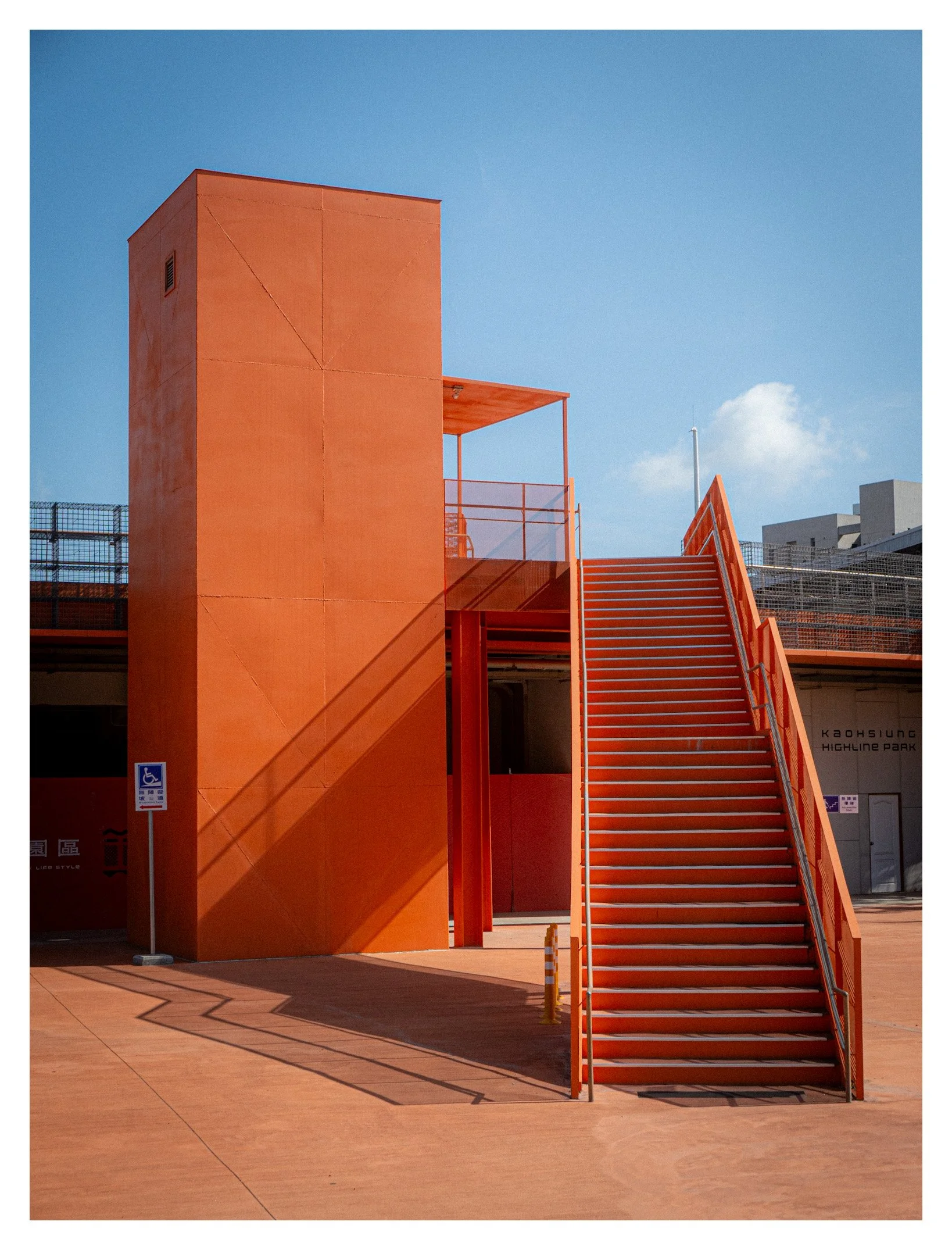
Discover how a bold splash of industrial orange under the Southern Taiwan sun challenges our perception of urban spaces. You will learn why structural shadows and severe architectural angles hold the secret to transforming a simple snapshots into an intentional piece of minimalist street photography.
Image Metadata
Camera Model: Leica D-Lux 8
Shutter Speed: 1/800
Aperture: f/5.6
ISO: 200
Art Critic Review and Analytical Breakdown
This image is a striking exercise in industrial minimalism, capturing a newly redefined architectural element within the Kaohsiung Highline Park. The photograph leans heavily on the interplay between stark geometry and raw color, using a monocolor structure to dominate the frame against a clear blue sky.
The composition relies on strong, contrasting lines. The vertical thrust of the orange tower on the left acts as a stabilizing anchor, balanced by the diagonal ascent of the stairs on the right. What elevates this image from a simple document of architecture into a photographic study is the shadow work. The harsh sunlight casts a crisp, zig-zagging geometric shadow from the staircase rail onto the tower’s face and the pavement below. This duplicate pattern functions as a rhythmic echo of the physical structure, adding depth and visual tension to an otherwise flat surface.
The color palette is delightfully restricted. The aggressive, high-visibility orange occupies the lower two-thirds of the frame, contrasting cleanly against the soft cerulean sky. This color blocking evokes a mid-century modernist aesthetic, reminiscent of structural color field studies.
Technical and Creative Areas for Improvement
Mind the Minor Distractions: Look closely at the lower left quadrant. The small blue-and-white accessibility sign, along with the partially obscured red construction barrier in the background, punctures the minimalist illusion. When composing street architecture, taking half a step to your right or altering your height can help eclipse these real-world intrusions behind your main subject.
Refine the Framing and Edge Control: The thin slice of a modern building showing on the far right edge pulls the eye out of the frame. Cropping slightly inward from the right or waiting for a slightly different angle would isolate the orange structure entirely, enhancing its surreal, standalone qualities.
Experiment with Exposure and Contrast: The harsh midday sun has slightly flattened the textures of the orange panels. Re-shooting this during the golden hour or underexposing by a third of a stop would deepen the shadows, saturate the industrial orange, and add a tactile quality to the surface of the structure.
Long-Term Growth: Photography Data Archiving
To sharpen your photographic eye over time, treat your imagery like an ongoing research project. Create an image ledger or spreadsheet to track patterns in your successful frames.
Log the Environmental Variables: Track the exact time of day, weather conditions, and light quality (e.g., harsh midday sun, overcast haze, golden hour).
Catalog Compositional Traits: Group your work by visual motifs—such as color blocking, leading lines, or isolated subjects.
Analyze the Overlap: Over six months, analyze the data. You may find that your Leica D-Lux 8 renders color most cohesively when shooting architectural subjects at f/5.6 during the sharp light of early afternoon, or that your eye naturally favors a 35mm equivalent focal length when framing urban geometry. Identifying these personal trends allows you to seek out specific shooting conditions with absolute intent.
Recommended Resources for Study
Photographers to Research
Michael Wolf: Specifically study his Architecture of Density series. His method of framing urban structures to eliminate the sky and horizon will give you masterclass ideas on how to compress space and emphasize pure pattern.
Fan Ho: Regarded as a master of light and shadow, his mid-century street photography of Hong Kong demonstrates how to use harsh, direct sunlight to slice a frame into dramatic, geometric zones.
Books to Read
"The Americans" by Robert Frank: To understand how framing can isolate fragments of an environment to tell a broader cultural story.
"William Eggleston's Guide" by William Eggleston: Essential reading for any photographer working with bold, saturated color palettes. Eggleston demonstrates how mundane, everyday structures become extraordinary through precise color positioning.
Educational Videos to Watch
To understand how master photographers construct their frames out in the wild, watch The Decisive Moment - Henri Cartier-Bresson Documentary.
For an immersive breakdown on handling bold, unpredictable color in urban environments, study the style of Alex Webb through Alex Webb: The Suffering of Light on YouTube.