

Day 214/365 Night Market Noir: Dissecting the Chaos of Kaohsiung after Dark
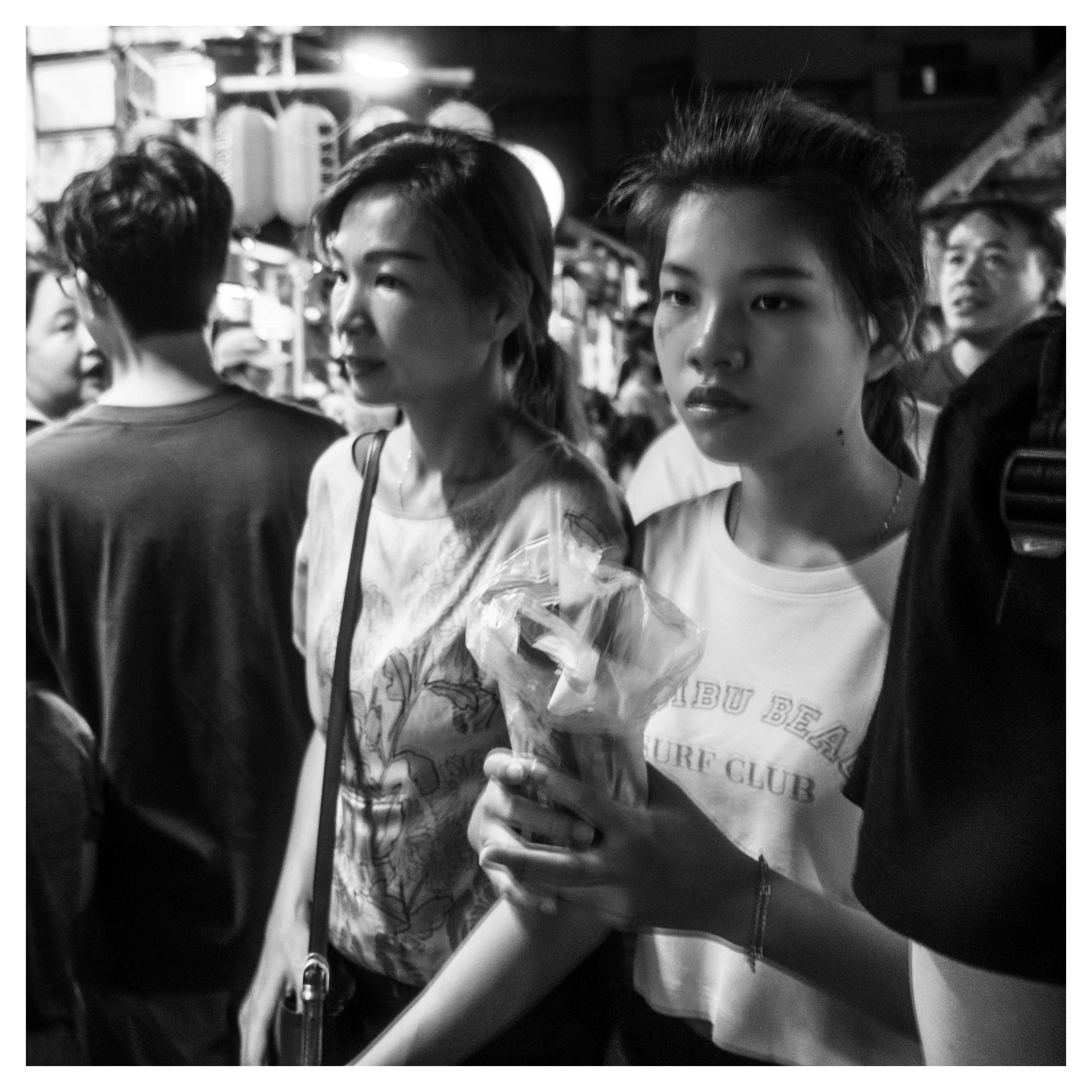
What happens when the crushing momentum of a Taiwanese night market collides with a moment of profound internal stillness? You’ll learn why a tight, candid frame of Kaohsiung’s nocturnal pulse holds the secret to transforming chaotic street photography into a compelling character study.
Image Metadata
Camera Model: Leica D-Lux 8
Shutter Speed: 1/125
Aperture: f/2
ISO: 200
The Critique: Psychological Depth in the Crowd
Street photography thrives on tension, and this image captures a wonderful juxtaposition. The night markets of Kaohsiung are sensory overloads—a barrage of neon lights, billowing steam, and constant motion. Yet, by locking focus on the young woman in the foreground, you have carved out a space of intense quietude amidst that storm.
The expression on her face is captivating. She is looking past the camera with a heavy, contemplative gaze, completely disconnected from her immediate environment. The plastic bag of snacks in her hand serves as an authentic anchor to the scene, letting us know exactly where we are without allowing the surrounding commerce to swallow her narrative. Behind her, the older woman provides an excellent secondary layer of human interest, looking off in a different direction and giving the composition a classic, multi-layered "slice-of-life" feel.
The choice of monochrome is highly effective here. It strips away the competing, mismatched colors of the market stalls, forcing the viewer to engage directly with the textures, the stark rim lighting along the subjects' hair, and the raw expressions of the crowd.
Pathways to Improvement
Refining the Frame
While the emotional core of the image is incredibly strong, the framing feels slightly constricted by the dark shape cutting into the right edge of the composition. This large silhouette acts as a visual roadblock. In the future, taking a subtle step to your left or holding the camera slightly higher would allow you to shoot over or around these immediate foreground obstacles, giving your main subject breathing room while retaining the packed atmosphere of the crowd.
Mastering Your Camera Metrics
You shot this at 1/125 at f/2. While the wide aperture correctly isolates your subject from the busy backdrop, a shutter speed of 1/125 is pushing the limits for sharp street portraits in a moving crowd. If anyone had moved quickly, you would have suffered from motion blur. Do not be afraid to bump your Leica's ISO up to 800 or 1600 at night. The digital grain produced by modern compact sensors actually lends a gritty, cinematic quality to black-and-white street photography, allowing you to shoot at 1/250 or 1/500 to freeze fleeting expressions with absolute clarity.
Elevating Your Craft Over Time
The Power of Meta-Analysis
To evolve as a visual storyteller, you must become a scientist of your own work. Start cataloging your images into a structured database to track patterns. Create columns for technical data (Focal Length, Shutter, Aperture, ISO) alongside conceptual keywords (e.g., Night, Reflection, Layering, Candids).
Over months of shooting, review this database to uncover your creative habits. You might find that your most successful images are consistently shot at f/2, or conversely, that your hit rate drops significantly when your shutter speed falls below 1/250. This analytical approach transforms intuition into predictable technical mastery.
Masters to Study
Chien-Chi Chang: A brilliant Taiwanese Magnum photographer whose seminal work Jet Lag is a masterclass in using black-and-white photography to explore isolation, movement, and the modern human condition.
Fan Ho: Study his historic street photographs of Hong Kong. He is the ultimate master of handling harsh geometric shadows and pinpointing single human subjects against chaotic, sprawling urban backdrops.
Michael Wolf: Look at his collection Tokyo Compression. It will teach you how to tightly crop human faces within crowded environments to evoke immense psychological depth and a sense of urban claustrophobia.
Photographers' Bookshelf
The Decisive Moment by Henri Cartier-Bresson – The foundational text for understanding timing, geometry, and composition in street photography.
Bystander: A History of Street Photography by Colin Westerbeck and Joel Meyerowitz – An encyclopedic look at how the genre has evolved, providing invaluable context for your own daily practice.
Essential Viewing
To further refine your approach to working with light, crowds, and compact cameras, study these deep dives into the philosophy of street photography:
Street Photography Masterclass with Joel Meyerowitz – A brilliant look into how to anticipate human behavior and read the rhythm of a street scene before pressing the shutter.
The Art of Monochrome and Geometry in Cities – An exploration of how to look past color and read the underlying structure of light and shadow in dense urban areas.
Uncompromising Compact Photography Tactics – A technical breakdown on how to configure compact, small-sensor cameras to maximize sharpness and response time when shooting candidly in low light.