

Day 222/365 The Art of the Fleet Decisive Moment: Street Photography in Takamatsu
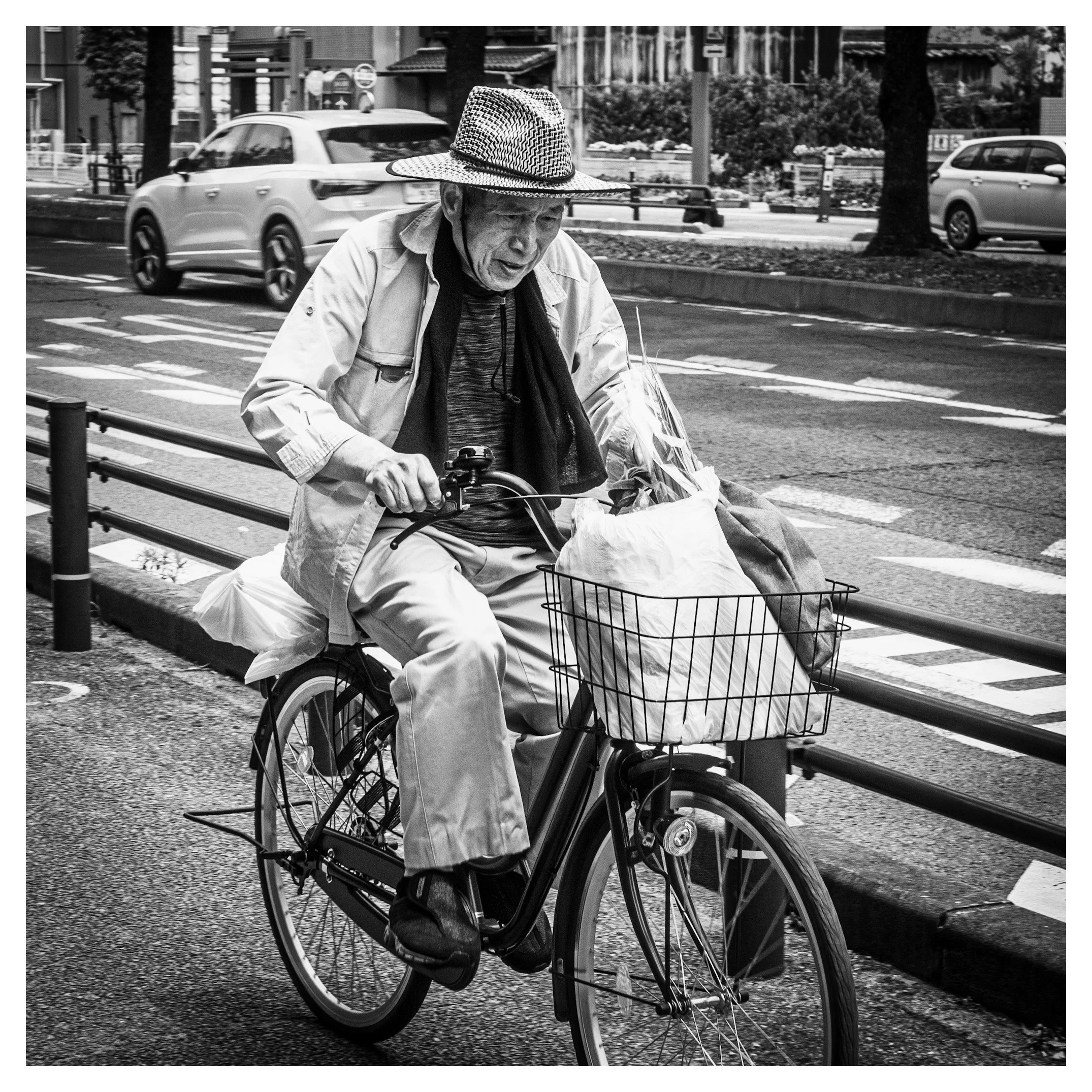
A transient moment on the streets of Takamatsu captured in stark black and white reveals a timeless intersection of human grit and urban geometry. You'll learn why evaluating background elements and tracking structural data can transform accidental street snaps into calculated photographic masterworks.
EXIF Data
Camera Model: Leica D-Lux 8
Shutter Speed: 1/320
Aperture: f5.6
ISO: 200
The Critique
Your image, "image.png," possesses a striking tactile presence that gets to the very core of documentary and street photography. The choice of a high-contrast monochrome treatment works elegantly here; it strips away the contemporary visual noise of Japan and anchors the frame around the texture of the rider's woven hat, the utilitarian wrinkles of his jacket, and the metallic geometry of the bicycle. There is an immediate sense of forward momentum, a slice of daily life captured mid-stride that honors the human element within an urban landscape.
The focus on the subject is beautifully sharp, throwing the background into a soft blur that isolates his expressive, downward gaze. He is a man caught in the singular flow of his own journey, and by rendering this in black and white, you have elevated an ordinary transit into a poetic study of character.
Where the Image Can Coalesce (Room for Improvement)
While the subject himself is full of character, street photography lives and dies by the strict relationship between the subject and the environment. To elevate this image, consider two critical adjustments:
Tame the Background Elements: The white car moving through the upper-left quadrant introduces a massive, high-key distraction. Because human eyes are naturally drawn to the brightest, sharpest shapes, that vehicle competes directly with the rider's face. In street photography, wait an extra fraction of a second for the background to clear, or shift your physical vantage point to place a clean, dark backdrop behind your main subject.
Refine the Frame Edge Geometry: The horizontal guardrails cutting directly behind the front wheel and into the bicycle basket create tight, intersecting lines that fragment the composition. Watch the edges of your frame before pressing the shutter. Giving the bicycle wheel just a few more millimeters of breathing room at the bottom would anchor the vehicle securely within the spatial plane.
Elevating Your Craft: The Technical Ledger Method
To build consistent mastery over time, you must stop treating your photography as a series of disconnected reactions and begin treating it as an ongoing data set. By compiling and tracking technical metrics across your images, you can diagnose hidden bad habits and isolate your strengths.
Create a dedicated metadata ledger for every shoot, noting the following structural data:
The Focal Length Distribution: Track whether you are relying too heavily on standard or compressed focal lengths. If you find yourself consistently shooting at a specific crop, challenge yourself to shoot exclusively with a fixed wide-angle perspective for a month to force a closer physical proximity to your subjects.
The Keeper-Rate Motion Matrix: Map your shutter speed against your successful "keepers." If you find micro-blur occurring in spontaneous moments, your tracking data will tell you if you need to bump your baseline street setting from 1/320 up to a safer 1/500 or 1/1000 to cleanly freeze rapid, unpredictable motion.
The Aperture-Depth Evaluation: Document how often you use wide-open apertures versus zones of deep focus. Tracking this will help you balance the easy appeal of subject isolation against the complex challenge of environmental storytelling, where both the subject and the background exist in sharp harmony.
Masters to Study, Pages to Turn
To feed your visual vocabulary, look to artists who have mastered the interplay of light, geometry, and human emotion:
Photographers to Research
Fan Ho: A true titan of monochrome geometry and shadow play. Study how he used intense, cinematic light shafts and precise architectural framing to isolate solitary figures within dense Asian urban centers.
Chien-Chi Chang: A master of documentary storytelling and member of Magnum Photos. His project The Chain is a definitive masterclass in environmental portraiture, tension, and emotional alienation.
Essential Reading
"Bystander: A History of Street Photography" by Colin Westerbeck and Joel Meyerowitz: This comprehensive text serves as the ultimate academic reference and encyclopedia tracking the evolution of the genre from its earliest roots to modern masterworks.
"Think Like a Street Photographer" by Matt Stuart: A brilliant, contemporary exploration packed with practical insights on observation, humor, and capturing candid moments with absolute spontaneity.
Critical Viewing
To further expand your understanding of composition, intent, and storytelling, study these dedicated visual deep dives:
Explore the complex structural layers and multi-dimensional framings used by legendary documentary artists in The Strategic Layers of Alex Webb.
Dive deep into the meticulous curation process and see how iconic images are chosen from a lifetime of negatives in The Art of the Contact Sheet.