

Day 223/365 Lines in the Sky: Abstracting the Ikuchi-bashi Bridge
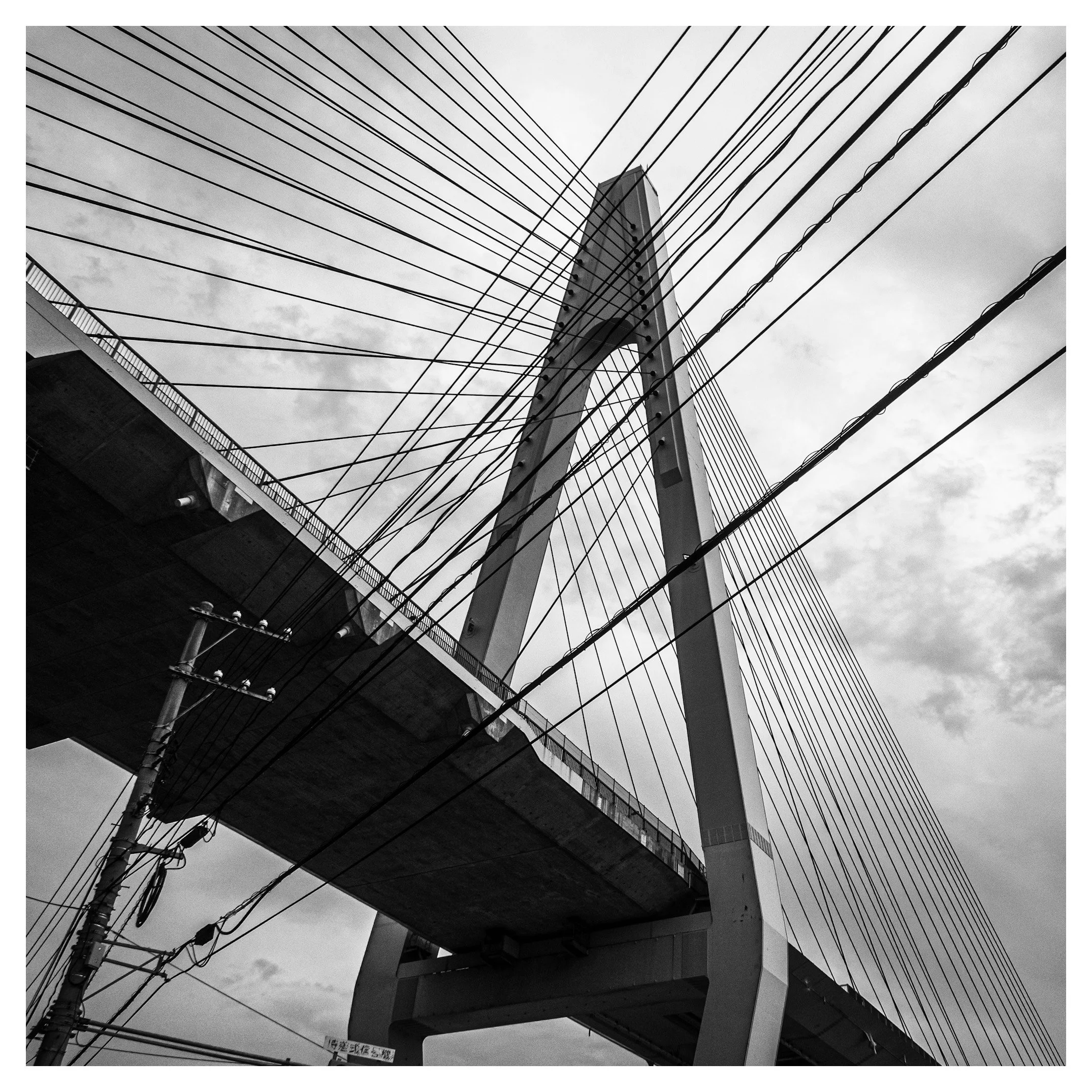
The Ikuchi-bashi bridge on Shikoku Island offers a masterclass in geometry, but capturing its true essence requires more than just pointing and shooting. You’ll learn why a simple shift in perspective and tracking your data can transform a stark monochrome landscape into a compelling narrative of human engineering.
Image Metadata
Camera Model: Leica D-Lux 8
Shutter Speed: 1/1600
Aperture: f5.6
ISO: 200
The Critique of image.png
In image.png, there is an admirable pull toward structural abstraction. Choosing a low-angle perspective forces the massive concrete pylon to slash upward through the frame, dividing the sky and turning a functional piece of infrastructure into a violent, elegant monolith.
The choice of monochrome is exactly what this frame demands. By stripping away color, the image becomes entirely about form, tone, and line. The web of stay-cables creates a fascinating, almost dizzying rhythm against the soft texture of the clouds. However, the lower-left corner introduces a competing narrative. The inclusion of the local utility pole and messy power lines breaks the grand, architectural isolation of the bridge. While environmental friction can add tension, here it feels less intentional and more like an uninvited guest breaking the clean geometry of the composition.
How to Improve the Image
Isolate the Monolith: To maximize the abstract quality of the bridge, try moving physically closer to the base of the pylon or zooming in slightly to crop out the street-level utility pole in the bottom-left corner. Eliminating that clutter allows the main structure to feel completely monumental and untethered from mundane surroundings.
Expose for the Highlights: The sky has some subtle cloud textures, but it edges slightly close to being overexposed. Bringing down the exposure by half a stop would preserve the delicate details in the clouds, providing a more dramatic, textured backdrop for the dark stay-cables to cut across.
Refine the Converging Lines: Pay close attention to how the leading lines interact with the edges of your frame. Letting the heavy diagonal line of the under-bridge deck anchor precisely into the lower-left corner would establish an even more stable, dynamic structural baseline.
Elevating Your Craft Through Data Tracking
Becoming a masterful photographer isn't just an intuitive journey; it is an analytical one. To systematically improve over time, you must begin building a personal database of your work. By logging technical metadata alongside qualitative notes for every serious image you shoot, you can uncover hidden patterns in your habits.
For example, tracking your data will reveal whether your sharpest, most compositionally sound frames happen at specific apertures, or if you consistently default to certain focal lengths when dealing with architectural subjects. It forces you to confront your technical pitfalls, such as using an unnecessarily fast shutter speed like 1/1600 for a static structure, which in turn pushes your ISO higher or forces a wider aperture than optimal. Over months of shooting, this database becomes a mirror, clearly showing you what is working, what needs to be abandoned, and how your unique visual voice is evolving.
Master Studies for Your Journey
To broaden your visual vocabulary and deepen your understanding of the medium, dedicate time to exploring these diverse masters, texts, and curated resources:
Photographers to Research
Fan Ho: Examine his historic monochrome work to see how a master utilizes dramatic shadows, clean geometric scale, and sweeping structural lines to frame human life within an urban environment.
Michael Wolf: Look at his architecture series to understand how compressing space and isolating dense, repeating lines can turn massive urban structures into captivating abstract art.
Essential Reading
Thoughts on Design by Paul Rand: While rooted in design, this text is foundational for photographers looking to understand how shape, form, and visual economy create impact within a square frame.
The Decisive Moment by Henri Cartier-Bresson: The ultimate guide to understanding how geometry, timing, and structural alignment converge to make a photograph truly cohesive.
Videos to Watch
The Language of Photography: Watch The Power of Black and White Composition to learn how master printmakers look at tones rather than subjects.
The Photographers' Eye Series: Watch Understanding Leading Lines and Structural Balance to discover how advanced perspectives can completely change the scale of industrial landscapes.